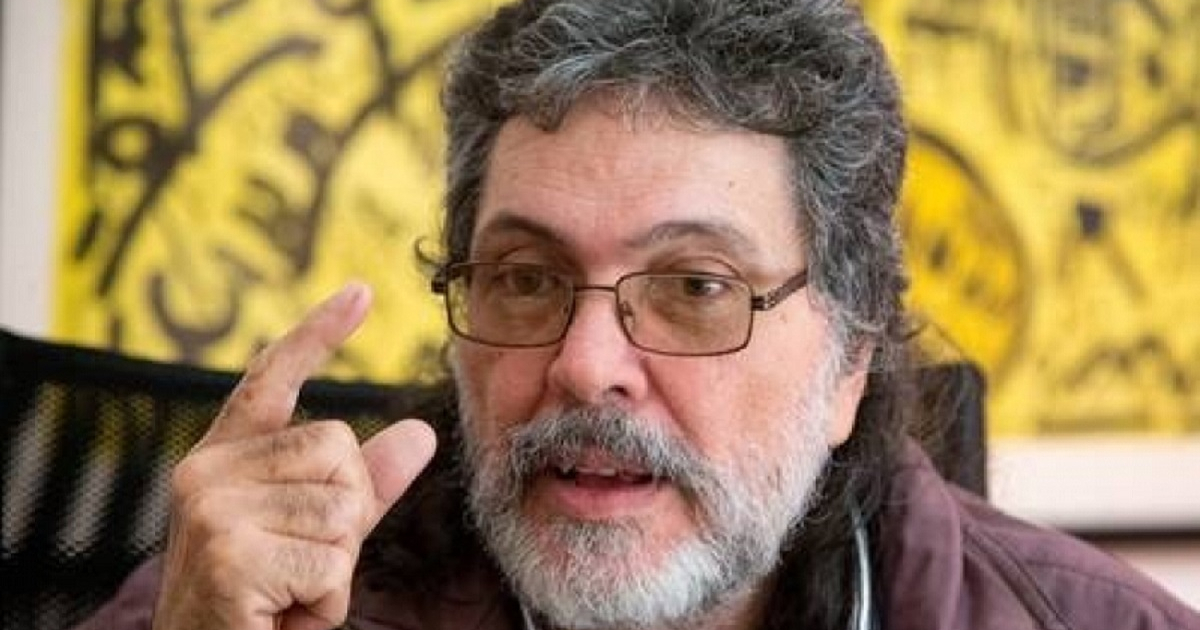
Abel Prieto, former Cuban Minister of Culture and current president of Casa de las Américas, took to Facebook to criticize Cubans who support Donald Trump and Marco Rubio, advocating for U.S. military intervention in Cuba. He labeled these individuals as "fervent annexationists" and deemed them "unworthy" of the Cuban name.
In his post, Prieto stated: "The Cubans who disgrace their own name by applauding Trump and Marco Rubio and calling for U.S. military intervention against Cuba create a monstrous, repugnant spectacle on social media."
The regime official expressed uncertainty about whether the term "secondhand embarrassment" adequately described his feelings towards what he called a "vengeful torrent of resentment," adding bluntly, "Their souls are sick."
To bolster his argument, Prieto invoked the words of José Martí, who famously said of himself, "Without homeland but without master," contrasting this with those who seek intervention: "Of these fervent annexationists, one might say, 'Without homeland but with a master.'"
The text concludes with a quote from Spanish poet Dámaso Alonso—"You will not bite my heart, mother of hatred," from *Los hijos de la ira*—and the slogan "Cuba will prevail!!!"
Additionally, Prieto, a regime spokesperson, underscored his message of animosity by including images of venomous snakes with his post.
Escalating Tensions Between Washington and Havana
Prieto's comments come amid an unprecedented escalation in tensions between Washington and Havana.
Since January 2026, the Trump administration enacted Executive Order 14404 on May 1, freezing Cuban regime assets and imposing secondary sanctions on foreign companies doing business with sanctioned entities.
During this period, the U.S. has imposed over 240 sanctions against the regime and intercepted at least seven oil tankers destined for Cuba, reducing the island's energy imports by 80 to 90%.
Secretary of State Marco Rubio announced additional sanctions against GAESA, the Cuban military conglomerate controlling between 40 and 70% of the island's formal economy, last Wednesday.
Exile Support for Military Action
Amid this climate, exile groups have openly backed military action. A Miami Herald poll revealed that 79% of Cuban Americans in South Florida support such an option.
The Cuban Resistance Assembly, based in Doral, endorsed a "surgical operation" against the regime: "If a surgical operation is needed to remove the oppressors... blessed be it," declared Luis Zúñiga, a member of the organization.
Trump himself fueled the debate on March 30 by stating: "Cuba will be next. It's a disaster, a failed country. It will collapse soon, and we'll be there to help." In May, he further suggested that the U.S. could "take control" of the island "almost immediately."
The Pentagon conducted 25 reconnaissance flights near Cuba and updated contingency plans, although AP sources clarified that no immediate military action is planned.
Cuban Regime's Response
The regime has countered with a narrative of resistance. Díaz-Canel declared on May 2 that "no aggressor, no matter how powerful, will find surrender in Cuba," while figures like Prieto mobilize in cultural spaces to reinforce this message.
According to reports this week, White House officials believe the Cuban regime might collapse by the end of 2026 without the need for direct military intervention.
Understanding U.S.-Cuba Relations
What are the recent actions taken by the U.S. against Cuba?
The U.S. has enacted over 240 sanctions, frozen Cuban assets, and intercepted oil shipments to the island, significantly impacting Cuba's energy imports.
How has the Cuban regime responded to U.S. pressures?
The Cuban regime has promoted a narrative of defiance, with leaders like Díaz-Canel asserting that Cuba will not surrender to external aggressors.
Why do some Cuban exiles support U.S. military intervention?
Many Cuban exiles believe that military intervention is necessary to remove the oppressive regime and instigate change on the island.