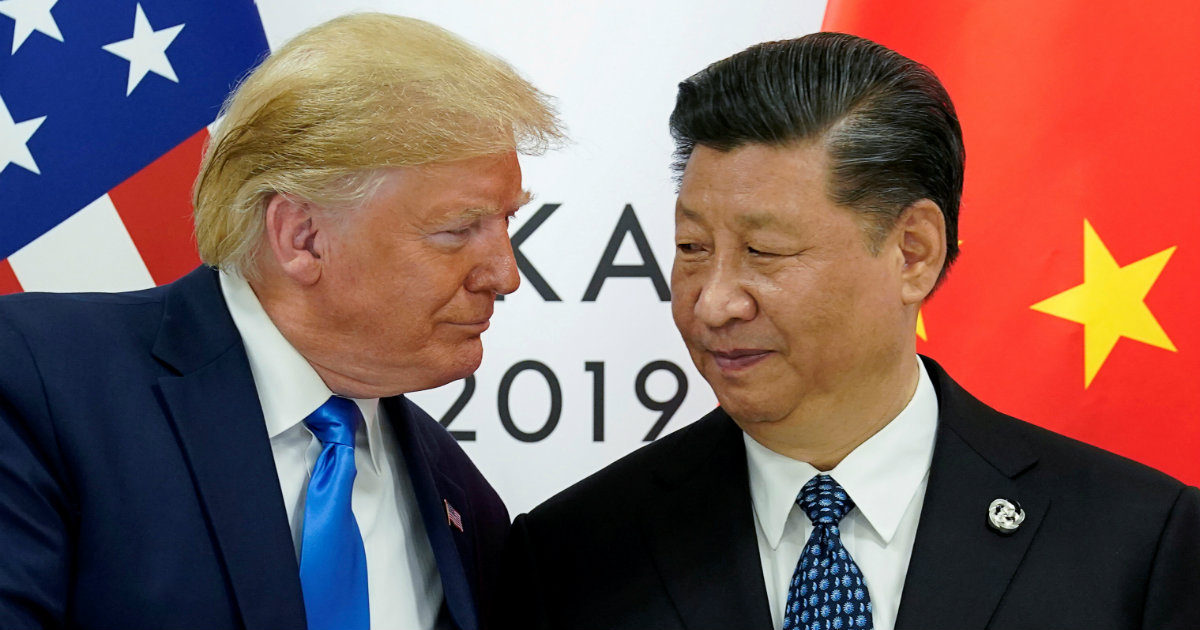
On Monday, China confirmed that U.S. President Donald Trump will embark on a state visit to Beijing from Wednesday, May 13, to Friday, May 15, as announced by the Chinese Ministry of Foreign Affairs.
Earlier that day, White House Principal Deputy Press Secretary Anna Kelly revealed that Trump is scheduled to arrive in the Chinese capital on Wednesday night, describing the trip as having "immense symbolic significance."
This marks the first visit of a U.S. president to Chinese soil in nearly nine years. The last visit was also by Trump, in November 2017, during his first term.
During that prior visit, Beijing displayed an elaborate reception, including a private tour of the Forbidden City, a ceremony at the Great Hall of the People, and a traditional opera performance.
Upcoming Summit's Agenda
The White House has outlined the summit's schedule. On Thursday, May 14, Trump will participate in a welcoming ceremony and hold bilateral talks with President Xi Jinping, followed by a banquet.
On Friday, May 15, before returning to the United States, the two leaders will engage in what Washington describes as a "working lunch."
Kelly mentioned that Trump and Xi Jinping will discuss agreements in the aerospace, agricultural, and energy sectors, including potential Chinese purchases of Boeing airplanes and agricultural products.
Both nations are also working on establishing a Trade Board to "manage the trade of non-sensitive products" and a bilateral investment forum.
Geopolitical Pressures and Strategic Interests
Before the summit, Chinese Vice Premier He Lifeng will travel to South Korea on Tuesday and Wednesday to meet with U.S. Treasury Secretary Scott Bessent in a final round of trade negotiations.
The geopolitical backdrop is fraught with tension. Trump arrives in Beijing under pressure from the ongoing conflict with Iran and the judicial chaos threatening his tariff policies. Despite domestic economic challenges, Xi Jinping maintains a stronger international stance.
One of the central topics will be Iran. Trump revealed in an interview with Fox Business that the two leaders exchanged letters about potential Chinese support for Tehran, describing Xi's response as "beautiful" and affirming that China was not sending weapons to Iran.
The U.S. plans to press China to halt this support, which Washington suspects is being funneled indirectly through third-party countries, a claim Beijing denies.
The U.S. has sanctioned Chinese companies and refineries linked to Iranian oil purchases and has even intercepted ships involved in this trade.
Key Issues: Iran and Taiwan
The blockade of the Strait of Hormuz has caused the Brent crude price to skyrocket from $67 to over $126 per barrel, which the International Energy Agency called "the most severe energy supply crisis in history."
Taiwan is also expected to be a significant discussion point. Chinese Foreign Minister Wang Yi stated that the island poses "the greatest risk" to bilateral relations, and Beijing is looking for signs of moderation from Washington.
The U.S. has implemented technology controls to curb China's development in semiconductors and artificial intelligence, while China leverages its control over critical minerals as a strategic pressure tool.
The last face-to-face meeting between the two leaders took place in October 2025 in Busan, South Korea, where they agreed to a trade truce that eased tensions but did not resolve the underlying conflict between the two powers.
White House Press Secretary Karoline Leavitt described the upcoming meeting between Trump and Xi Jinping as "pivotal" and "monumental."
Key Aspects of Trump and Xi Jinping's Meeting
What is the significance of Trump's visit to Beijing?
Trump's visit to Beijing is significant as it marks the first time a U.S. president has visited China in nearly nine years, highlighting the importance of U.S.-China relations.
What will Trump and Xi Jinping discuss during their meeting?
They are expected to discuss agreements in aerospace, agriculture, and energy sectors, as well as China's support for Iran and Taiwan's impact on bilateral relations.
Why is Taiwan considered a risk in U.S.-China relations?
Taiwan is considered a risk because it represents a significant point of contention between the U.S. and China, with Beijing viewing it as a critical issue in their bilateral relations.