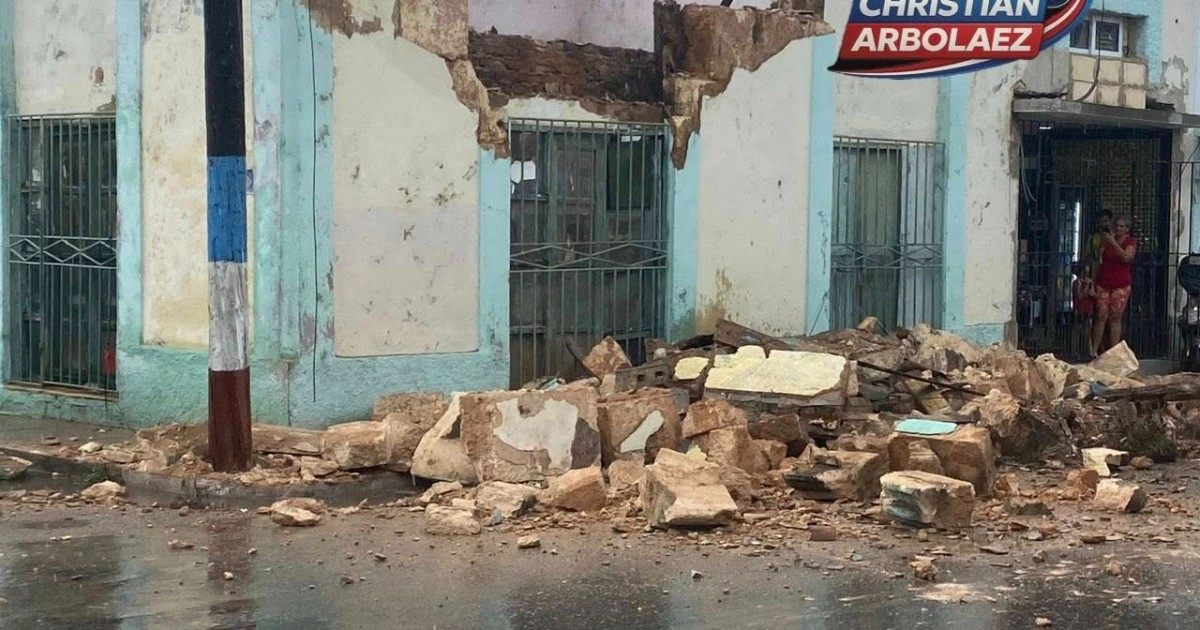
A section of a warehouse located at the intersection of Ruiz and Velázquez streets in Cárdenas, Matanzas province, collapsed this Monday, thankfully without causing any injuries.
Independent journalist Christian Arbolaez reported on social media that the heavy rainfall during the day was likely the final trigger for the collapse of a structure that had been in a state of significant decay for a long time.
"According to local residents, today's rain ultimately led to the structure's collapse, which had been threatening to fall for quite some time," Arbolaez noted.
Photos shared online depict the building's front facade completely caved in, with debris and masonry blocks scattered across the wet street, while onlookers assessed the damage from afar.
A major tragedy was averted as no one was inside the premises at the time of the collapse.
"The most incredible—and also the most crucial—aspect is that no one was present at the site at that moment. Many people gather there daily, so a real tragedy could have occurred," the journalist emphasized.
Residents in the vicinity had long warned about the risks posed by the building, but no repairs or interventions were ever made.
This incident is not an isolated one. Just days prior, images depicting extreme decay in Cárdenas highlighted the neglect of a bustling historic area of the city, with dilapidated buildings, deeply cracked pavements, and piles of debris.
On April 26, the cross atop the bell tower of the San Antonio de Padua Chapel in Cárdenas had to be removed due to collapse risks after suffering severe lightning damage.
The pattern of state-owned warehouses collapsing due to structural decay is not new in Cuba. In January 2023, the "Unidad 3007 La Viajera" warehouse in Banes, Holguín, experienced a total roof collapse without any injuries. In July 2025, the government of Colón, also in Matanzas, restricted access to several warehouses due to "advanced deterioration and lack of maintenance."
The structural decay crisis in Cuba is reaching alarming proportions. The Ministry of Construction reported a deficit of 805,583 housing units in January 2025, projected to reach 929,000 by late 2026. Of the 4.1 million homes in the country, only 65% are considered to be in good condition. Cement production operated at just 10% of its installed capacity in 2024, severely limiting repair possibilities.
Cárdenas, known as the "City of the Flag" for being the site where General Narciso López first hoisted the Cuban flag on May 19, 1850, now faces urban decay that starkly contrasts its historical significance. In November 2025, retirees in Cárdenas received pensions of merely 4,000 Cuban pesos—approximately nine dollars—after enduring long lines at banks.
"Fortunately, this time it was just a big scare and material damages," Arbolaez concluded in his post.
Understanding the Structural Decay Crisis in Cuba
What caused the warehouse collapse in Cárdenas?
The collapse was primarily triggered by heavy rainfall, which led to the failure of a structure already in significant decay.
Are building collapses common in Cuba?
Yes, building collapses are not uncommon in Cuba, often due to structural decay and inadequate maintenance of state-owned properties.
What is being done to address the housing crisis in Cuba?
Efforts to address the housing crisis are hampered by limited resources and low cement production capacity, leaving many structures in disrepair.