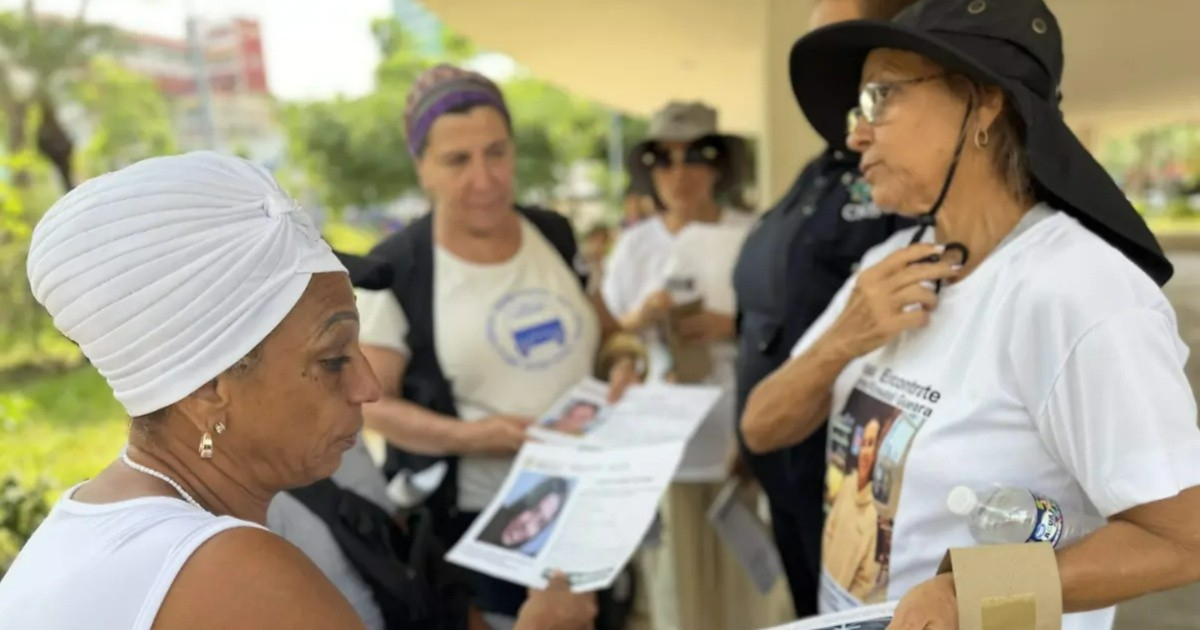
The mothers and grandmothers of six missing Cubans who vanished in Chiapas returned to Cuba on May 9, without locating their children or receiving concrete answers from Mexican authorities. This followed an extensive search operation carried out from May 5 to May 9 in the state of Chiapas.
Hailing from Matanzas, Havana, Camagüey, and Santiago de Cuba, these families traveled to Mexico for the first time with humanitarian visas provided by the Mexican government, 17 months after their last contact with their children.
The six Cubans disappeared on December 21, 2024, when around 40 migrants from Cuba, Honduras, and Ecuador boarded two boats from San José El Hueyate in the municipality of Mazatán, Chiapas, aiming to reach Juchitán de Zaragoza, Oaxaca. The boats' GPS signals vanished at 8:25 a.m. in the Pacific Ocean, just off the coast.
Before setting sail, several migrants sent frantic messages to their families: "We can't swim," "they're giving us life jackets," "there's shooting nearby," "a hellish shootout has erupted here... these people are heavily armed."
The identified Cubans in the group are: Elianis de la Caridad Morejón Pérez (18 years old), Dairanis Tan Ramos (33), Jorge Alejandro Lozada Santos (24), Meiling Álvarez Bravo (40) and her son Samei Armando Reyes Álvarez (14), Lorena Rozabal Guevara (28), and Ricardo Hernández (33).
These migrants paid between $8,000 and $10,000 for the journey — a route dominated by the Jalisco New Generation Cartel.
Efforts in Vain: A Desperate Search for Answers
During their mission, the families visited the San Miguel "El Hueyate" community, the Siglo XXI immigration station in Tapachula, and numerous shelters, posting flyers with photos of the missing individuals. Unfortunately, they were unable to gather any substantial information to locate their loved ones.
The search was organized by the Regional Network of Migrant Families and included families from Cuba, Ecuador, Honduras, and Colombia, with additional support from Italian representatives.
Despite the heartache of returning empty-handed, the mothers and grandmothers remain steadfast in their belief that their children are alive and have vowed to continue their search until they are found.
Mexican Government's Inaction Under Scrutiny
Human rights organizations have highlighted the Mexican government's lack of response. In June 2025, attorney Yesenia Váldez from the Foundation for Justice criticized the absence of active search efforts six months after the disappearance: "Not a single action has been taken to find them. It's as if the state has erased them."
This case is part of a broader migrant crisis unfolding at Mexico's southern border. Between September and December 2024, San José El Hueyate witnessed at least three mass disappearance events, totaling 83 missing migrants, according to civil organizations.
Simultaneously, a 19-year-old Cuban woman disappeared in Tapachula on April 30, and in March, eight Cuban rafters went missing en route to Mexican shores.
Continuing Crisis in Chiapas
In the early months of 2026, over a dozen migrants vanished along Chiapas's southern border, with Suchiate and Tapachula being the focal points for cases involving victims from Cuba, Guatemala, Venezuela, Haiti, and Nicaragua.
The international search brigade was initially set to continue until May 16, but the Cuban families decided to return home earlier, unable to fulfill the purpose that had driven them to leave the island for the first time.
Understanding the Migrant Crisis in Chiapas
Why did the Cuban families go to Mexico?
The Cuban families traveled to Mexico to search for their missing children, who disappeared while attempting to migrate through Chiapas in December 2024.
What challenges did the families face during their search?
The families encountered several obstacles, such as a lack of cooperation from Mexican authorities and insufficient information about their missing relatives' whereabouts.
How has the Mexican government responded to these disappearances?
Human rights groups have criticized the Mexican government for its inadequate response and lack of active search efforts to locate the missing migrants.