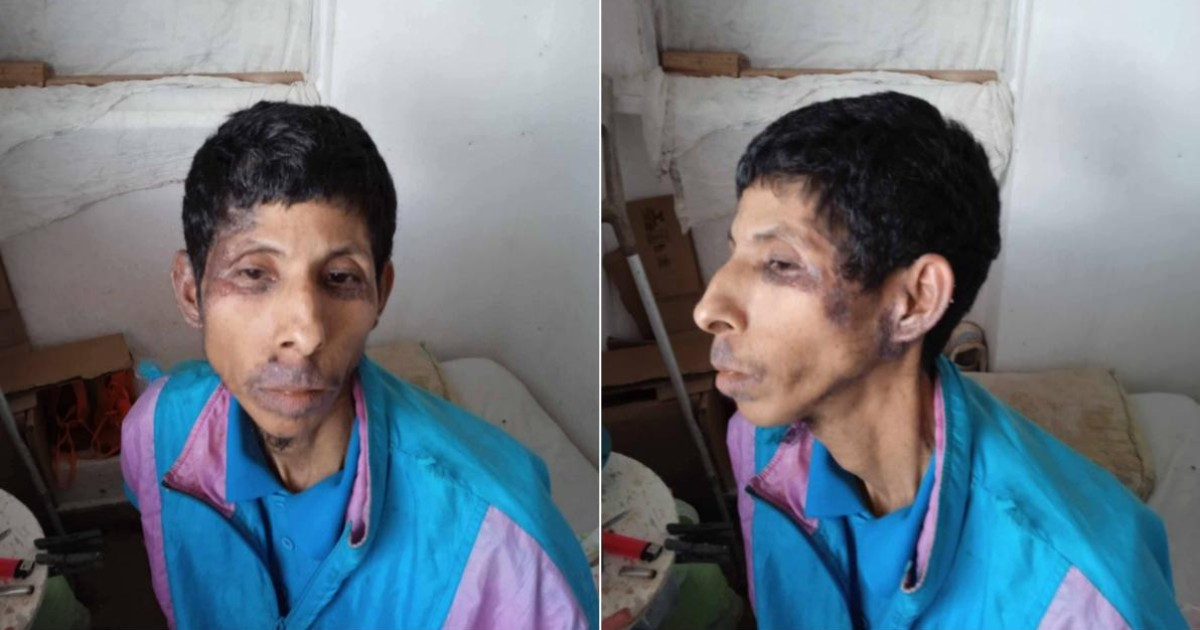
A young man with autism in Cuba is battling a severe bacterial infection that is rapidly destroying his tissues, yet he has been turned away by the Hospital del Rincón and other healthcare facilities without receiving any treatment. This alarming situation was brought to light in a Facebook post by Irma Lidia Broek.
The response from each facility the family approached was consistently the same: "No beds, no medicine, nothing can be done." Without antibiotics or any treatment to halt the progression of the infection, the young man has been "sent home to die."
The distressing images accompanying the post reveal severe skin lesions on both legs, exhibiting dark and purplish areas suggesting necrosis or gangrene, along with blisters, peeling, ulcerated skin, and a soiled bandage stained with blood.
On his face, the young man displays erythema, crusts, peeling, and a partially closed, swollen right eye, indicating a potential case of herpes zoster ophthalmicus or another serious infection.
The photographs show a modest room with wooden floors, highlighting the precarious living conditions.
Amidst his suffering, the young man begged his sister, "Please, don't let me die."
"His autism makes him doubly vulnerable, and just when he needed the most protection, the State has turned its back on him in the most inhumane way," Broek lamented in her post.
The urgent plea calls for three immediate actions: evaluation by medical specialists, admission to a facility equipped to treat the infection, and provision of antibiotics and treatments to combat the gangrene.
This case highlights the dire collapse of Cuba's healthcare system, the most severe in decades.
Even the Minister of Public Health, José Ángel Portal Miranda, admitted to the National Assembly in 2025 that only 30% of essential medications are available. Hospitals are plagued by prolonged power outages, lack basic supplies, and over 96,000 surgeries have been postponed.
The medication crisis in Cuban hospitals affects 80% of the population, who have faced significant challenges in accessing healthcare, according to independent reports. Approximately 39.4% of households rank the lack of medications among their top three issues.
In this context, individuals with autism face an added layer of vulnerability.
In April, families of people with autism in Cuba sent an open letter to Díaz-Canel, condemning the systematic neglect by the State, which institutionalizes autistic adults from age 16 or 18 without offering integration options.
The regime's response included a largely symbolic visit by the leader to an autism school for media coverage, a move criticized as propaganda with no real answers to the families' demands.
This is not the first documented case of neglect toward an autistic individual by the Cuban system. In July 2022, a blind and autistic young man died in El Cotorro due to the absence of an ambulance to transfer him.
In 2021, a mother reported the abandonment of her 23-year-old daughter with severe autism and epilepsy by the healthcare system. Last September, the Ministry of Education denied a specialized center enrollment to a six-year-old boy with moderate autism, despite having a medical certificate.
Meanwhile, the regime maintains its narrative as a "medical powerhouse" and continues deploying doctors abroad on international missions.
"A single share can make the difference for his cry to be heard by the Cuban Ministry of Public Health or for helping hands to arrive in time to save him," concluded Broek in her appeal for help.
Exploring Cuba's Healthcare Crisis and Autism
What are the main challenges faced by the Cuban healthcare system?
The Cuban healthcare system is struggling with severe shortages of medications, basic supplies, and hospital resources, leading to postponed surgeries and inadequate patient care.
How does the healthcare crisis affect individuals with autism in Cuba?
Individuals with autism face increased vulnerability due to the lack of specialized care and support, compounded by the overall collapse of the healthcare system.