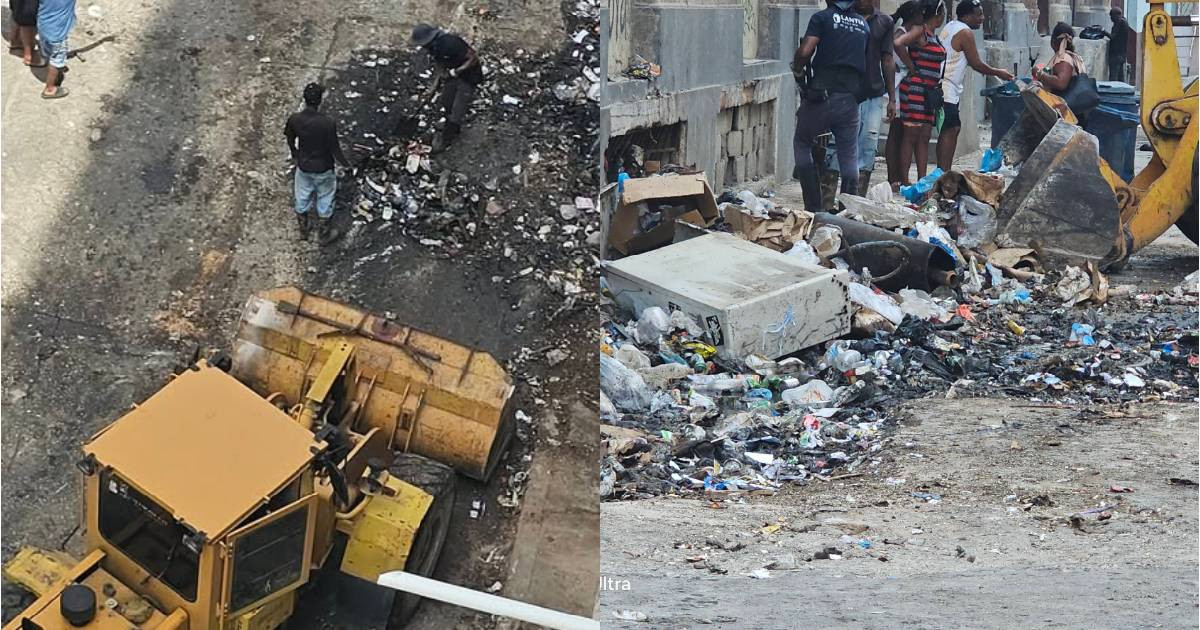
Eric Eduardo Broche Vidal, a resident of Central Havana, has publicly accused the Cuban government of "counter-revolutionary" actions following the demolition of an electrical hub at the intersection of Dragones and Zanja, just blocks away from the Capitol building. This act has left an entire block without power, water, and elevator service.
Broche took to Facebook to share his frustration, explaining that the Public Services department demolished the hub without repairing it, resulting in a complete outage of essential utilities for the area.
He described an exhaustive journey spanning "days, months, and years" of attempting to navigate institutional channels, filing complaints with the government, engaging with the Ministry of Transportation, visiting the electric company, Public Services, and the National Revolutionary Police, all to no avail.
"Today marks the culmination... a flawless demolition by the public services without a shred of remorse... leaving a block without electricity, water, and a building without an elevator—not due to the country's challenges, the U.S. blockade, or external sanctions," Broche wrote.
Broche directly attributes the failures to "the complicity, irresponsibility, and lack of commitment of the Government," the electric company, and the Communist Party, dismissing the regime's typical excuses.
"Anyone in a position of power who is supposed to serve the people yet destroys what little we have is engaging in counter-revolution... unfortunately, you have become the people's worst enemy," he declared.
In Cuba, the term "counter-revolution" carries significant political weight, traditionally used by the regime to criminalize dissent. Reappropriating it to criticize state institutions flips the official narrative on its head.
The complaint, supported by images, depicts heavy machinery, workers amidst debris, and the severe urban decay at the heart of the capital.
Comments from neighbors and acquaintances echoed the sentiment of Broche's post. Ada Rosalina Vidal Segura articulated the community's exhaustion. "Years of following the correct channels, endless interviews, countless damages and losses to the nation's and residents' heritage and economy. What options are left for us?" she asked.
Mayda González noted that the situation "has surpassed the limits of indifference and disrespect towards the humble Cuban people," while Gipcia Guardiola remarked, "In my 47 years, I've never seen anything like this in Havana."
"That's right, there's no other word for it. You've been warning about this for a long time, told many, and nothing was done. This was foreseen, and no one bothered to prevent it," Elizabeth González Aznar concluded in the comments.
This incident is part of a broader collapse of basic services in Havana. A staggering 87% of the water supply system relies on the national electrical grid, making it susceptible to the chronic blackouts plaguing Cubans.
Public Services operates with minimal resources; as of February 2026, only 44 out of 106 garbage trucks in Havana were operational due to a lack of fuel.
This operational deficit has led to a documented pattern of collateral damage. In La Lisa, a public services excavator broke a main water pipe, leaving families without water for over ten days without any institutional response.
Recently, residents of Cerro warned that heavy machinery used in garbage collection was traversing over the separator covering the Albear canal, a 19th-century hydraulic structure that supplies 15% of the capital's water.
The Dragones area in Central Havana had already been identified as a hotspot of extreme unsanitary conditions in April 2026, with accumulated garbage endangering the San Judas and San Nicolás Parish for the third time in under two months.
Understanding the Impact of Utility Outages in Havana
What caused the utility outages in Central Havana?
The outages were caused by the demolition of an electrical hub by Public Services, leaving an entire block without electricity, water, and elevator service.
How have residents responded to the government's actions?
Residents, like Eric Eduardo Broche Vidal, have publicly criticized the government's actions, accusing them of "counter-revolution" and expressing frustration over the lack of institutional response.
How does the term "counter-revolution" relate to the situation?
In Cuba, "counter-revolution" is a politically charged term traditionally used to criminalize dissent. Using it against state institutions represents a significant reversal of the official narrative.
What broader issues does this incident highlight?
This incident underscores the broader collapse of basic services in Havana, exacerbated by the reliance on an unreliable electrical grid and a lack of resources for public services.