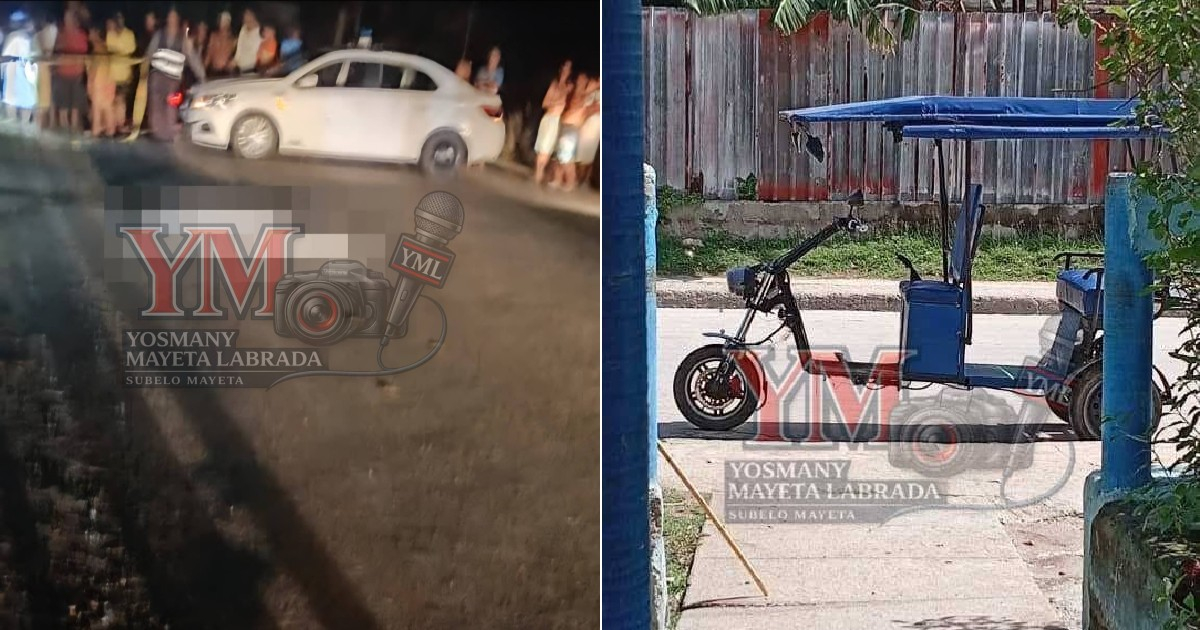
In a tragic event that has left a neighborhood in mourning, Ramón Orlando Martínez, a beloved knife sharpener from the Marimón neighborhood in Santiago de Cuba's José Martí District, was fatally stabbed during a Saturday night robbery aimed at stealing his electric tricycle, according to his daughter's report.
The attack took place on Avenida Las Américas, one of the main thoroughfares in the city. Despite efforts to save him, the severity of his injuries led to his death at the scene, as shared by communicator Yosmany Mayeta Labrada on Facebook, who was contacted by Martínez's family.
"My father was brutally stabbed just for his electric tricycle taxi," his daughter wrote, urgently appealing for help to locate the vehicle and those responsible for the crime. "I don't have much strength to write, please help me put this out there to catch the murderer," she pleaded.
Martínez was well-known and cherished in Marimón, often seen navigating the streets on his tricycle, which he used both for transportation and for his livelihood sharpening knives—a trade that earned him the community's respect and affection over the years.
Mayeta shared images of the stolen tricycle, a blue vehicle with a metal frame and distinct features that could aid in its identification. The family suspects it might be hidden nearby in the neighborhood, the communicator noted.
The family has called for widespread dissemination of the information to capture the perpetrators and recover the tricycle, urging anyone who might have seen the vehicle or know its whereabouts to come forward. "Finding it could be crucial to solving this crime," Mayeta added.
"Once again, violence has struck a hardworking family in Santiago de Cuba, leaving behind grief, outrage, and a community's demand for justice as they mourn one of their own," the communicator concluded.
This incident is not isolated in Cuba. On April 15, Adonis Fuentes González was killed in Cienfuegos under similar circumstances; he was attacked with knives while parking his electric tricycle, and the battery and charger were stolen.
Earlier this month, in San Miguel del Padrón, Havana, police arrested a suspect for stealing another electric tricycle, which was recovered when the owner identified it in a Facebook sales post—a common pattern in these crimes.
Violence in Santiago de Cuba has escalated in recent weeks. Last week, a farmer was killed in Segundo Frente municipality for his oxen, and a 23-year-old was fatally stabbed in San Luis, also in the eastern province.
The theft of electric tricycles has become widespread across Cuba, driven by a severe economic and energy crisis that has increased these vehicles' value. Their owners, mostly humble workers who rely on them for survival, have become prime targets for criminals.
In a climate of growing insecurity due to escalating crime and violence in Cuban communities, victims' families increasingly turn to social media to report crimes and seek public assistance.
The Cuban government does not release official crime statistics. However, the independent Cuban Observatory of Civic Audit recorded 2,833 verified crimes in Cuba during 2025, a 115% increase from 2024 and a 337% rise from 2023, with thefts being the most common crime: 1,536 cases, a 479% increase since 2023.
Santiago de Cuba ranked as the fourth most affected province, with 323 documented cases amid a crime wave showing no signs of slowing down.
Understanding the Surge in Electric Tricycle Thefts in Cuba
Why are electric tricycles being targeted by criminals in Cuba?
Electric tricycles are targeted due to their increased value amid Cuba's economic and energy crisis. Many owners use them for essential transportation and income, making them attractive targets for theft.
What steps are being taken to combat the rise in violence and thefts in Cuba?
Victims' families often use social media to report crimes and seek community assistance. However, there is a lack of official statistical reporting or comprehensive governmental measures to address the rising crime rate.
How is the community reacting to the increase in crime?
Communities are expressing outrage and a strong demand for justice. They are actively participating in efforts to identify and capture those responsible for crimes in their areas.