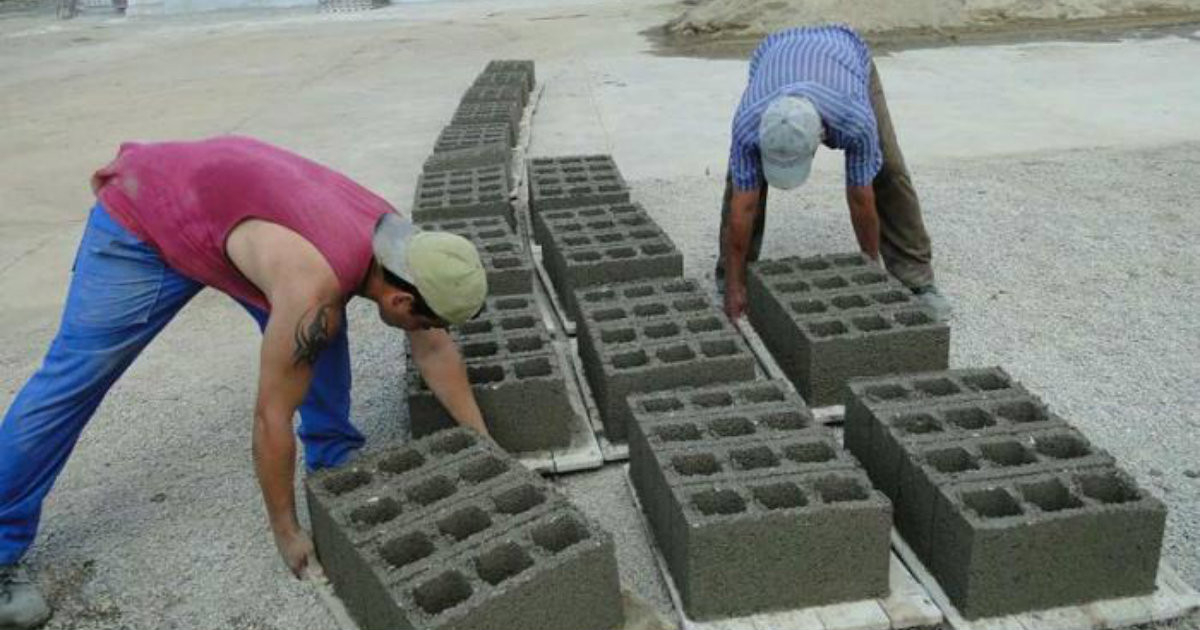
In Cárdenas, a man was recently apprehended while dismantling blocks from an old university building. This incident comes amidst escalating public grievances about theft, government neglect, and rising crime rates in the Matanzas province.
The individual, identified as Yoan Jiménez Hernández, was caught red-handed removing cement blocks from the former university site "Aida Pelayo" in Cárdenas. This information was reported on Saturday by the official Facebook page "Con Todos La Victoria," which is affiliated with the Ministry of the Interior.
The post itself took on a sarcastic tone, describing how Jiménez was removing the blocks "as if they were Lego pieces," equipped with a hoe and a sledgehammer. This highlighted the stark reality of the decay and lack of protection at abandoned or poorly monitored state facilities.
According to reports, Jiménez was arrested on the spot and is now facing legal proceedings. Authorities accompanied the news with their usual slogan, "ZERO TOLERANCE against crime, illegalities, and social indiscipline!"—a stark contrast to ongoing public complaints about unchecked looting and crime.
Public Outcry Over Increasing Thefts
Comments on the post revealed that such incidents are far from isolated. Local residents reported that systematic theft of blocks and construction materials is impacting schools, sports areas, and other public spaces across various municipalities in Matanzas.
Elia Rosa Faz García, a neighbor, mentioned that the perimeter fence of Oscar Rodríguez primary school has also lost blocks. "Given the traffic, it's crucial for our children's safety," she explained.
From Jovellanos, Damarys Rosa Fernandez Mesa warned about the relentless urban decay. "At Horacio's sports field, not a single block remains—they dismantle it night after night," she noted.
Calls for Police Action Amidst Growing Crime
Some comments directly criticized police inactivity. Rosa Amelia Cabrera Gomez accused officers of being "holed up inside stations eating and sleeping," while judges and prosecutors act with impunity.
Marlene Blazquez summarized the ongoing pattern: "Nothing is safe, and within days, scavengers tear everything apart," she illustrated.
Meanwhile, Bárbara De Armas echoed the sentiments of many citizens: "With these shameless individuals, zero tolerance is necessary. Hard punishment is needed."
The public's sense of abandonment aligns with a context of escalating crime in Matanzas. According to the Cuban Citizen Audit Observatory (OCAC), the province recorded 503 verified crimes in 2025, the highest in the country, surpassing Granma, Havana, and Santiago de Cuba.
Nationally, the OCAC documented 2,833 crimes in 2025, marking a 115% increase from 2024 and a staggering 337% rise since 2023. Robberies were the most common crimes, with 1,536 cases, a 479% jump from 2023.
Cárdenas has seen a series of criminal incidents in recent months. In April, three masked youths carried out an armed robbery at an ice cream factory in the city.
In May, a suspect was arrested for the murder of a young worker, who was also robbed of his horse-drawn vehicle. In February, a daylight robbery sparked outrage on social media.
The Role of Scarcity in Fueling Crime
The looting of construction materials from state buildings is a response to the severe shortages faced by the Cuban population. With 89% of Cubans living in extreme poverty, according to the Cuban Observatory of Human Rights, and the lack of legal access to construction materials, many resort to dismantling abandoned or unused structures.
Understanding Crime in Matanzas
What was Yoan Jiménez Hernández doing when he was arrested?
Yoan Jiménez Hernández was caught removing cement blocks from the former university site "Aida Pelayo" in Cárdenas.
How prevalent is crime in the Matanzas province?
Matanzas recorded 503 verified crimes in 2025, the highest in Cuba, according to the Cuban Citizen Audit Observatory.
What are the main reasons for the looting of construction materials?
The scarcity of construction materials and extreme poverty are driving many to dismantle abandoned or unused buildings to obtain these resources.