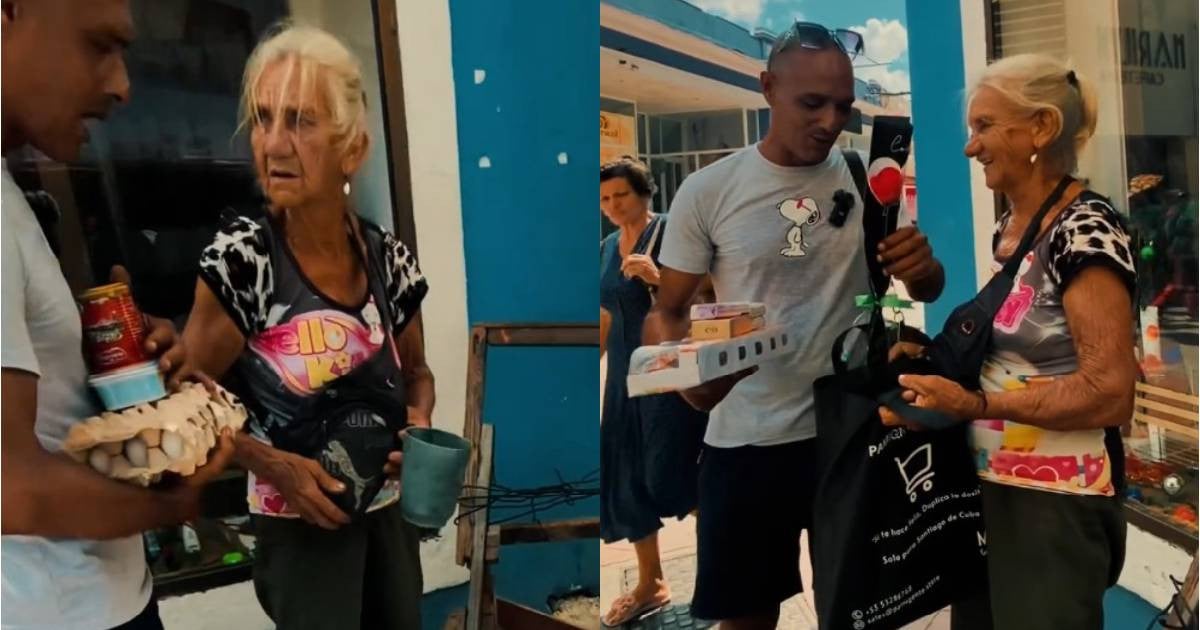
Martha, a 77-year-old grandmother with three children, shatters any official narrative of social justice in Cuba. Her day begins at 2 a.m. in the neighborhood of La Prueba, Santiago de Cuba, where she embarks on a nearly 15-kilometer journey, pushing a cart to sell okra and earn enough money to buy food.
On the eve of Mothers' Day, independent activist Yasser Sosa Tamayo came across Martha, who was selling okra for 200 pesos each and 100 pesos per jar. Struck by her situation, he surprised her with a bag of basic groceries containing rice, spaghetti, eggs, and detergent.
The video of this encounter, shared on Facebook, has drawn over 53,000 views and thousands of reactions. It captures a raw and unfiltered reality that the official discourse tries to normalize—elderly women forced to continue laboring at an advanced age to avoid falling into destitution.
"You have to fight to eat. To eat, because life is hard," Martha remarked to the camera, conveying the resilience of someone who has long stopped expecting solutions from others.
Widespread Hardship Among the Elderly
Sosa Tamayo summed up the sentiment prevalent among the viewers. "The saddest part isn't Martha walking 14.8 kilometers. The saddest part is that at 77, she still has to do it to survive."
Among the comments, Leandro Ramo Ruiz noted, "It's just a glimmer of light; but in the darkness we live in, it appears as a blinding torrent."
The post concluded with a poignant statement capturing the essence of current-day Cuba: "There are countries where grandmothers rest. In Cuba, many still strive to survive."
A Grim Reality for Cuban Pensioners
Martha's story resonates not because it is extraordinary, but because in Cuba, it has become commonplace. A survey conducted by the Independent Union Association of Cuba among 506 retirees across five provinces revealed that 99% say their pension does not cover basic needs, and 90.7% continue to work post-retirement, mainly in the informal economy.
Even after the minimum pension was raised to 4,000 pesos in August 2025, this amount barely lasts a week. A croquette costs 150 pesos, a loaf of bread 140, and the basic food basket in Havana is estimated at 12,000 pesos per person per month, three times the minimum pension.
The Cuban Observatory for Human Rights estimates that 79% of people over 70 cannot afford three meals a day, in a country where 89% of the population lives in extreme poverty.
Mothers' Day Amid Economic Struggles
This Mothers' Day is marked by widespread hardship across the island. In Sancti Spíritus, a craft fair faced criticism for its exorbitant prices, unaffordable for those earning an average salary of 6,930 pesos. "Art for the moms of the rich," commented one citizen.
In Santiago de Cuba, a mother anonymously addressed a letter to leader Miguel Díaz-Canel, asking "How do I explain hunger to a 7-year-old?" Meanwhile, the regime persists with its narrative of "creative resistance."
The same city where Martha begins her day in the early hours is also home to young people distributing food in response to the lack of state intervention. Sosa Tamayo documented the case of a 14-year-old boy selling pastries in a park to support his mother in April.
Frequently Asked Questions About Economic Hardship in Cuba
Why do elderly people in Cuba still have to work?
Many elderly Cubans continue to work because their pensions do not cover basic living expenses, forcing them to seek additional income to survive.
What challenges do Cuban pensioners face?
Cuban pensioners face significant financial hardship, as their pensions are insufficient to meet rising costs of living, pushing many to work in the informal economy to make ends meet.
How are younger Cubans coping with the economic situation?
Younger Cubans are finding ways to cope by engaging in informal work, such as selling goods in parks or distributing food, due to the lack of sufficient state support.