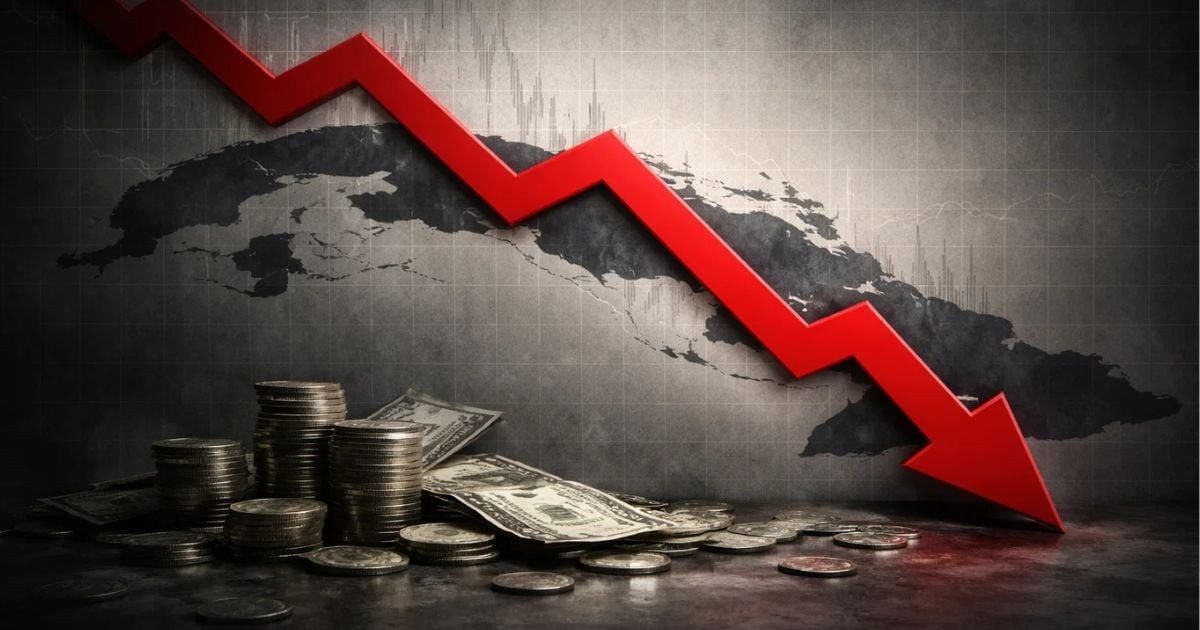
Renowned Cuban economist Pedro Monreal has raised concerns that Cuba's economy might experience a sharp contraction of at least 15% in GDP by 2026. This alarming forecast is set against a backdrop of persistent inflation, a shortage of foreign currency, and an energy crisis that Monreal argues is incompatible with the current economic agenda of the communist regime.
The impetus for Monreal's analysis was the official data released by the National Office of Statistics and Information (ONEI) regarding the Consumer Price Index (CPI) for April 2026. The cumulative rise in consumer prices from January to March hit 7.18%, surpassing the previous year's 6.56% for the same period.
In a series of posts on X, Monreal questioned, "Has stagflation been triggered? For the first time this year, the cumulative increase in consumer prices in Cuba (7.18%) exceeds last year's (6.56%) for the same period. Coupled with a GDP plunge, this indicates an unstoppable stagflation."
The Dire Implications of Stagflation
Stagflation represents a scenario where an economy shrinks while prices soar, leading to decreased production, higher costs, and stagnant wages. Monreal asserts that the potential 15% GDP drop in 2026, paired with steep price hikes, would not only devastate the economy and social welfare but also complicate economic policy.
Monreal's critique of the regime's "2026 Social Economic Program" is scathing, dismissing it as utterly irrelevant and suggesting it could be shelved without any practical impact. He further questions the reliability of the government's economic data, suggesting the situation could be even more dire.
The Need for Economic Restructuring
"Achieving macroeconomic stabilization in Cuba in the short term—where reducing inflation is a key indicator—is unattainable without redesigning our international integration strategy, which involves negotiations with the United States," Monreal emphasized.
A 15% GDP decline would mirror the worst year of the Special Period in 1993, when the Cuban economy contracted by 14.9%. Monreal warns that today's crisis is even more intractable due to an unsustainable external debt and the lack of structural reforms. Since 2019, independent estimates indicate a cumulative contraction of 23%.
The Economic Commission for Latin America and the Caribbean (ECLAC) predicts a 6.5% GDP drop for Cuba in 2026, the steepest in Latin America, while The Economist Intelligence Unit forecasts a 7.2% contraction. Monreal believes these projections are overly optimistic. The government's own forecast of 1% growth lacks support from independent entities.
Energy Crisis and Social Challenges
The official economic program has been labeled "absolutely irrelevant" by Monreal for failing to address the structural crisis: a fiscal deficit of 74.5 billion Cuban pesos, ongoing inflation, and an unsolved energy crisis. Even Vice President Salvador Valdés Mesa admitted that "6,000 pesos are not enough to live due to high prices," with the average salary nearly matching this monthly amount—equivalent to about 12 euros on the informal market—against a living cost estimated between 25,000 and 50,000 pesos.
Cuba's energy woes exacerbate the situation. While the nation requires between 90,000 and 110,000 barrels of oil daily, it produces only 40,000. The capture of Nicolás Maduro in January cut Venezuelan supplies, and the sole relief—a Russian shipment of 730,000 barrels in March—was depleted by May. Blackouts exceed 24 consecutive hours in several provinces.
Geopolitical Dimensions
Monreal also highlights a geopolitical dimension: Cuba's economic stabilization heavily depends on reaching an agreement with Washington. However, Miguel Díaz-Canel stated on April 22 that "if the United States doesn't agree to negotiate on Cuban terms, there will be no negotiation," as the regime faces fresh U.S. sanctions imposed on May 1.
According to ECLAC, Cuba ranks last in macroeconomic management among 27 Latin American and Caribbean countries, and the social deterioration since 2020 is unprecedented since the Special Period. Monreal warns that without real structural reforms and an understanding with the United States, the regime’s economic model has hit its limit.
Frequently Asked Questions about Cuba's Economic Outlook
What is causing the potential 15% GDP decline in Cuba by 2026?
The forecasted GDP decline is attributed to persistent inflation, currency shortages, an energy crisis, and structural economic issues that challenge the current regime's economic program.
How does the current crisis compare to the Special Period in Cuba?
The current crisis is considered more challenging due to an unmanageable external debt and a lack of structural reforms. The cumulative economic contraction since 2019 is estimated at 23%, surpassing the difficulties faced during the Special Period.
Why is a negotiation with the United States crucial for Cuba's economic stabilization?
A negotiation with the United States is seen as essential to redesign Cuba's international economic integration, crucial for achieving macroeconomic stabilization and reducing inflation.