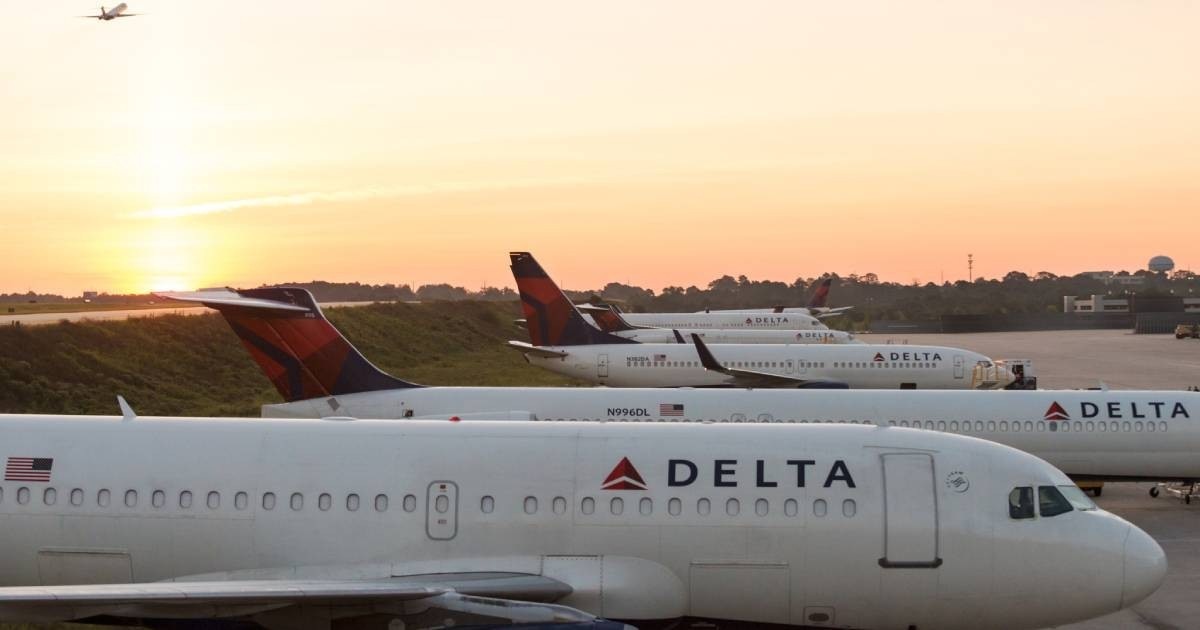
Delta Air Lines has requested that a United States federal court dismiss the lawsuit filed against it under Title III of the Helms-Burton Act for operating flights to Havana's José Martí International Airport.
On April 28, the airline filed a motion with the U.S. District Court for the Southern District of Florida, arguing that the claim brought by José Ramón López Regueiro is "legally barred on multiple levels" and lacks legal merit.
The plaintiff alleges that Delta is "trafficking" in confiscated Cuban property by using the Havana airport, invoking the Liberty Act (Helms-Burton), which permits litigation in U.S. courts over property nationalized after the Cuban Revolution.
However, Delta countered that since 2016, the U.S. government has explicitly authorized its regular flights to Havana, meaning its operations have complied with federal policy.
"The activities described in the lawsuit pertain solely to legal travel to Cuba authorized by federal orders," Delta stated in its court filing.
Delta also indicated that López Regueiro may have acquired any potential rights to the property after the March 12, 1996 deadline set by the law, thus invalidating his claim. According to Delta, documents attached to the lawsuit itself reveal that the plaintiff did not have control over the alleged claim before 2010.
Another key argument in Delta's defense is that the airline holds a certified claim from the U.S. Foreign Claims Settlement Commission (FCSC) related to confiscated properties in Cuba, including offices at the Havana airport, following nationalizations by the Cuban government in 1962.
The company asserted that the Helms-Burton Act was specifically designed to protect certified claim holders and not to allow lawsuits against them by individuals with uncertified claims.
Moreover, Delta challenged the constitutionality of the Helms-Burton's judicial mechanism, arguing that Congress cannot create a cause of action whose enforcement can be suspended at the discretion of the U.S. president.
The lawsuit against Delta is part of a series of legal actions initiated in U.S. courts under Title III of Helms-Burton against companies connected to operations on properties nationalized by the Cuban regime.
Understanding the Helms-Burton Act and Its Impact on Delta Air Lines
What is the Helms-Burton Act?
The Helms-Burton Act, also known as the Cuban Liberty and Democratic Solidarity Act, is a U.S. federal law that allows Americans to sue foreign companies trafficking in property confiscated by the Cuban government after the revolution.
Why is Delta Air Lines facing a lawsuit under this act?
Delta Air Lines is being sued under the Helms-Burton Act because it operates flights to Havana's José Martí International Airport, which is allegedly built on confiscated property. The lawsuit claims this activity constitutes trafficking in confiscated property.
How does Delta Air Lines defend against these allegations?
Delta argues that its flights to Havana are legally authorized by the U.S. government and that the lawsuit lacks legal foundation. They also state that the Helms-Burton Act was intended to protect certified claim holders, not to allow claims against them.