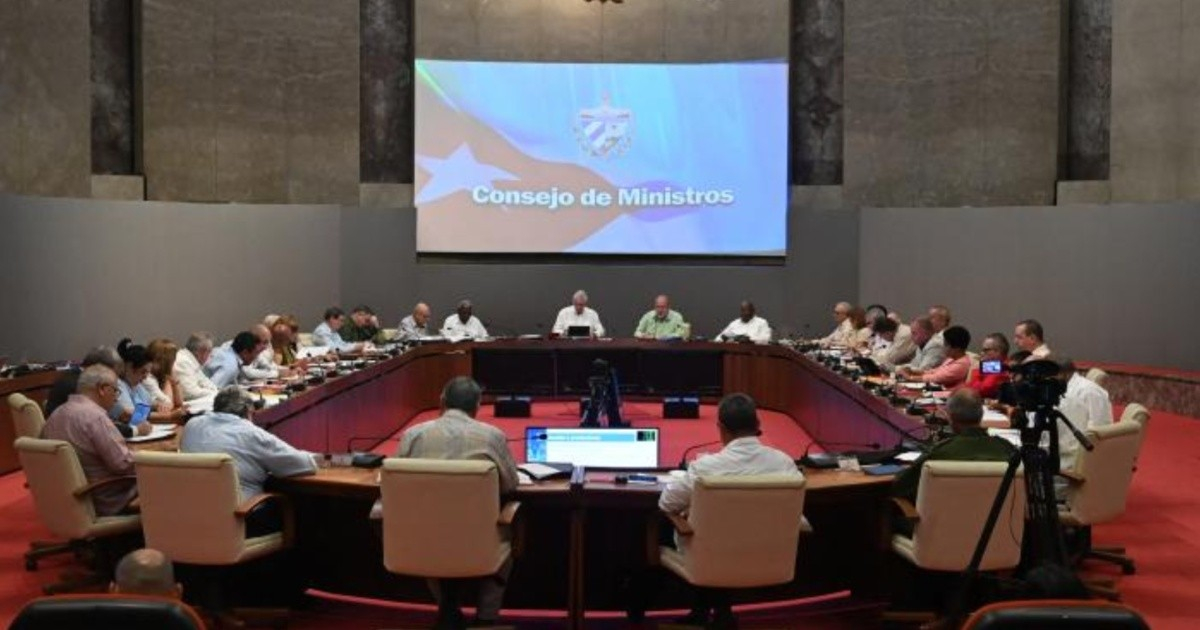
This month, Cuba's Council of Ministers approved a legislative initiative that aims to streamline the Central State Administration, reducing its entities from 27 to 21. This decision was reported by Granma, the official newspaper of the Communist Party of Cuba, in its Saturday edition.
The regular April session was presided over by Miguel Díaz-Canel and led by Prime Minister Manuel Marrero Cruz. Andry Matilla Correa, Dean of the Law Faculty at the University of Havana, presented the proposal, emphasizing that it represents more than just a structural change but a comprehensive redesign of each entity within the Central State Administration.
The draft law will establish general organizational principles, determine the number, names, missions, and functions of the ministries and other state entities. It is slated for presentation to the National Assembly of People's Power in July 2026.
Marrero Cruz justified the restructuring by acknowledging decades of bureaucratic bloat: "A small country with such a complex situation cannot sustain a large, cumbersome bureaucracy. This inefficiency necessitates a different design."
Ongoing Government Reforms
This reform is part of a broader governmental restructuring. In April, Díaz-Canel announced plans to reduce the number of ministries, eliminate intermediate structures, downsize large state enterprises, and increase municipal autonomy, all set to be completed by mid-2026.
The Economic and Social Program 2026 has reported 81 specific objectives approved by the end of the first quarter: 32 have been implemented, and 49 are in progress, out of a total of 158 planned actions.
Additionally, Decree 127 "On Budgeted Institutions" came into effect on May 8, 2026, providing a regulatory framework for resizing the budgeted sector, which employs over 50% of the active workforce and encompasses approximately 2,443 units nationwide.
Challenges in Economic Policy
During the same Council of Ministers session, Deputy Prime Minister and Minister of Foreign Trade and Foreign Investment, Oscar Pérez-Oliva Fraga, noted that traditional methods are failing to yield results. He stressed the need for greater initiative and innovative proposals to adapt to current conditions.
The Council also approved legislative initiatives concerning the Labor Code and the Housing Law, both scheduled for presentation to the National Assembly in July 2026.
On the economic front, the Minister of Economy and Planning, Joaquín Alonso Vázquez, reported that the year-on-year inflation rate as of March 2026 was 13.42%, slightly higher than in February. Inflationary pressures are notably concentrated in non-state agricultural market prices, which increased by 31.9% in Havana.
The draft law that merges and eliminates six central state entities is expected to reach the National Assembly in July. However, given Cuba's history of frequently announced but slowly executed structural reforms, the real impact of this initiative remains to be seen.
Understanding the Changes in Cuba's Central Administration
What is the aim of reducing the Central State Administration entities in Cuba?
The objective is to streamline the administration by reducing the number of entities from 27 to 21, thus addressing bureaucracy inefficiencies and creating a more effective government structure.
When will the draft law be presented to the National Assembly?
The draft law is set to be presented to the National Assembly of People's Power in July 2026.
What is the economic impact of these reforms on Cuba?
While the reforms aim to improve efficiency, the year-on-year inflation rate reached 13.42% in March 2026, with significant price increases in the non-state agricultural market.