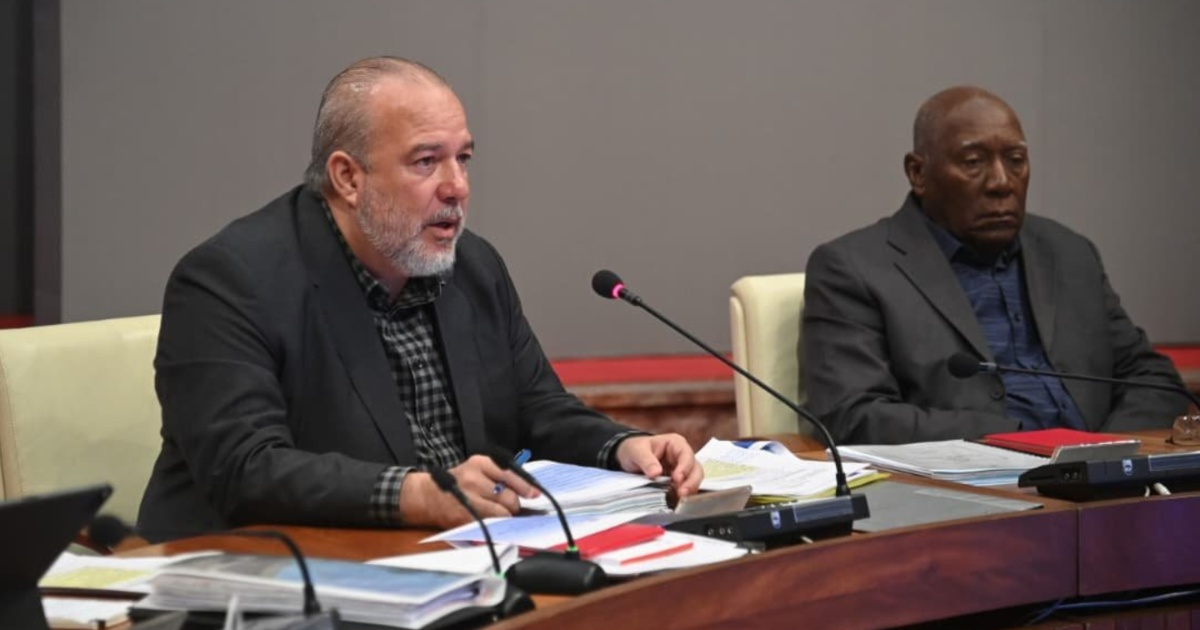
The Cuban Vice Prime Minister, Oscar Pérez-Oliva Fraga, acknowledged on Saturday during the regular session of the Council of Ministers that "traditional methods are not yielding results." He urged the government to act with "greater initiative" and come up with "different proposals" to tackle the ongoing economic crisis in Cuba.
Presided over by Miguel Díaz-Canel and led by Prime Minister Manuel Marrero Cruz, the meeting reviewed the outcomes of the Government's Economic and Social Program 2026 in the first quarter of the year, as reported by the Presidential portal.
Pérez-Oliva was more candid than in previous statements, emphasizing the need to "move beyond the limitations of our companies and entities and consider the benefits that any decision we make might have for the country."
This statement marks one of the most direct acknowledgments by the regime itself regarding the inefficacy of its management model amid the worst economic crisis since the Special Period.
Meanwhile, Marrero called for everyone to "speak the same language" in implementing the program, which he described as a "richly enhanced document, consulted with popular wisdom" containing "all our major goals and commitments."
Of the 81 specific objectives approved for this phase, 32 have been implemented, and 49 are in progress. Out of 158 planned actions, only 65 have been completed, he asserted.
The Minister of Economy and Planning, Joaquín Alonso Vázquez, reported that the year-over-year inflation at the end of March reached 13.42%, slightly higher than in February, while warning of a potential "new spike in inflationary pressures."
Agricultural prices in the non-state market increased by 31.9% during the quarter, primarily concentrated in Havana.
The investment plan faced setbacks due to shortages of fuel, steel, cement, and financing, although the government noted partial advancements in the energy sector: five photovoltaic solar parks were completed with a capacity of 58.74 MW, and 239 MW were recovered through rehabilitations in thermoelectric plants in Santa Cruz del Norte and Cienfuegos.
This call for "reinvention" comes as Cuban communism faces a prolonged farewell amid an exhausted model, with GDP having fallen by 23% since 2019 and an additional contraction of 7.2% projected by 2026.
Pérez-Oliva's admission contrasts with the rhetoric of Foreign Minister Bruno Rodríguez, who just last week insisted that Cuba is not an inefficient state but rather "besieged" and "attacked."
In April, Díaz-Canel himself announced there would be less bureaucracy and fewer ministries before mid-2026, which the regime is presenting as a structural reform of the state apparatus.
Nevertheless, a national survey revealed that the president faces overwhelming disapproval from the population, with 92% of Cubans expressing deep dissatisfaction with the government and only 0.1% wanting to maintain the system as it is.
The session also exercised legislative initiative on the drafts of the Housing Law, Labor Code, and the Organization of the Central State Administration, the latter directly linked to the announcement of reducing the bureaucratic apparatus, the source specified.
As the regime debates whether to preserve or dismantle the current system, the vice prime minister's warning encapsulates the central contradiction of the moment: the government acknowledges that its methods are not working, yet it remains unwilling to abandon them.
Key Insights into Cuba's Economic Challenges
What did Oscar Pérez-Oliva Fraga admit about Cuba's current methods?
Oscar Pérez-Oliva Fraga admitted that Cuba's traditional methods are not yielding results and called for new initiatives and different proposals to address the economic crisis.
How has Cuba's GDP changed since 2019?
Since 2019, Cuba's GDP has fallen by 23%, with an additional contraction of 7.2% projected by 2026.
What challenges is Cuba facing in implementing its investment plan?
Cuba's investment plan is facing challenges due to shortages of fuel, steel, cement, and financing. However, there have been some advancements in the energy sector.