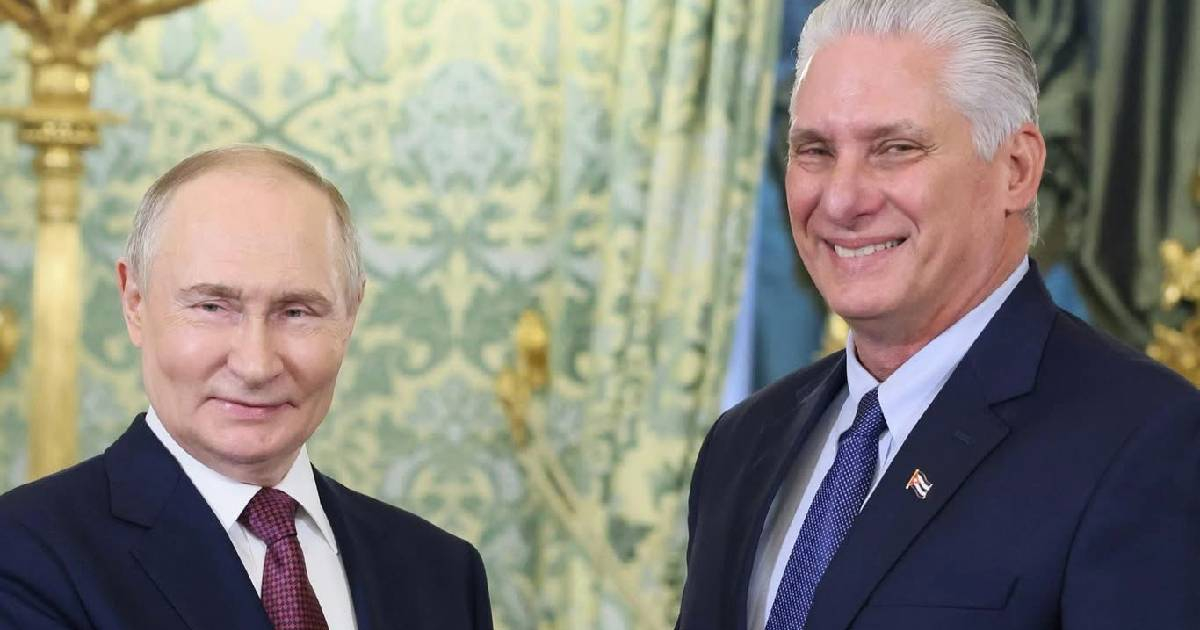
On Saturday, Miguel Díaz-Canel took to X to express his congratulations to Vladimir Putin in honor of Victory Day. He extended a "warm and grateful embrace" to the Russian president, his administration, and the "heroic people of the Russian Federation," marking the 81st anniversary of Nazi Germany's defeat in World War II.
The Cuban leader praised the Russian people as those who "sacrificed the most lives in the fight against fascism" and warned that this "terrible scourge is resurfacing today with threatening force in the world." His message closely aligns with Moscow's official narrative used to justify its invasion of Ukraine.
The tweet featured the iconic photograph of a Soviet soldier raising the USSR flag over the destroyed Reichstag in Berlin, taken on May 2, 1945, by Soviet photographer Yevgeny Khaldei.
Unlike in 2024 and 2025, when Díaz-Canel personally attended the Red Square parade alongside Putin, this year, he opted for a social media message. The parade was notably scaled back due to the ongoing conflict in Ukraine.
Changes in Moscow's Commemoration
This year marked the first parade since 2007 without tanks, nuclear missiles, or heavy military vehicles, attributed to the "operational situation" on the Ukrainian front and threats of drone attacks.
The only foreign leaders present in Moscow were Alexander Lukashenko (Belarus), the presidents of Kazakhstan and Uzbekistan, the leader of Laos, and the King of Malaysia.
In his address on Red Square, Putin proclaimed, "our cause is just," equating the war in Ukraine to the fight against Nazism, mirroring the language used by Díaz-Canel in his own statement.
Cuba-Russia Relations and Economic Challenges
Díaz-Canel's gesture follows the celebration of the 66th anniversary of diplomatic relations between Cuba and Russia, with Moscow reaffirming its "steadfast commitment" to continue supporting the Cuban regime.
In this context, Russian Ambassador Viktor Koronelli announced that Moscow is exploring projects to exploit nickel, cobalt, and other precious metals on the island, taking advantage of the withdrawal of Canadian companies like Sherritt.
The diplomatic enthusiasm shown by Díaz-Canel is in stark contrast to the energy crisis in Cuba. The Cuban leader admitted on May 2 that the Russian oil supply is "running out these days," with no clear timeline for the next shipment.
The most recent shipment, the tanker Anatoli Kolodkin, arrived in Matanzas on March 31 with 730,000 barrels, which accounts for only 10% of the island's energy needs.
In 2026, Cuba faces an electricity crisis with blackouts lasting over 12 hours in Havana and up to 40 consecutive hours in rural areas. Russian Foreign Minister Sergei Lavrov acknowledged in April that the oil aid to Cuba "will likely last a couple of months."
Understanding Cuba's Diplomatic and Energy Challenges
Why did Díaz-Canel not attend the Red Square parade in person this year?
This year, Díaz-Canel chose to send a social media message instead of attending the parade in Moscow, likely due to the scaled-back nature of the event amidst the ongoing war in Ukraine.
What are the implications of Cuba's current energy crisis?
Cuba's energy crisis includes severe blackouts, impacting daily life and the economy. The depletion of Russian oil supplies adds to the urgency for alternative energy sources.
How is Russia supporting Cuba economically?
Russia is exploring projects to exploit natural resources like nickel and cobalt in Cuba and has shown a willingness to support the Cuban regime amid international economic challenges.