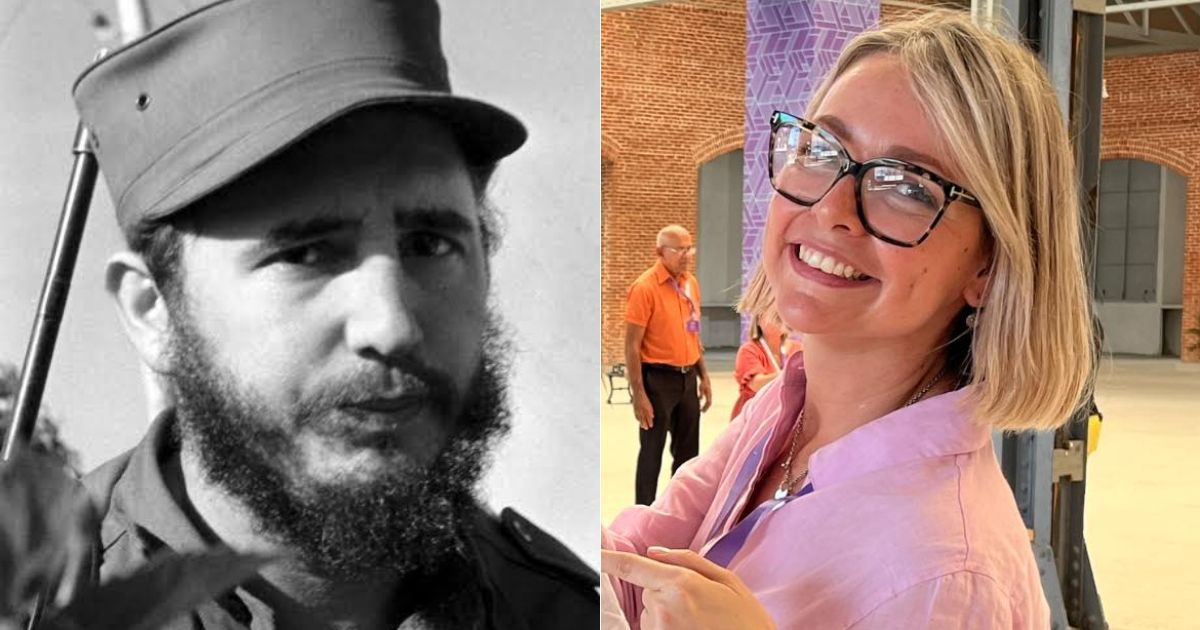
Marxlenin Pérez Valdés, a doctor in Philosophical Sciences, host of the state-run program "Cuadrando la Caja," and wife of Fidel Castro's grandson, took to Facebook this week to express her unwavering admiration for the late Cuban leader. She referenced a 2008 quote from Castro, asserting that it remains relevant today: "How challenging it is to be concise in the battle of ideas!"
The irony is palpable, almost necessitating a four-hour speech to unpack it. This phrase is from a reflection Castro titled "No Concessions to the Enemy's Ideology," which he concluded on April 15, 2008. The same Castro set the record for the longest speech in the history of the United Nations General Assembly: a marathon 269 minutes delivered on September 26, 1960, according to UN records.
The Legacy of Long-Windedness
This wasn't an isolated instance. In January 1959, after entering Havana, Castro spoke for seven uninterrupted hours on television, which was described as potentially a world record. He also gave a 17-hour interview to Italian journalist Gianni Miná, marking one of the longest interviews ever recorded. Clearly, he was a man who understood the difficulty of brevity but seldom made earnest attempts at it.
Castro was well aware of his own verbosity, often pledging to "be brief" in his reflections and speeches to avoid tiring his audience. This promise, much like many others under the regime, remained unfulfilled. Between 2008 and 2016, he penned over 500 "Reflections" for Granma and Cubadebate, some of which contained inconsistencies that seemingly no one dared to correct.
A New Age of Ideological Battle
True to her roots, Marxlenin doesn't shy away from analysis. In her post, she highlights how "virtuality and its codes" complicate the "battle of ideas for dignified peoples." The culprits, she claims, are "the world's owners" who concoct "fashionable consumer fantasies" so their "ideological battle goes unnoticed while infiltrating our minds." She concludes with Castro's caution: "One must be very careful not to play into the enemy's ideology."
This isn't the first time the academic has turned to the "Comandante" to address current crises. In November 2025, she published an article in Cubadebate titled "It Was Worth Being Born and Living in Fidel's Century," urging readers to find answers to present issues in the dictator's legacy. The public responded with their own summary: "The horse left a debt that a goat can't leap over."
Understanding the Context
Her name, a combination of Karl Marx and Vladimir Lenin, was chosen by her parents while studying philosophy at the University of Havana, where she later became a tenured professor of Marxism. Her marriage to Fidel Castro Smirnov, the dictator's grandson, places her at the core of Cuba's political-ideological elite.
The timing of this latest homage is, at the very least, noteworthy. This week, power outages in Cuba have worsened, with an electricity generation deficit nearing 1,900 MW, leading to blackouts of up to 24 hours a day in eastern provinces like Granma, Holguín, and Santiago de Cuba.
The food situation is equally dire: 33.9% of Cuban households reported experiencing hunger in 2025, a 9.3 percentage point increase from 2024. As of April 2026, 96.91% of the population lacked adequate food access. A staggering 80% of Cubans believe the current crisis is worse than the Special Period of the 1990s.
In this context, invoking Castro as an ideological guide and warning against the "enemy's ideology" perfectly encapsulates what the Comandante himself described as the "battle of ideas": lengthy, repetitive, and utterly detached from the harsh realities faced by Cubans. In this regard, Castro was right—being concise in such a battle is indeed challenging.
FAQs on Ideological Battles in Cuba
What is the significance of Marxlenin Pérez Valdés's post about Fidel Castro?
Marxlenin Pérez Valdés's post highlights her continued admiration for Fidel Castro and emphasizes the ongoing battle of ideas against opposing ideologies, reflecting a traditional view of Cuban political discourse.
How does the current crisis in Cuba compare to the Special Period?
The current crisis in Cuba, marked by severe power outages and food shortages, is seen by 80% of Cubans as worse than the hardships experienced during the Special Period in the 1990s.
Why is Fidel Castro's propensity for long speeches ironic in this context?
Fidel Castro's tendency for lengthy speeches is ironic given his own acknowledgment of the difficulty in being concise in ideological battles, a struggle he himself rarely overcame.