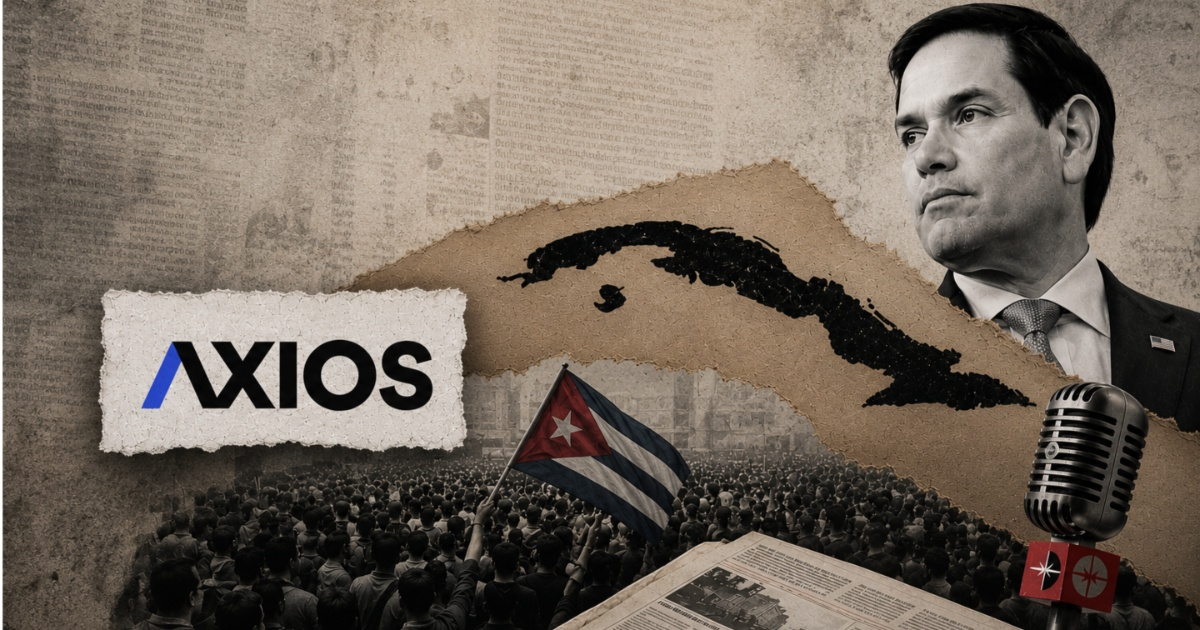
The Cuban regime's official propaganda outlet, Cubadebate's Media Observatory, launched an attack on the American news site Axios and journalist Marc Caputo last Wednesday. The piece accused them of serving as a "privileged channel" for disseminating the U.S. State Department and Senator Marco Rubio's positions regarding Cuba.
The backlash was triggered by an exclusive article from Axios released on the same day, which exposed new sanctions by Rubio targeting GAESA and the mining company Moa Nickel S.A., in accordance with Executive Order 14404 signed by Trump on May 1.
Axios's report also claimed, "according to a source," that the State Department was relocating personnel to the Southern Command in Miami in anticipation of potential "future hostilities" with Cuba and that Washington had bolstered its disaster preparedness logistics center in South Florida.
Cubadebate accused the outlet of fostering "a political and media climate conducive to intensifying aggression against Cuba," describing Caputo as "a functional cog in a narrative production chain" where political power leaks are transformed into public agenda.
The state-run site pointed out that Axios "does not present the sanctions as isolated measures but as part of a broader discourse architecture: 'regime change,' 'national security threat,' 'hostilities,' 'foreign intelligence platform.'"
This isn't the first time the regime has lashed out at Axios. On April 28, the same Media Observatory criticized the platform, accusing it of being a leak channel for the State Department in response to an April 17 article by Caputo. That piece revealed historic negotiations in Havana between U.S. officials and Cuban leaders, including Raúl Guillermo Rodríguez Castro, Raúl Castro's grandson.
The Axios article highlighted that it was the first time in a decade a U.S. government plane landed in Cuba, information the regime preferred to keep under wraps.
Cubadebate's pattern of attacking independent or critical media is systematic. The state-run portal has repeatedly targeted outlets like CiberCuba, elTOQUE, CubaNet, and Diario de Cuba, accusing them of "mercenarism" and CIA connections, following the same logic of discrediting those who publish information inconvenient for the dictatorship.
As for the sanctions that sparked the attack, Rubio labeled GAESA as "the heart of Cuba's kleptocratic communist system" and claimed Moa Nickel "has exploited Cuba's natural resources to benefit the regime at the expense of the Cuban people."
The Secretary of State also warned that sanctions against the regime will continue "in the coming days and weeks," as part of Trump and Rubio's strategy of maximum pressure against the Cuban dictatorship.
The day after Cubadebate's second attack on Axios, the Media Observatory published another article titled "The White House Sets the Beat, USA TODAY Stages the Scene," continuing its systematic campaign against American media covering the escalating pressure on Havana.
Frequently Asked Questions about Rubio's Sanctions and Media Reactions
What triggered Cubadebate's attack on Axios?
Cubadebate's attack was triggered by an Axios article revealing new sanctions by Marco Rubio against GAESA and Moa Nickel S.A., and its portrayal of the broader U.S. strategy towards Cuba.
What are GAESA and Moa Nickel?
GAESA (Grupo de Administración Empresarial S.A.) is a Cuban conglomerate with significant economic power, while Moa Nickel S.A. is a mining company involved in nickel production in Cuba.
How has the Cuban regime responded to media criticism?
The Cuban regime systematically attacks independent and critical media, accusing them of being mercenaries or linked to the CIA to discredit inconvenient information.