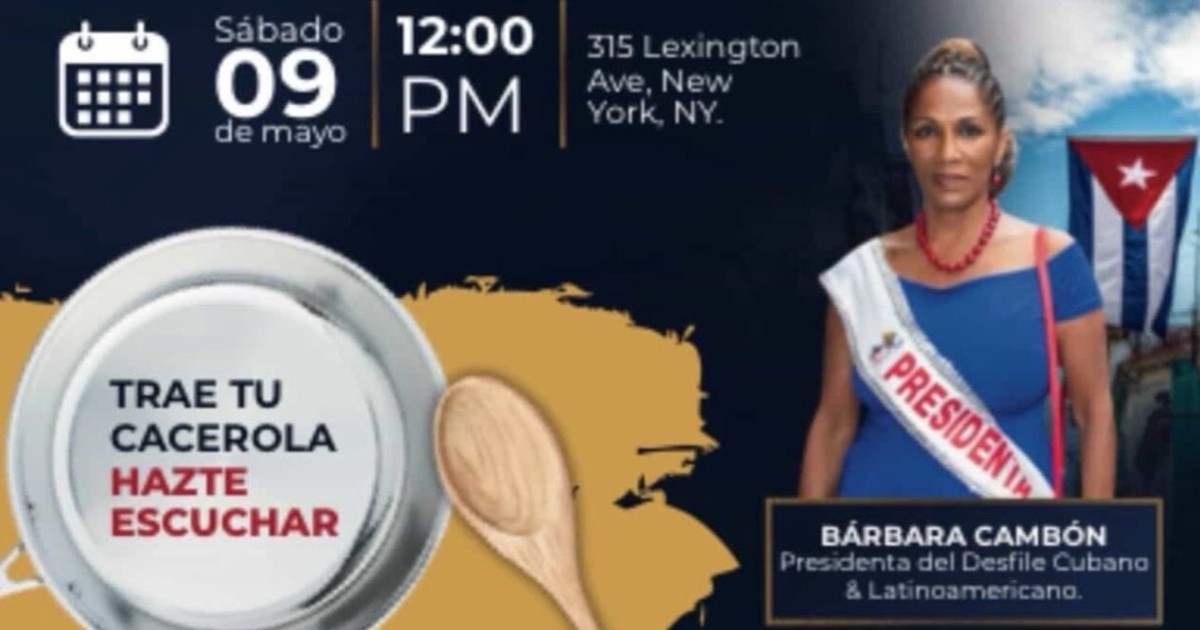
This past Saturday, a group of Cubans living in New York gathered at noon in front of Cuba's Permanent Mission to the UN, located at 315 Lexington Ave, Manhattan. They organized a "cacerolazo," banging pots and pans to demand freedom for Cuba and to protest the oppression of the communist regime.
Journalist Mario J. Pentón reported live from the scene, capturing the essence of the event with a spirited message: "In New York, with a cortadito in hand and my fellow Cubans ready to bang pots outside the dictatorship's headquarters."
The call to action was spread on social media by Cuba Libre Network starting Friday, promoting the slogan "One voice, worldwide" and urging, "Bring your pot. Make yourself heard."
Leading the demonstration were prominent figures such as Dr. Félix E. Roque, former mayor of West New York, New Jersey, and a retired U.S. Army colonel, along with Bárbara Cambón, president of the Cuban and Latin American Parade, a significant civic expression of the Cuban community in New York.
Voices Against Oppression
Dr. Roque, a respected voice in Cuban-American activism in the Northeast, expressed his perspective back in December 2014 when the Obama administration announced the reestablishment of diplomatic relations with Havana: "Today is a sad day for all of us who left everything we knew because of communism."
The protest this Saturday is part of a global surge of mobilizations by the Cuban diaspora, which by 2026 has reached over 120 cities worldwide, featuring rallies, caravans, and marches organized from Miami to Madrid.
Escalating Global Protests
This wave of activism is fueled by the historic number of political prisoners in Cuba: 1,250 verified inmates as of March 2026, according to Prisoners Defenders, with more than 2,000 detained since the protests of July 11, 2021.
In recent months, Cubans have staged demonstrations in Madrid, Miami, and other cities during international days of protest, as well as outside the Cuban consulate in Barcelona, organized by the Ibero-American European Alliance Against Communism.
Across the United States, caravans and gatherings have taken place in various cities, including Las Vegas, where the Cuban community flooded the streets in a freedom caravan.
U.S. Policy and International Pressure
The Trump administration has consistently maintained a policy of maximum pressure on the Cuban regime, issuing ultimatums for the release of political prisoners, which Havana has persistently ignored.
Understanding the Cuban Protests
What is a "cacerolazo" and why is it significant?
A "cacerolazo" is a form of protest where participants make noise by banging pots and pans. It is significant as a peaceful yet powerful way to express dissent and draw attention to a cause, often used in Latin America.
Who are the key figures leading the Cuban protests in New York?
Dr. Félix E. Roque, a former mayor and retired U.S. Army colonel, and Bárbara Cambón, the president of the Cuban and Latin American Parade, are significant leaders in these protests.
Why are Cubans protesting in so many cities worldwide?
Cubans are protesting globally to demand freedom and human rights, driven by the increasing number of political prisoners and ongoing oppression by the Cuban regime.
How has the U.S. government responded to the situation in Cuba?
The U.S. government, particularly under Trump's administration, has adopted a stance of maximum pressure, demanding the release of political prisoners and rejecting the regime's actions.