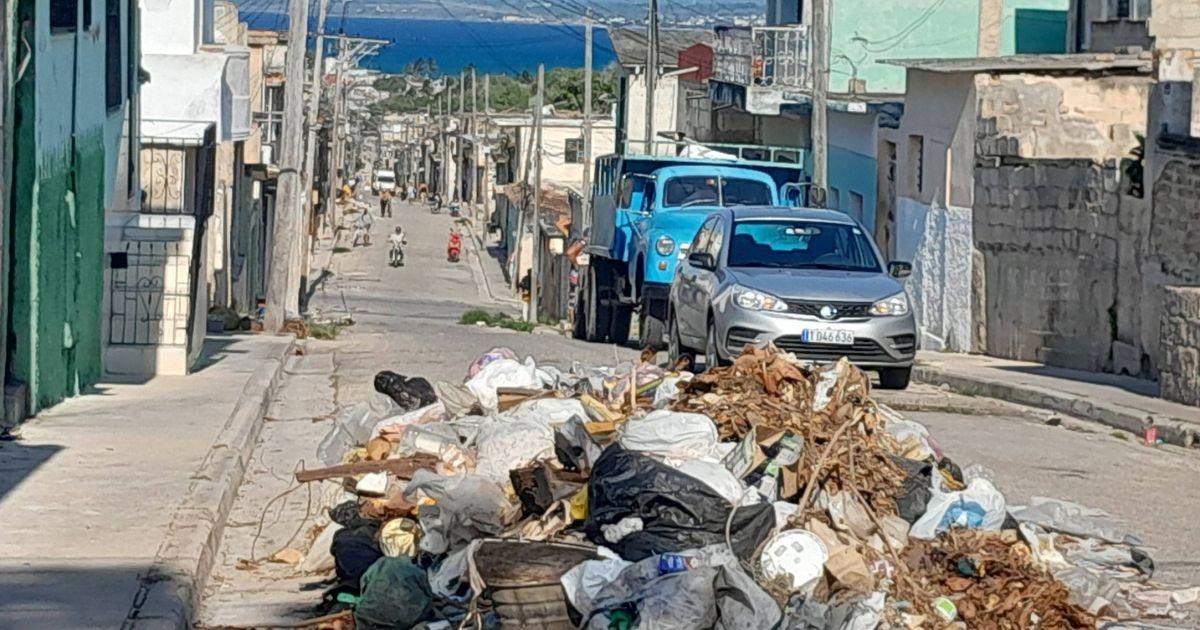
On Friday, Matanzas journalist Yirmara Torres Hernández turned to Facebook to express her frustration over the growing number of makeshift garbage dumps in her neighborhood, near the Eliseo Noel Camaño Pediatric Hospital.
“A garbage dump has appeared on my corner,” Torres lamented, describing the extreme unsanitary conditions at the intersection of Salamanca and San Carlos streets, where the accumulation of trash now obstructs vehicle passage.
“Beyond the dump, you can see the bay. Matanzas offers those stunning views from anywhere, that captivating blue... But the garbage is in the foreground,” she noted, highlighting the stark contrast between the city's natural beauty and its surrounding neglect.
The Growing Health Hazard
Torres and her neighbors are most troubled by more than just the sight: “The worst is the stench, and the cockroaches, and the rats,” she warned, pointing out the health risks in this densely populated residential area, just steps away from a children's hospital.
The situation has already led to tangible consequences: a neighbor’s rooster was stolen from his yard, with Torres noting, “The thieves didn’t have to work hard. The pile of trash served as their ladder.”
Community at a Tipping Point
The journalist emphasizes that the problem isn't confined to her street. Garbage dumps also surround the Ramón Mathiew secondary school and approach the Eliseo Noel Camaño Pediatric Hospital. Torres bitterly remarks that her street, once kept clean due to its proximity to the hospital, is now engulfed in the crisis: “No electricity, no water, but with garbage.”
In the face of governmental inaction, Torres suggests practical solutions: “Can’t we use animal-drawn carts? Couldn’t we hire carts? What about electric tricycles?” She notes that these are not far-fetched ideas, citing Guantánamo's use of electric tricycles and Santa Clara’s use of animal-drawn carts to tackle their garbage collection crises.
Systemic Challenges and Urgent Questions
Torres poses a question that the regime is reluctant to address: “What if we handed these services over to private individuals?” Her underlying question is even more pressing: “What are we waiting for to solve the garbage problem? For us all to get sick or die?”
This concern is not merely rhetorical. Matanzas is grappling with a complex epidemiological scenario, with active outbreaks of hepatitis A, dengue, and chikungunya. In April 2026, a provincial health alert was issued for hepatitis A in municipalities such as Matanzas, Cárdenas, and Versalles, diseases directly linked to unsanitary conditions.
More than 300,000 residents of the province lack a stable water supply, as acknowledged by Deputy Prime Minister Inés María Chapman. The water crisis in Matanzas exacerbates the health risks posed by the garbage accumulating in the streets.
The same pediatric hospital Torres mentions operated in October 2025 with all 75 beds filled by arbovirus patients, and in February 2026, it was documented to have deplorable sanitation conditions: bathrooms with trash, dirty floors, and deteriorating walls.
Former president of the Union of Cuban Journalists in Matanzas for seven years, Torres resigned from her position in February 2023 and has since been documenting the province's crisis on Facebook. Her neighbors hope that she can effect change. “They think one has power... and they don’t know it’s not so... The most we can do is denounce,” she wrote.
“Cuba has experienced tough times, but never so much chaos, such neglect... so much garbage,” the reporter concluded.
Health and Sanitation Crisis in Matanzas
What are the main health risks associated with the garbage problem in Matanzas?
The primary health risks include the proliferation of pests such as cockroaches and rats, and the spread of diseases like hepatitis A, dengue, and chikungunya, which are linked to unsanitary conditions.
What solutions has Yirmara Torres proposed for the garbage crisis?
Torres has suggested using animal-drawn carts, hiring carts, and employing electric tricycles for garbage collection, similar to solutions implemented in Guantánamo and Santa Clara.
How has the water crisis in Matanzas impacted the garbage situation?
The lack of a stable water supply for over 300,000 residents exacerbates the health risks associated with the garbage problem, as adequate sanitation becomes difficult to maintain.