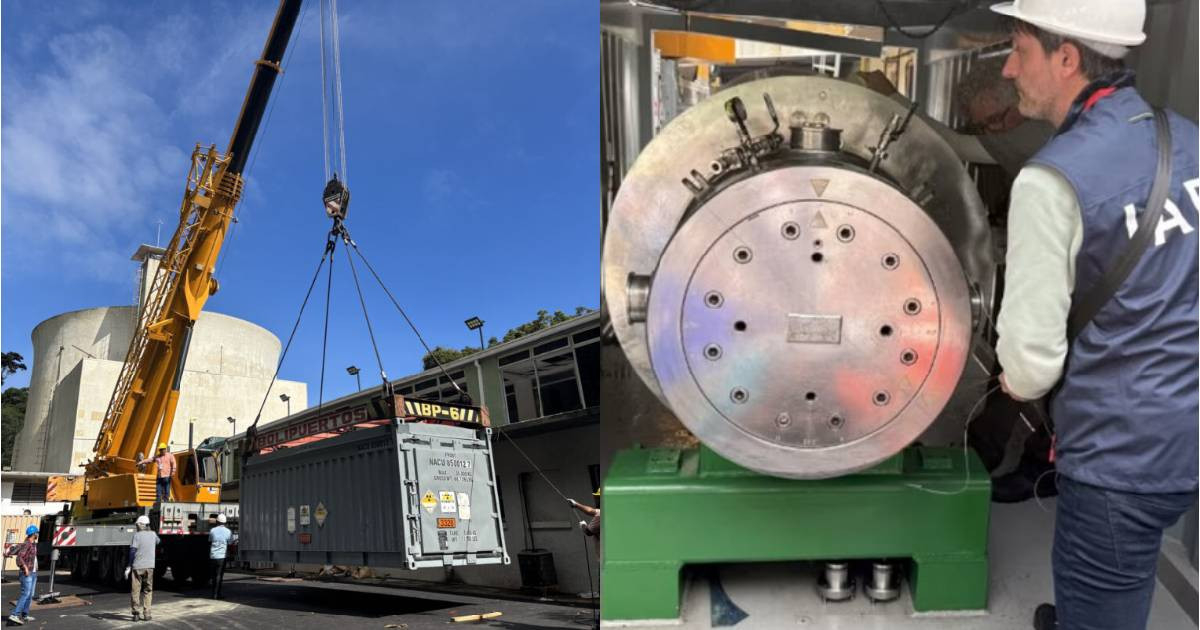
The U.S. Department of Energy announced on Friday the successful removal of all remaining enriched uranium from Venezuela’s RV-1 research reactor, marking a significant milestone in nuclear non-proliferation efforts across South America.
In a collaborative effort, the Defense Nuclear Nonproliferation (DNN) team from the National Nuclear Security Administration (NNSA) worked alongside the Venezuelan Institute for Scientific Research, the International Atomic Energy Agency (IAEA), and UK experts to extract 13.5 kilograms (roughly 30 pounds) of enriched uranium, which exceeded the critical 20% threshold, as confirmed by the U.S. embassy in Caracas.
The RV-1 reactor, which had supported nuclear physics and energy research for decades, ceased operations in 1991, leaving its uranium as unused surplus material.
This operation was executed in under six weeks following the initial site visit, a rapid pace credited by NNSA administrator Brandon Williams to decisive action from the White House. "The secure removal of all enriched uranium from Venezuela signals a new era for the country. Thanks to President Trump's decisive leadership, what usually takes years was accomplished in mere months," the embassy's statement highlighted.
The catalyst for this operation was Energy Secretary Chris Wright's visit to Venezuela in February, after which the NNSA coordinated with the State Department, Venezuelan authorities, and the IAEA to plan the extraction process.
After removal, the uranium was transported 160 kilometers over land to a Venezuelan port, where it was loaded onto a specialized vessel operated by the UK-based Nuclear Transport Solutions.
The shipment reached U.S. shores in early May, with the containers being delivered to the Savannah River Site in South Carolina. There, the material will be processed into high-assay low-enriched uranium for use in the U.S. civil nuclear program.
Dr. Matt Napoli, Deputy Administrator of the DNN, personally oversaw the operation in Venezuela. "I couldn't be prouder of the team that executed this crucial mission. I also extend my gratitude to our Venezuelan partners for facilitating the removal and paving the way for future cooperation," he stated.
The Energy Department framed the operation as part of Trump and Rubio’s three-phase plan for Venezuela, which accelerated following the capture of former President Nicolás Maduro on January 3 during Operation Absolute Resolution.
Relations between Washington and Caracas have been normalizing rapidly. The U.S. removed Delcy Rodríguez from its sanctions list in April, and by the month's end, American Airlines resumed direct Miami-Caracas flights for the first time in nearly seven years.
Since 1996, the NNSA has removed or confirmed the final disposition of over 7,350 kilograms of highly enriched uranium and plutonium from numerous countries, a record that the Department of Energy presented as evidence of the technical capabilities deployed in Venezuela.
Key Insights into Venezuela's Uranium Transfer to the U.S.
Why did Venezuela transfer enriched uranium to the United States?
The transfer was part of a broader effort to enhance nuclear non-proliferation in South America and to signify a renewed cooperation between Venezuela and the United States.
How significant is the removal of uranium from Venezuela?
Removing the uranium is significant as it prevents the potential for nuclear proliferation and marks a step forward in the normalization of relations between Venezuela and the U.S.
What happens to the uranium once it reaches the U.S.?
Upon arrival in the U.S., the uranium is processed into high-assay low-enriched uranium at the Savannah River Site in South Carolina for use in the civil nuclear program.