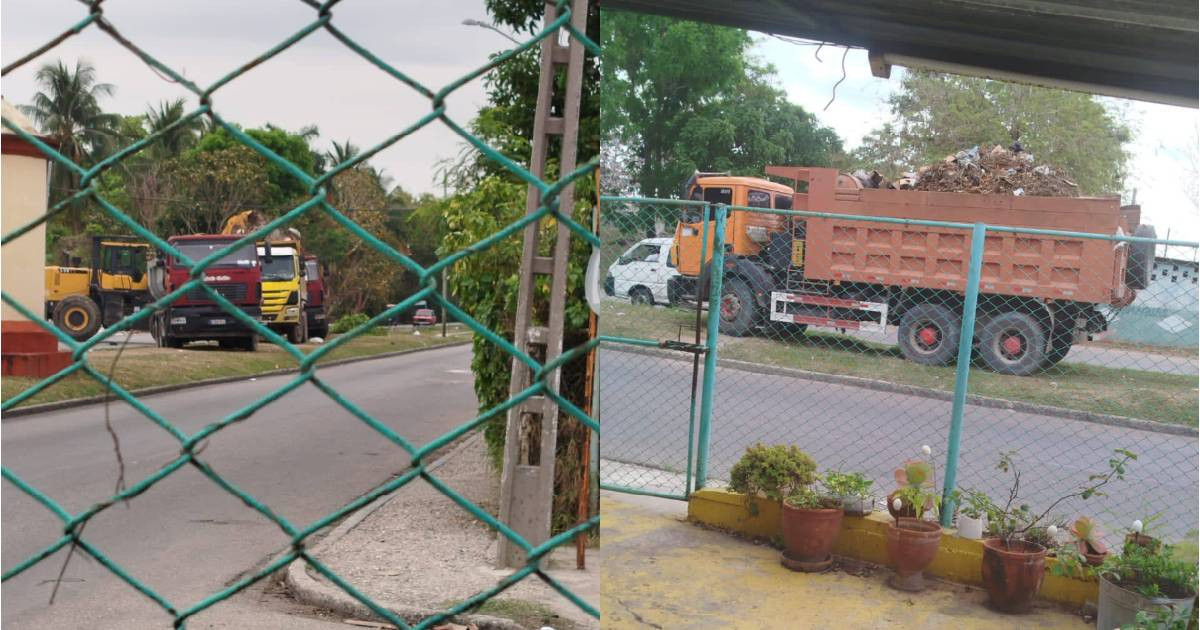
Residents near the Vento highway, adjacent to the Casino Deportivo in Havana's Cerro municipality, raised concerns on Friday about the use of dump trucks and front loaders for garbage collection operations. These vehicles are reportedly driving and operating on the central divider that covers the Albear Canal, a crucial 19th-century waterworks that still provides water to parts of the Cuban capital.
Mario Hui, who brought attention to the matter via his Facebook profile, emphasized that the area "is not designed for the transit, parking, or operation of heavy equipment, given the importance of the ancient and fragile construction crafted nearly two centuries ago by engineer Francisco de Albear."
The situation was further underscored by Herminia Watson Brown, a local resident, who reported that a hole already exposes the hydraulic canal below. "If they continue, they will break it, and now with the trucks on top, negligence is rampant," Watson commented.
Hui encapsulated the community's fears by posing a critical question: "Can you imagine if this hydraulic canal collapses... how many hundreds of thousands in this vast city would be left without the precious liquid?"
The Historical Significance of Albear Aqueduct
The Albear Aqueduct, designed by Cuban engineer Francisco de Albear y Lara (1816-1887), began construction in 1861 and was officially opened in 1893. It operates through gravity, requiring no mechanical pumping, and channels water from the Vento springs over a distance of about 20 kilometers to Havana.
Recognized as a National Monument and one of the Seven Wonders of Cuban Civil Engineering, it is also part of UNESCO's Global Network of Water Museums. Currently, it delivers approximately 15% of the water needed by the capital.
Context of a Water Crisis
This warning emerges amid an unprecedented water crisis in Havana. Official figures from Aguas de La Habana indicate that around 200,000 residents, roughly 10% of the city's population, are experiencing some form of water scarcity, although locals believe this number is grossly underestimated.
Damage to infrastructure is not an isolated issue. In La Lisa, a community services backhoe broke a main water pipe during garbage collection, leaving families without water supply for over 10 days without any institutional response.
Negligence and Infrastructure Damage
In the Martí neighborhood, near the reported area, heavy machinery has created makeshift "pools" at street corners where water and solid waste accumulate.
Libertad González Lajara, another resident, shared that garbage trucks knocked down and severed telephone cables on the Vento highway, leaving them unrepaired.
Many citizens blame the regime directly. Frank Alberto Hernández stated, "It’s the government's fault—municipal, provincial, and national. It's a chain of blame that has been dragging on for years. Decisions are made by 'officials' appointed for their political merits, not for their knowledge."
Abel Del Pino Fernández captured the public's frustration with a widely shared sentiment: "It's unbelievable that no one cares, or that common sense doesn't dictate that one of the seven wonders of Cuban engineering is below... and still in service. This happens when everything belongs to no one."
The Black Market and System Vulnerabilities
The NGO Food Monitor Program has reported that Havana's water black market has reached extreme levels: illegal pumps known as "water thieves" are sold for up to 36,000 Cuban pesos, while private water trucks charge between 18,000 and 26,000 pesos per load.
With 87% of the water supply system dependent on the national power grid, it is highly susceptible to chronic power outages. The Albear Canal, however, remains one of the few components operating independently due to its gravity-based design.
FAQs About the Albear Canal and Havana's Water Crisis
What is the significance of the Albear Canal in Havana?
The Albear Canal is a 19th-century hydraulic work designed by Francisco de Albear, providing about 15% of Havana's water supply. It is recognized as a National Monument and part of the UNESCO Global Network of Water Museums.
Why is the Albear Canal at risk?
The canal is threatened by the presence of heavy machinery used for garbage collection operations, which is not suitable for the area due to its historical and structural significance.
How does Havana's water crisis affect residents?
Around 200,000 residents are affected by water scarcity, which is exacerbated by infrastructure damage and the reliance on the national power grid, making the system vulnerable to power outages.