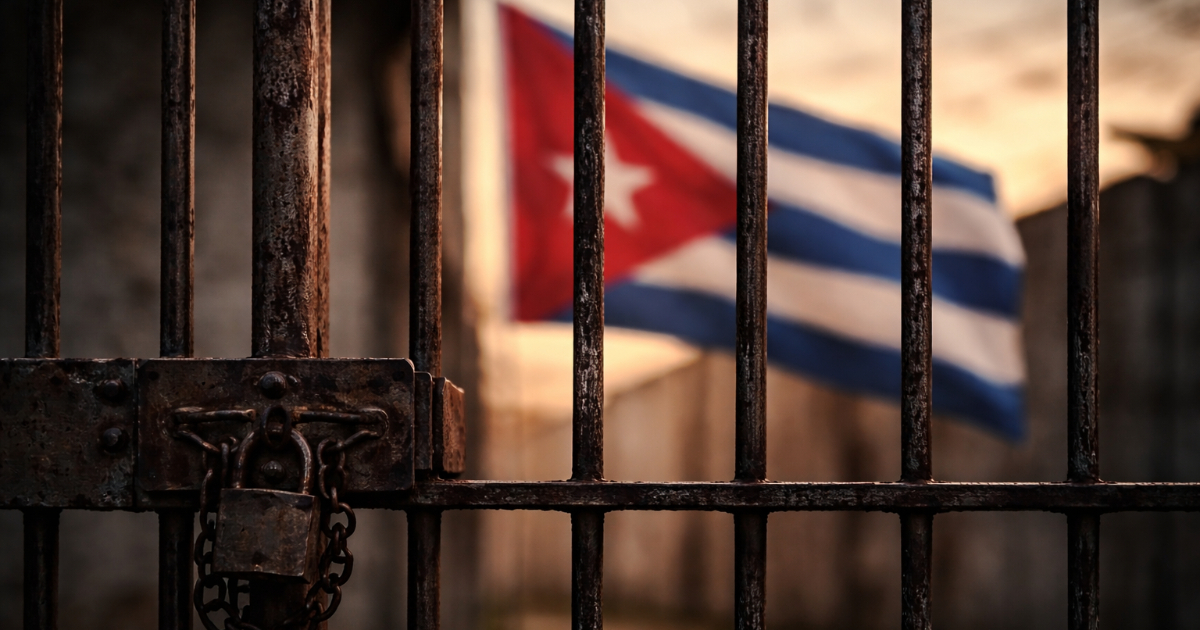
In collaboration with Amnesty International, Cubalex has announced a live broadcast scheduled for Monday, May 11. The event, titled "Delayed Freedom: Selective Releases and Harassment of Politically Motivated Detainees," aims to shed light on the dire state of human rights within Cuba.
The discussion will be streamed at 9 AM Mexico time, 11 AM in Havana, Miami, and Washington, and 5 PM in Madrid. It will be accessible via the Facebook and YouTube platforms of Mario J. Pentón and Cubalex, with the latter also moderating the session.
Speakers for the event include Laritza Diversent, director of Cubalex; Johanna Cilano Pelaez, Caribbean regional researcher for Amnesty International; Anamely Ramos, member of the Cultural Rights Observatory; and Yanelys Nuñez, coordinator of the Museum of Dissidence.
State-Controlled Excarcerations: A Tool for Political Manipulation
Both organizations caution that the Cuban government's conditional release processes have not halted repression. Their statement highlights a "troubling increase in harassment of detainees and their families."
The opaque nature of the system will be a central topic, examining how conditional releases are utilized as a political control mechanism rather than an act of justice—a concern repeatedly voiced by Cuban activists.
Escalating Harassment and Health Concerns
The event will also address the rise in intimidation through threats, relocations, communication restrictions, and denial of benefits, as well as the punitive measures against families demanding medical care for loved ones.
Cubalex and Amnesty International have raised alarms over the severe health decline of notable figures such as Sayli Navarro Álvarez, Félix Navarro, Loreto Hernández García, Donaida Pérez Paseiro, Roberto Pérez Fonseca, Maykel Castillo Pérez ("Maykel Osorbo"), and Luis Manuel Otero Alcántara. Amnesty International recognizes these individuals as prisoners of conscience.
The Shadow of Recent Mass Pardons
The timing of the event follows the obscure announcement of a mass pardon for 2,010 individuals in April 2026, with no official lists or full freedom guarantees. Amnesty International criticized the measures as "non-transparent, discretionary, and lacking full freedom assurances," noting that none of the named prisoners of conscience had been released by that date.
This pattern is not unfamiliar. In January 2025, after talks with the United States and Vatican mediation, the regime announced the release of 553 people. However, Cubalex found that only 205 had political sanctions, with at least seven returning to prison and one forced into exile. The organization has documented that about 70% of political releases between 2010 and 2025 were privately negotiated with mediators, in exchange for silence or exile.
The Reality of Political Imprisonment in Cuba
As of March 31, 2026, the organization Prisoners Defenders confirmed 1,042 political prisoners, including 29 women and 44 minors. Other independent groups estimate over 750 individuals are detained for political reasons.
Cubalex and Amnesty International continue to urge the government led by Miguel Díaz-Canel to "immediately and unconditionally release all individuals imprisoned for exercising their fundamental rights" amid a climate where the Cuban regime acknowledges political prisoners' existence but refuses unconditional release.
Understanding the Context of Political Imprisonment in Cuba
What is the focus of the Cubalex and Amnesty International event?
The event is centered on discussing the selective releases and ongoing harassment of political prisoners in Cuba, highlighting the human rights crisis in the country.
Who are some of the key figures affected by the Cuban regime's policies?
Notable individuals such as Sayli Navarro Álvarez, Félix Navarro, and Luis Manuel Otero Alcántara, recognized as prisoners of conscience by Amnesty International, are severely affected by the regime's policies.
What are the criticisms of the recent mass pardon announced by the Cuban government?
The mass pardon was criticized for its lack of transparency, discretionary nature, and absence of full freedom guarantees, with no prisoners of conscience being released as of the announcement.