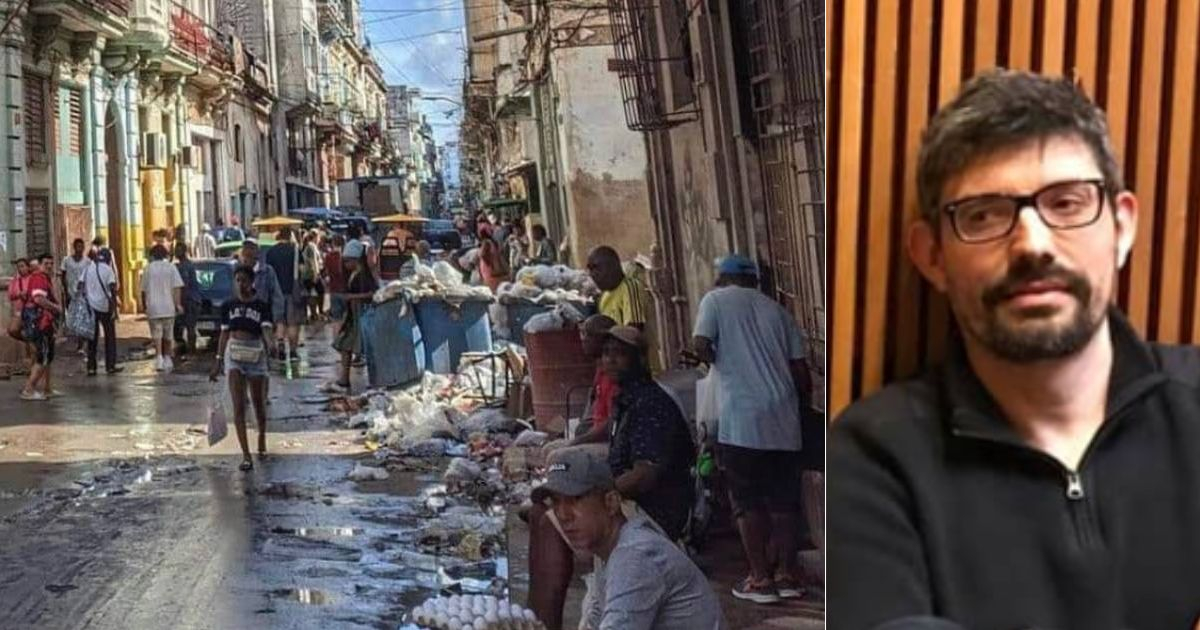
Argentine historian and journalist Pablo Stefanoni has recently published an essay that critically analyzes the impending demise of Cuba's revolutionary model. Drawing on philosopher Jean Baudrillard's concept of the "regret of history," Stefanoni describes the island's current state as a cycle nearing its end when the founding epic ceases to resonate with everyday reality.
Initially released in Italian in the Pubblico bulletin of the Feltrinelli Foundation, Stefanoni's essay, titled "The End of Revolutionary Cuba," was later translated into Spanish by the Center for Studies on the Rule of Law Cuba Próxima, with an introduction by its director, Roberto Veiga. Veiga regards Stefanoni as "one of the most insightful voices of contemporary Latin American intellectual left."
Stefanoni writes, "The images of Cuba—with its crumbling buildings, frequent power outages, hospital crises, and lack of prospects—no longer carry any epic narrative." He notes the fading slogans that once proclaimed, "Imperialist gentlemen, we are not afraid of you," while political elites—particularly the military—have transformed into economic elites.
The Shift in Cuban Power Dynamics
As a sign of this transition, Stefanoni highlights reports suggesting that Raúl Rodríguez Castro, popularly known as "Raulito," grandson of Raúl Castro and his chief of personal security, is secretly negotiating with the United States. Stefanoni poses a critical question: if Fidel Castro resisted reforms and Raúl initiated changes with a more pragmatic approach, will his grandson be the one to broker an exit with Washington?
Official confirmation of such negotiations came on April 20, when the Trump administration acknowledged a formal meeting with Rodríguez Castro in Havana, bypassing the Communist Party and President Miguel Díaz-Canel.
Historical Roots of Cuban Attrition
Stefanoni traces Cuba's decline back to 1959 when the Revolution captivated Latin America's left with its moral strength akin to David versus Goliath. Under Fidel Castro's charisma, however, the system veered towards a Soviet model, epitomized by the 1971 arrest of poet Heberto Padilla and the maxim, "Within the Revolution, everything; outside the Revolution, nothing."
The author argues that Cuba's symbolic survival relied on a "heroic rent" fueled by Washington's aggressive policies, leading much of Latin America's left to overlook the "internal blockade." Connectivity shattered this discourse monopoly: citing analyst Wilder Pérez Varona, Stefanoni notes that "for the first time in six decades, the State has ceased to monopolize the production and circulation of public discourses," and the spread of "Patria y Vida" challenges not just a narrative but also the emotional and moral regime that has long upheld official legitimacy.
Material and Symbolic Crises
This symbolic rupture aligns with an unprecedented material crisis. In early 2026, the electrical deficit exceeded 1,900 MW with blackouts lasting over 20 hours a day, while the healthcare collapse left only 30% of essential medicines available, prompting over 850,000 Cubans to emigrate to the United States between 2021 and 2024.
Cuban economist Ricardo Torres, cited in the essay, encapsulates the structural paralysis: "No social project can sustain itself indefinitely without a sufficient material base. For too long, Cuban leadership has sought to evade that limit." The military's economic presence through GAESA—controlling 40% to 70% of Cuba's GDP—did not change this dynamic; hence, the Trump administration's sanctions against GAESA target the core of the regime's military-economic power.
Stefanoni's essay concludes with a compelling image of Cuba caught between a declining communist elite and new imperial forms that merge the Cold War neoconservative ambitions with the political-emotional fluctuations of the White House occupant.
Roberto Veiga introduces the text as an invitation to stop viewing Cuba as a "theme park of past utopias" and instead see it as a real country, "with citizens demanding the right to envision a future beyond eternal resistance."
Key Questions about Cuba's Future
What are the signs of the end of the Cuban revolutionary model?
The fading epic of the revolution, the transformation of political elites into economic ones, and secret negotiations with the U.S. are key indicators of the model's decline.
How has connectivity affected the Cuban regime's discourse?
Connectivity has broken the state's monopoly on public discourse, allowing alternative narratives like "Patria y Vida" to challenge the regime's legitimacy.
What challenges does Cuba face in its current material crisis?
Cuba is experiencing severe power outages, a healthcare collapse, and significant emigration, with over 850,000 Cubans leaving for the U.S. between 2021 and 2024.