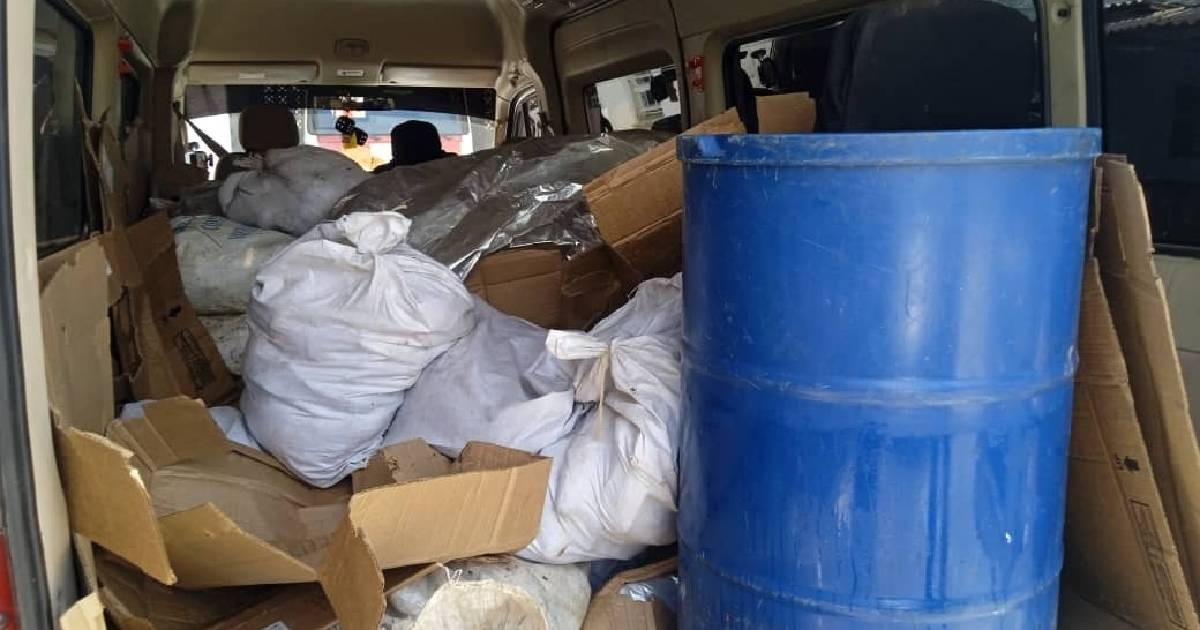
A minibus, operated by a private enterprise in Cuba, was halted in Bauta, a town situated in the province of Artemisa. The vehicle was discovered carrying a significant load of beef, lobster, and fish intended for Havana's black market. This information comes from Artemisa Noticias Cuba's Facebook page, affiliated with the provincial committee of the Communist Party in the region.
The post identifies Francisco Ernesto Martínez and Yannier Matos as the individuals involved, alleging they were attempting to bypass checkpoints managed by the National Revolutionary Police (PNR).
The vehicle in question, a FOTON T van with the license plate W008732 and labeled "El Transportador" on its rear window, was found with the goods packed in white sacks and plastic barrels, as evidenced by photos shared in the social media post.
Propaganda and Police Operations
The incident's highlight is not merely the confiscation but also how it was publicized. Artemisa Noticias Cuba's account follows a pattern of social media profiles functioning as mouthpieces for the PNR and the Ministry of the Interior (MININT), often sharing police operations with a victorious tone, images of the apprehended individuals, and hashtags like #BlueHeroes, #WinningAgainstCrime, and #SafeArtemisa.
The post featured an edited image adorned with flame effects, decorative emergency lights, and Cuban flags, presenting the detainees inside the vehicle under the official campaign banner "Blue Heroes." This initiative is promoted by state media to glorify police efforts.
Legal and Economic Implications
The post describes the suspects as "criminals," claiming their activities threaten "food security, the economy, and public health," showcasing the state security apparatus's narrative rather than independent journalism.
Legally, the operation involves highly sensitive products for the regime: private beef sales are banned in Cuba per Ministry of Agriculture Resolution 304/2023, and lobster trade is monopolized by the state.
Private enterprises, legalized in 2021 amid a limited economic opening, are prohibited from handling these products, making the use of their vehicles a method to legally mask the transport of black market goods.
Seizures of illegal meat and products have surged across Cuba in recent months amid a food crisis that fuels demand in the informal market.
In March 2025, for instance, authorities in Guanabacoa arrested traffickers with 23 sacks of illegally transported beef in an undocumented vehicle, part of numerous operations that year in Havana, Granma, Las Tunas, and Santa Clara.
The structural scarcity endured by the Cuban populace after decades of communist dictatorship is the driving force behind this underground market, while the regime responds with police operations later turned into digital propaganda.
Understanding the Black Market Operations in Cuba
What led to the seizure of the minibus in Bauta?
The minibus was seized due to its involvement in transporting a large quantity of beef, lobster, and fish intended for the black market in Havana, violating Cuban laws prohibiting private sales of these goods.
Why is the private sale of certain goods prohibited in Cuba?
Private sales of items like beef and lobster are forbidden in Cuba to maintain state control over essential goods and resources, with specific products being state monopolies as part of the country's socialist economic policies.
How do private enterprises play a role in the black market?
Private enterprises, or MIPYMEs, sometimes inadvertently provide a legal guise for transporting black market goods by using their business vehicles, despite regulations against handling such products.