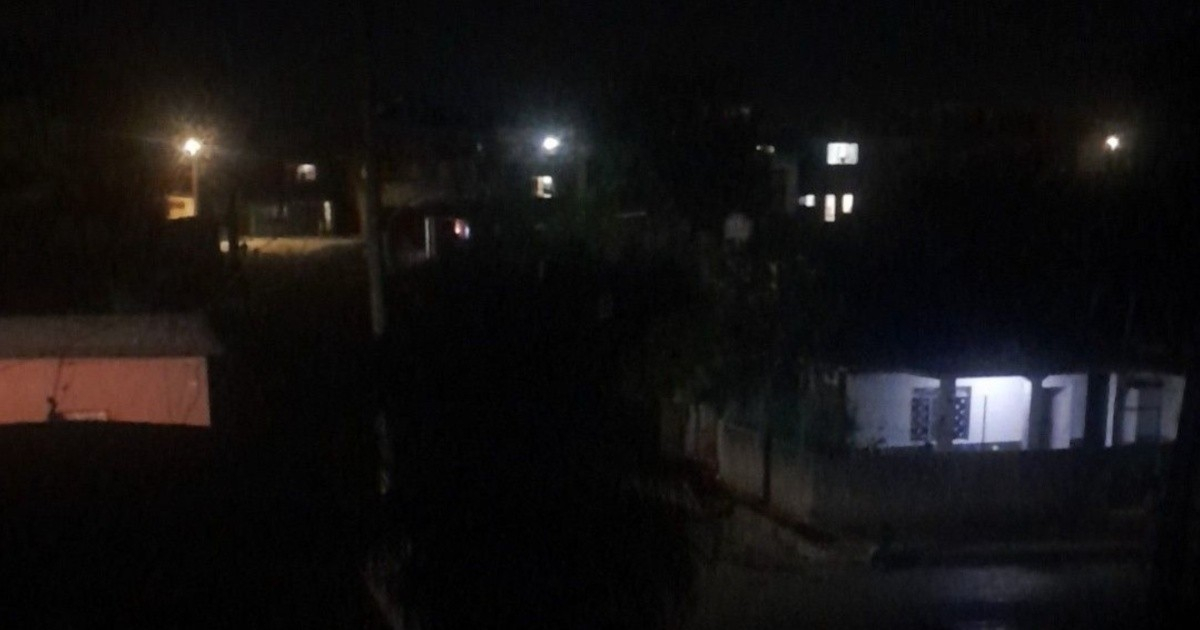
Habaneros unleashed their fury on social media this Friday over power outages lasting more than 12 hours, fueled by accusations that specific circuits remain powered while entire neighborhoods have been left in darkness for days.
The phrase capturing the residents' anger is unmistakable: "There's power in the UNE chief's block."
According to an update from the National Electric Union released today, the National Electric System (SEN) woke up to a mere 1,400 MW available against a demand of 2,740 MW, resulting in 1,340 MW being out of service. The forecast for the evening peak hours is even bleaker, predicting a deficit of 1,690 MW and an estimated impact of 1,720 MW.
The previous day saw the capital suffer a total service interruption for 24 hours, with a national maximum impact of 1,876 MW at 8:40 p.m.
Havana's Electric Company acknowledged that "emergency circuit shutdowns were necessary with 105 MW" and that "service restoration was not possible."
What fuels the frustration is not only the extent of the outages but their uneven distribution.
Voices of Frustration Emerge on Social Media
On the Facebook group "Empresa Eléctrica de La Habana," comments pour in with accounts of neighborhoods plunged into darkness while nearby areas remain lit.
"Emergency circuits have been without power for three nights, today since two in the afternoon without power and no hope of it being restored. How long will this abuse continue, and stop lying that all the blocks are off, because from where I live I can see blocks with lights," one user wrote.
An inhabitant from Block 3 of Vedado was more blunt: "Circuits that never go off and it’s not because they have something essential nearby. It's a blatant show of disrespect, and no one from the State or anywhere else seems to notice this."
From the Tejas corner, another resident lamented: "There's electricity all around us and we've been unable to sleep or run the motor for several days, enduring sheer hardship."
One individual was more explicit about the reasons: "There are circuits within the blocks that are hardly ever turned off or affected, and they aren’t prioritized. It's simply because someone important lives there or they pay to keep the power on."
Underlying Structural Challenges
The root of the crisis is structural. The Antonio Guiteras thermoelectric plant was taken offline on May 5 due to its eighth boiler malfunction this year, losing 140 MW. This is compounded by issues at the CTE Lidio Ramón Pérez and Units 3 and 5 of CTE Antonio Maceo, alongside maintenance at Mariel, Renté, and Nuevitas.
Fuel shortages are critical. The only significant shipment in 2026 came from the Russian tanker Anatoli Kolodkin, which delivered approximately 730,000 barrels donated by Moscow, now depleted.
Even Díaz-Canel himself admitted on May 2: "That oil is nearly gone, and we don't know when additional fuel will arrive in Cuba." A second Russian vessel remains adrift in the Atlantic with no confirmed destination.
Leadership and Hope for Improvement
The UNE's new director, Rubén Campos Olmo, appointed in March to replace Alfredo López Valdés, previously led the often-failing Antonio Guiteras plant.
Short-term hope was offered by Jorge Gómez Sánchez, the Guiteras plant's production deputy director: "If all goes according to plan, the Guiteras could be synchronized before Mother's Day and exceed 200 megawatts." This deadline is set for Sunday, May 10.
Understanding the Havana Blackouts
Why are there prolonged blackouts in Havana?
The blackouts are due to a significant shortfall in power availability versus demand, exacerbated by structural issues and fuel shortages.
How are power outages distributed in Havana?
Outages are unevenly distributed, with some areas experiencing prolonged blackouts while others remain powered, leading to public frustration.
What is being done to address the power crisis?
Efforts to address the crisis include maintenance and potential synchronization of the Antonio Guiteras plant, hoping to restore some capacity soon.