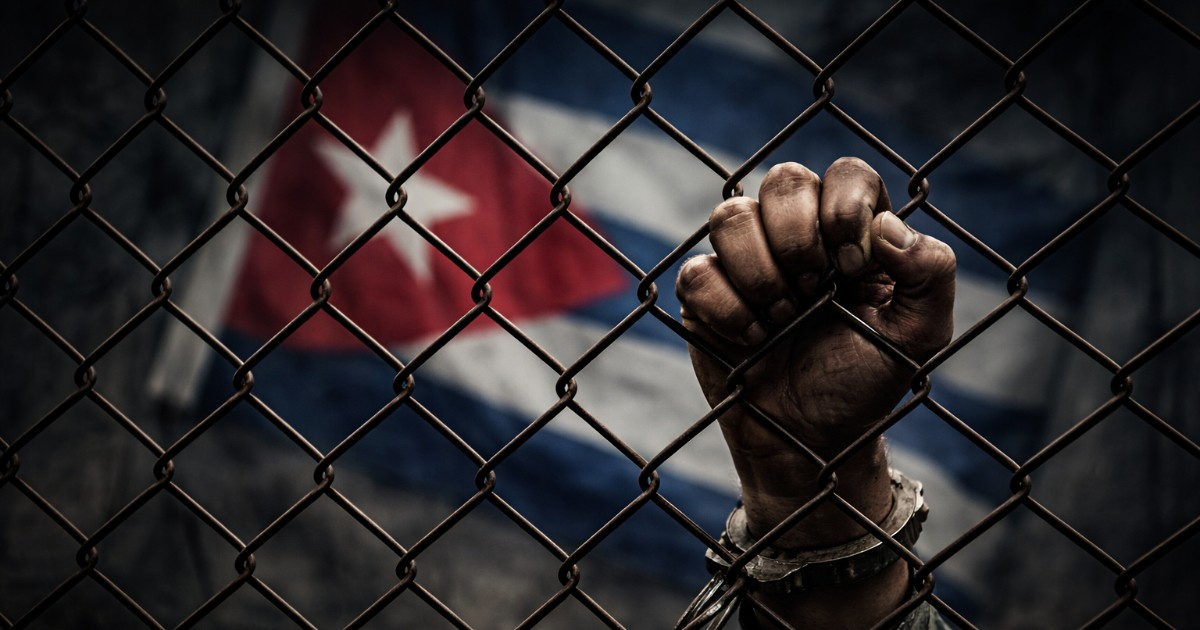
In the Provincial Prison of Holguín, political prisoner Roilán Álvarez Rensoler faced threats of execution from prison guards. They warned him and other inmates detained for political reasons that they would be shot if the United States were to launch a military intervention in Cuba, as reported by his sister in an audio shared this Thursday by Martí Noticias.
“They threaten that if anything happens here on the Island—namely, if the U.S. government intervenes—those who will be executed first are them, simply for thinking differently,” stated Álvarez Rensoler's sister. Her words highlight the severe intimidation political prisoners endure in Cuba.
The activist's sister also described Álvarez Rensoler's health as "critical": he suffers from persistent headaches, a "delicate" kidney, frequent fevers, and is unable to lie on his bed due to bedbug infestations.
A member of the Patriotic Union of Cuba (UNPACU), Álvarez Rensoler was arrested on January 30 along with other activists in Holguín, accused of anti-government graffiti and damaging a billboard featuring Fidel Castro in Birán.
Following his arrest, Álvarez Rensoler initiated a hunger strike at the detention center known as "Todo el mundo canta" in Pedernales, demanding his release. The protest lasted 49 days and resulted in a cardiorespiratory arrest on March 19, necessitating his hospitalization at Lucía Íñiguez Landín Clinical Surgical Hospital in Holguín, where he was revived using a defibrillator.
On that same day, the Inter-American Commission on Human Rights issued precautionary measures via Resolution 19/26, urging the Cuban regime to ensure his life and well-being. Álvarez Rensoler ended his hunger strike on March 19 after speaking with his sister Arianna and consuming fruit juice. He was subsequently transferred to the Provincial Prison of Holguín, known as "El Yayal," where he suffers from significant aftereffects.
Secret Plans and Prisoner Threats
The threats reported are part of the clandestine "Baraguá" plan, approved by the National Defense Council on January 17 as a segment of the "plans and measures for transitioning to a state of war." According to Diario de Cuba, this plan, crafted by the Ministry of the Interior in collaboration with the General Prosecutor's Office, includes the "isolation" of political prisoners during potential armed conflict, using them as hostages for any negotiations aimed at halting hostilities.
The recent execution threats imply that hostage negotiations are not the regime’s only strategy for those imprisoned for their beliefs. For ordinary prisoners, the "Baraguá" plan envisions exceptional releases and military mobilizations, excluding those deemed "national security risks," a category that encompasses dissidents and opposition figures.
The case of Álvarez Rensoler is not isolated in illustrating the increasing repression. Independent journalist and activist Ángel Cuza was detained on April 30 in front of his young daughter in Havana by State Security agents and was recently moved to the El Vivac detention center in Calabazar.
“The girl said they grabbed him by the neck and hit him,” recounted Cuza’s wife in an audio sent to Diario de Cuba. Cuza also accused the agents of planting false evidence—gunpowder-filled bullets—to charge him with illegal possession of firearms and explosives.
According to Prisoners Defenders, Cuba currently holds approximately 650 active political prisoners, making it one of the countries with the highest number of politically motivated incarcerations in the Western Hemisphere.
FAQs on Cuba's Political Climate and Prisoner Conditions
What is the "Baraguá" plan?
The "Baraguá" plan is a secret initiative approved by Cuba's National Defense Council that includes measures such as isolating political prisoners during armed conflicts and possibly using them as hostages in negotiations.
How many political prisoners are currently in Cuba?
As reported by Prisoners Defenders, there are about 650 political prisoners in Cuba, marking it as one of the countries with the most politically motivated detentions in the Western Hemisphere.