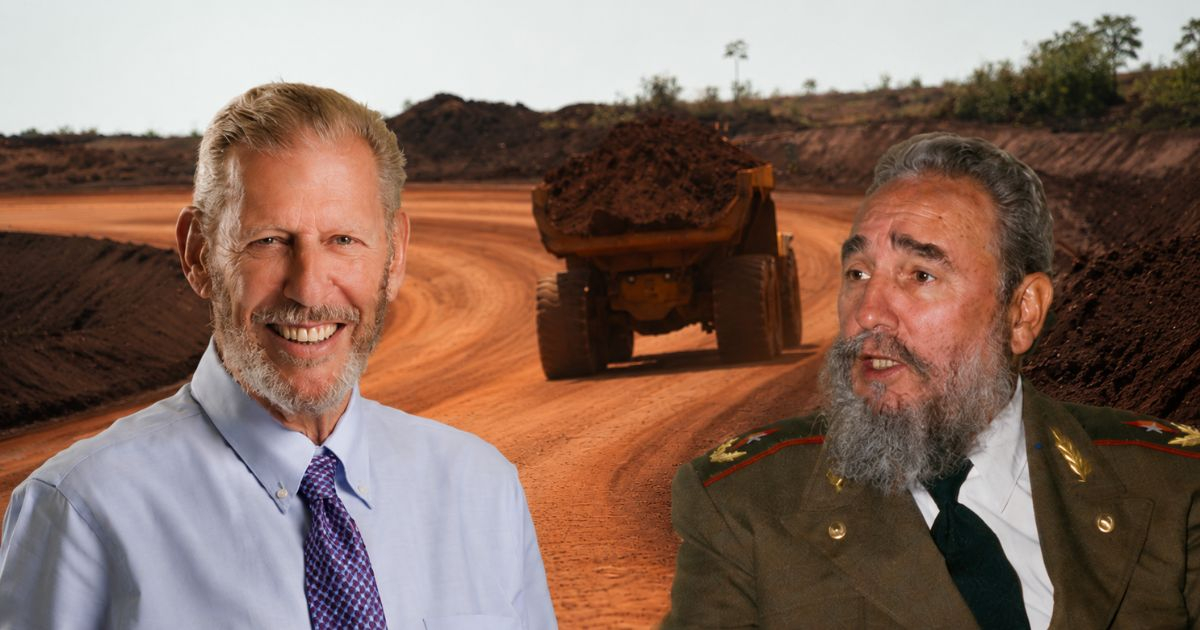
For over 35 years, Canadian company Sherritt International stood as the largest foreign investor in Cuba, serving as a steadfast economic ally to the communist regime. Despite ongoing pressure from Washington, the firm endured visa bans for its executives to the United States for three decades, while building a vast empire on the island centered around nickel, cobalt, oil, and electricity. However, everything came crashing down on May 7, 2026.
This is the full account of how it happened.
The Origins: A Canadian Company on the Brink (1927-1990)
Sherritt's journey did not begin in Cuba. Founded in 1927 as Sherritt Gordon Mines Limited, the company initially focused on mining basic metals in Manitoba, Canada. Over the decades, it operated copper and nickel mines in northern Canada, built a key refinery in Fort Saskatchewan, Alberta, in 1954, and developed a pioneering ammonia leaching process for nickel concentrates.
By the late 1980s, the company faced financial insolvency. Its refining contract with INCO expired in 1990, leaving its Alberta refinery without sufficient ore, as analyzed by The Cuban Economy. In that same year, financier Ian W. Delaney seized control of the company, then known as Sherritt Gordon, with backing from figures such as Eric Sprott. His next moves would permanently alter the company's trajectory.
The Cuban Turn: 1991, Fidel's Favorite Capitalist
In 1991, Delaney traveled to Havana in search of a solution to his Canadian refinery’s supply crisis. With the Soviet collapse plunging Cuba into its "Special Period," Fidel Castro urgently needed foreign investors to revitalize the crumbling economy. This meeting marked the beginning of what Bloomberg would soon call "Fidel's favorite capitalist."
Sherritt began by purchasing Cuban nickel concentrate for its Canadian refinery. The partnership quickly took shape: by December 1994, Sherritt and the Cuban General Nickel Company (GNC) established a 50/50 joint venture, integrating mining in Moa (Holguin), processing in Cuba, and refining in Alberta. Within its first quarter, the partnership generated $14.3 million in profits on sales of $131 million, as reported by Bloomberg.
Interestingly, the Cuban government became a foreign investor in Canada as it co-owned the Alberta refinery, a fact rarely highlighted by the regime's official propaganda, according to The Globe and Mail's interview with Delaney. Delaney even kept a photo of his family with Castro in his office, openly declaring, "Cuba is my favorite." The company rebranded as Sherritt International Corporation that year and expanded into oil and gas operations on the island.
Expansion and the First Clash with Washington (1996-2000)
By the mid-90s, Sherritt emerged as Cuba’s largest direct foreign investor, aggressively diversifying its island presence:
- 1995: Commenced nickel, cobalt, oil, and gas production in Cuba.
- 1998: Established Sherritt Power Corporation, holding a 30% stake in Energas S.A., a tripartite venture with CUPET and the Electric Union to generate electricity from associated gas.
- 1998: Acquired 37.5% of Cubacel, Cuba’s mobile operator, for $38 million.
- Invested in a hotel in Havana, a golf course in Varadero, and an agricultural business.
Washington responded swiftly. On July 11, 1996, the State Department informed Sherritt's executives and major shareholders of their U.S. entry ban, invoking the newly signed Helms-Burton Act (Cuban Liberty and Democratic Solidarity Act), as documented by Canadian Parliament's Hill Notes. This was the first application of the Act’s Title IV against any global company, affecting close family members, spouses, and children.
Canada reacted strongly, branding the move "extremely frustrating" and dismissing Helms-Burton as "offensive to international trade." Sherritt stood its ground. "We operate legally in Canada, Cuba, and every jurisdiction where we work. We do not operate in the United States," corporate spokeswoman Patrice Best told the Los Angeles Times. The visa bans for Sherritt's executives remained unlifted for three decades.
Becoming a Cornerstone of Cuba's Economy (2000-2015)
At the dawn of the new century, Sherritt remained a pivotal foreign player in Cuba across three key sectors:
- Mining (Moa JV): The Moa mine, expropriated in 1960 from the American Moa Bay Mining Company — valued at $88.3 million by the U.S. Foreign Claims Settlement Commission — evolved into a world-class operation under joint management.
- Energy: Through Energas, Sherritt built gas-fired power plants with an installed capacity of 506 MW, contributing 10-15% of Cuba's national electrical capacity.
- Oil: Sherritt operated several fields in northern Cuba (Varadero, Puerto Escondido-Yumurí), producing 15,000 to 20,000 barrels of Cuban crude oil daily by the early 2010s. In 2014, the company renewed its CUPET contract, extending it to 2028.
In 2005, Sherritt and Pebercan Inc. discovered an offshore field along the northern coast, estimated at 100 million barrels. In 2011, Ian Delaney stepped down as CEO—though he remained chairman—handing the reins to CFO David Pathe. Delaney once aspired to make Sherritt the "Canadian Pacific of Cuba."
The Pathe Era, Debt, and Trump 1.0 (2012-2021)
David Pathe led Sherritt through nearly a decade marked by numerous challenges. Under his leadership, the company entered and exited a nickel joint venture in Madagascar (Ambatovy), which burdened Sherritt with $3.5 billion in debt that Pathe gradually reduced. In Cuba, meanwhile, Cuban partners accumulated growing arrears: the regime simply did not pay its debts to Sherritt, which continued recording them as receivables on its balance sheets.
In 2019, when the Trump administration activated Title III of the Helms-Burton Act—suspended since the Clinton era—allowing civil lawsuits in U.S. courts against companies "trafficking" in confiscated property, Sherritt was directly targeted. This move severely impacted its stock, plummeting from over $10 to under $1, according to The Havana Consulting Group.
Restructuring and the "Cobalt Swap" (2021-2024)
In June 2021, Leon Binedell, a seasoned South African miner with 25 years of experience at Xstrata/Glencore and PwC, took over as CEO. By October 2022, he secured an innovative agreement with Cuban partners: the "cobalt swap," whereby Cuba would repay its accumulated debt—362 million Canadian dollars in receivables—not in cash but in finished cobalt over five years (2023-2027). The deal included retroactive penalty clauses of 8% annually for non-compliance.
This was a clever, albeit revealing solution to the dictatorship's economic failure: Cuba lacked foreign currency to settle its debt, and Sherritt, aware of the rising demand for cobalt for electric vehicle batteries, seized the opportunity. By the end of 2024, only 25% of the 368 million had been recovered.
In 2025, the joint venture's production reached 25,240 tons of nickel and 2,728 of cobalt (100% base), according to Sherritt's production data, while Energas' power generation totaled 799 GWh. However, the firm reported a net loss of $65.4 million in 2025, as per Financial Times Markets. In December 2025, Binedell stepped down, with Peter Hancock, a former Glencore executive, stepping in as interim CEO.
The Crisis of 2025: Fuel Shortages and Blackouts
Even before the final blow, Sherritt was feeling the full brunt of the Cuban crisis. In February 2026, the company announced a temporary halt to its Cuban operations due to a lack of diesel fuel needed to power the Moa mine, a direct result of Cuba's deepening energy crisis exacerbated by U.S. sanctions, which slashed energy imports by 80-90%. The company recorded revenues of just $108.4 million in the third quarter of 2025, with its stock trading at a mere 0.13 Canadian dollars.
The Final Blow: Trump's Executive Order and Withdrawal (May 2026)
On May 1, 2026, President Donald Trump signed Executive Order 14404, invoking the International Emergency Economic Powers Act (IEEPA), expanding sanctions against Cuba to entire sectors: energy, defense, metals and mining, financial services, and security. Crucially, it introduced secondary sanctions against foreign financial institutions dealing with blocked Cuban entities. For Sherritt, whose business model relied on international banking access, this was a death sentence.
On May 7, 2026, Sherritt announced the immediate suspension of its direct participation in all Cuban joint ventures. The company clarified that although it had not yet been formally designated, "the mere issuance of the executive order creates conditions that materially alter the corporation's ability to operate ordinarily."
That same day, Secretary of State Marco Rubio directly designated Moa Nickel S.A.—the joint venture between Sherritt and the Cuban GNC—under the new sanctions, accusing the Cuban regime of "profiting from assets originally expropriated from American individuals and companies." The sanctions also targeted GAESA, the Cuban military conglomerate controlling approximately 40% of the island's economy, and its director Ania Lastres.
The immediate consequences were severe:
- Three board members resigned with immediate effect: Brian Imrie (chairman), Richard Moat, and Brett Richards.
- Sherritt began repatriating all its expatriate personnel in Cuba and requested its Cuban partners to do the same for Cuban personnel stationed in Canada.
- Sherritt's stock plummeted 30% on the day of the announcement.
- Cuba lost its largest foreign mining partner and between 10% and 15% of its electricity generation amid a blackout crisis.
The Legacy: 35 Years of a Unique Chapter
Sherritt's departure closes a 35-year chapter during which a Canadian company consistently defied Washington's pressure to become the Cuban regime's most significant foreign economic partner. From the initial handshake between Delaney and Castro in 1991 to the forced exit in May 2026, Sherritt extracted over 3 billion pounds of nickel.
Simultaneously, it accumulated hundreds of millions in unpaid debt from its Cuban partners, endured visa bans for its executives for three decades, and ultimately fell victim to the same tightening of sanctions its executives had long denounced as "offensive and ineffective."
The "capitalist favorite of Castro" departs. And with it, one of the last economic pillars keeping an increasingly isolated regime afloat.
Key Questions on Sherritt's Exit from Cuba
Why did Sherritt International leave Cuba?
Sherritt International left Cuba due to the expansion of U.S. sanctions under Executive Order 14404, which included secondary sanctions against foreign financial institutions, making it impossible for Sherritt to continue its operations.
What was the impact of Sherritt's departure on Cuba?
Sherritt's exit resulted in Cuba losing its largest foreign mining partner and a significant portion of its electricity generation capacity, exacerbating the island's existing economic and energy crises.
What was the 'cobalt swap' agreement?
The 'cobalt swap' was an agreement where Cuba would repay Sherritt's accumulated debt in the form of finished cobalt over five years, instead of cash, due to Cuba's lack of foreign currency.