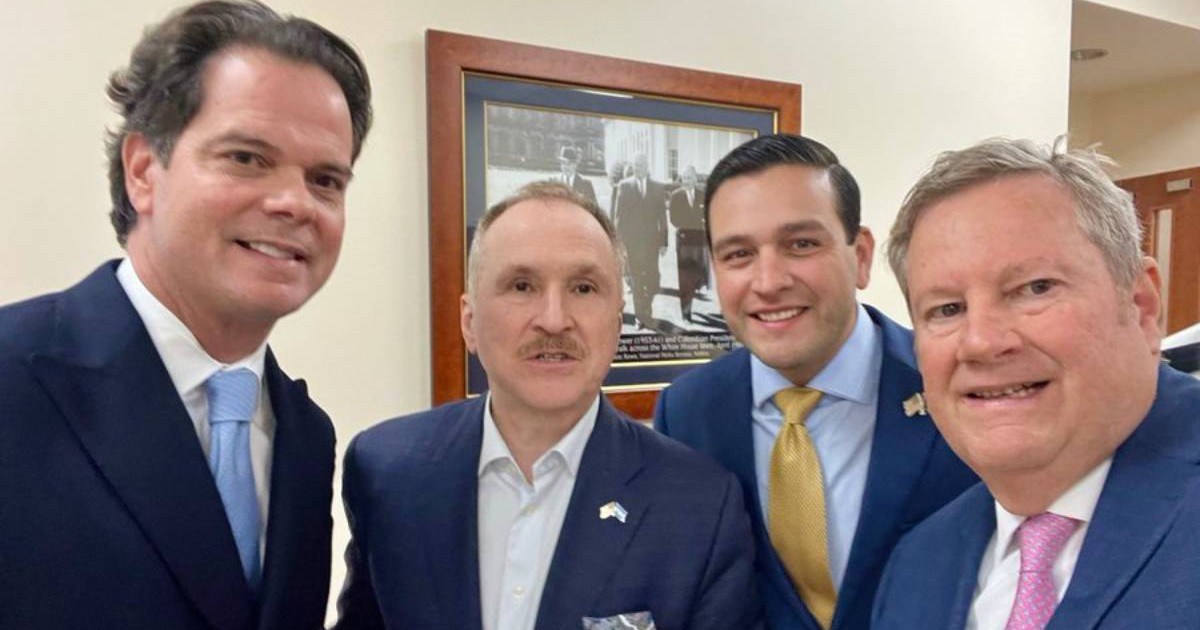
Mike Hammer, the head of the U.S. Embassy mission in Havana, recently shared a photograph that has sparked conversation. In the image, he is seen alongside three Cuban-American ambassadors, posing a provocative question aimed at the Cuban regime: “Why do Cubans find such success outside of Cuba?”
In the photo, Hammer stands with Peter Lamelas, ambassador to Argentina; Kevin Cabrera, ambassador to Panama; and Bernie Navarro, ambassador to Peru. They are all dressed in formal navy blue suits, seemingly at a government venue in Washington.
This rhetorical question subtly critiques Cuba’s political system, suggesting that the single-party socialist regime stifles individual progress, private enterprise, and social mobility. In contrast, when Cubans emigrate and operate in environments that embrace economic and political freedom, they often rise to prominent positions.
Cuban-American Success Stories
The careers of the ambassadors mentioned by Hammer exemplify this contrast. Peter Lamelas, a Cuban-American doctor and entrepreneur, left Cuba at the age of four aboard a Red Cross ship. He proudly identifies as “Cuban by birth, American by the grace of God.”
Kevin Cabrera, born in Florida in 1990, was confirmed by the Senate as ambassador to Panama on April 9, 2025. Before this role, he served as a Miami-Dade County Commissioner and directed Trump’s campaign in Florida in 2020.
Bernie Navarro, the founder of Benworth Capital in Coral Gables, was sworn in as ambassador to Peru on January 16, 2026, by Secretary of State Marco Rubio, also of Cuban descent. Rubio holds the highest position that a person of Cuban origin has achieved in a U.S. administration.
A Strategic Approach to Foreign Policy
The appointment of Cuban-Americans to key positions in foreign policy is part of a calculated strategy by the Trump administration. These officials, familiar with the failures of Castro's model, are positioned to shape hemispheric policy effectively.
Joining the three ambassadors is Benjamín León Jr., a Cuban-American appointed as ambassador to Spain.
With 37 years in the Foreign Service, Hammer frequently uses social media to criticize the Cuban regime and engage with the diaspora. In February, after facing a government-organized protest in Trinidad, he defiantly declared, “We will not be intimidated!”
Later that month, during a meeting with over 100 European Cuban exiles in Madrid, Hammer echoed the messages of Trump and Rubio, encapsulating Washington’s stance with a clear statement: “Change in Cuba is coming.”
Understanding Cuban Success Abroad
What factors contribute to the success of Cubans outside of Cuba?
Cubans often excel abroad due to the opportunities for personal development, private entrepreneurship, and social mobility that are available in countries with economic and political freedoms.
How does the U.S. benefit from appointing Cuban-Americans to key diplomatic positions?
Cuban-Americans bring first-hand understanding of the failures of Castro's regime, allowing them to craft policies that effectively address hemispheric concerns and promote U.S. interests.