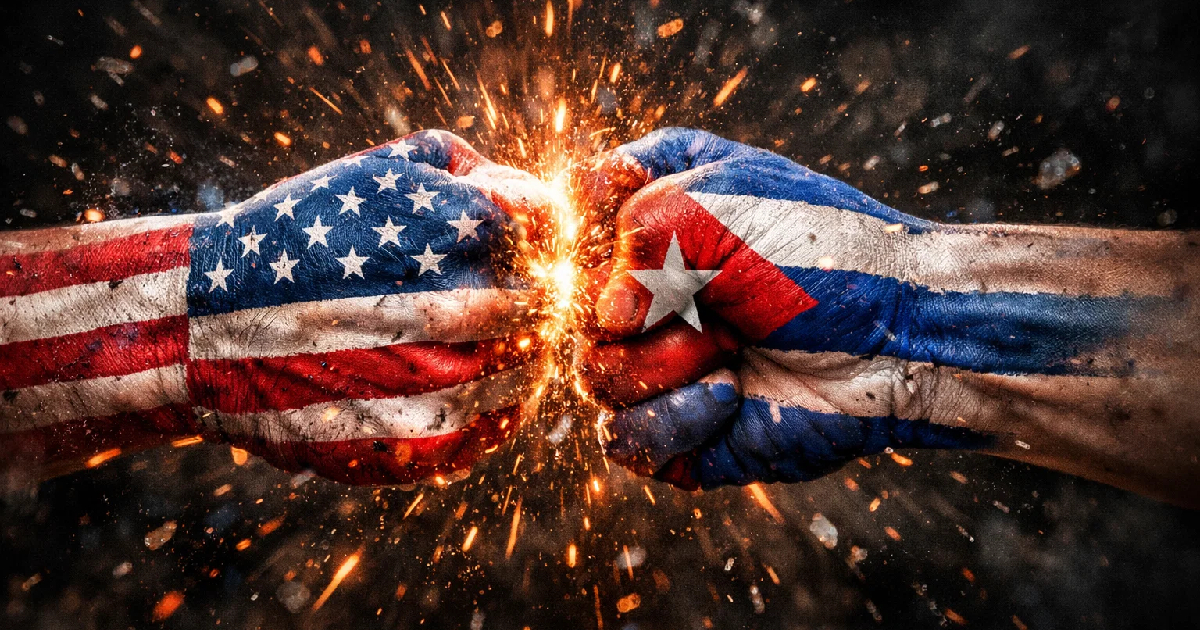
Orlando J. Pérez, a Political Science professor at the University of North Texas in Dallas, has raised concerns that the latest sanctions introduced by Marco Rubio against GAESA clearly indicate that diplomatic talks between Washington and Havana are faltering.
In a post on X, Pérez highlighted that these newly imposed sanctions on the Cuban military conglomerate, along with previous restrictions and recent actions taken by the U.S. Southern Command, signify "obvious signs" of a negotiation breakdown.
The professor, who has provided testimony to the U.S. Congress regarding Cuba and Venezuela, remarked, "The gap between the changes Cubans will make and what the U.S. can provide is where negotiations will collapse. It appears we've hit that limit."
Potential Next Steps for U.S. Policy
Pérez further suggested that "the future actions hinge on how bold the White House is willing to be, considering the tumultuous situation in the Middle East."
On Thursday, Secretary of State Marco Rubio announced sanctions targeting the Grupo de Administración Empresarial S.A. (GAESA), its director Ania Guillermina Lastres Morera, and the mining company Moa Nickel S.A., under an Executive Order signed by Trump on May 1.
Rubio described GAESA as "the core of Cuba's kleptocratic communist system," estimating that the conglomerate controls approximately 60% of the island's economy, with illicit assets amounting to as much as $20 billion.
Impact on Cuba's Economy and Resources
"While the Cuban people endure hunger and disease, much of GAESA's revenue directly supports the communist regime, its military, and secret police to fund their repression," Rubio stated.
Regarding Moa Nickel, the Secretary of State asserted that the company "has exploited Cuba's natural resources to benefit the regime at the expense of the Cuban people" and that "it profits from assets originally expropriated by the Cuban regime from U.S. citizens and corporations."
The same day these sanctions were announced, Sherritt International exited Cuba, halting all operations and initiating the repatriation of expatriate employees, leading to a 30% drop in its stock value.
Backdrop of Diplomatic Tensions
This development comes amidst heightened diplomatic tensions. On Wednesday, Rubio was photographed in front of a map of Cuba at the Southern Command headquarters in Doral, Florida, during the 2026 Chief of Mission Conference, acknowledging that the meeting "had something to do with Cuba."
The backdrop involves secret negotiations — known as "Operation Cubastroika" — which began in February 2026 and included a covert meeting of Rubio's team with Raúl Guillermo Rodríguez Castro, grandson of Raúl Castro, bypassing Díaz-Canel.
On April 20, the U.S. issued a two-week ultimatum to release high-profile political prisoners. When the deadline expired without a satisfactory response, Trump signed the new executive order on May 1.
Since the beginning of 2026, the U.S. has imposed over 240 sanctions against the Cuban regime and intercepted at least seven tankers, reducing the island's energy imports by 80% to 90%.
Rubio cautioned that "additional designations can be expected in the coming days and weeks," and neither he nor Trump has ruled out military action.
Frequently Asked Questions on U.S.-Cuba Relations
What is GAESA and why is it significant?
GAESA is a Cuban military conglomerate that controls a significant portion of the island's economy. It is considered vital to the regime's financial and political infrastructure, making it a primary target for U.S. sanctions aimed at pressuring the Cuban government.
Why are U.S.-Cuba negotiations currently stalled?
Negotiations are stalled due to the perceived gap between what changes the Cuban government is willing to make and what the U.S. can offer in return. Recent sanctions and diplomatic tensions have further complicated these talks.
What are the potential consequences of these new sanctions?
The new sanctions could further strain Cuba's economy, potentially leading to increased hardship for the Cuban population while putting additional pressure on the regime to engage in meaningful negotiations with the U.S.