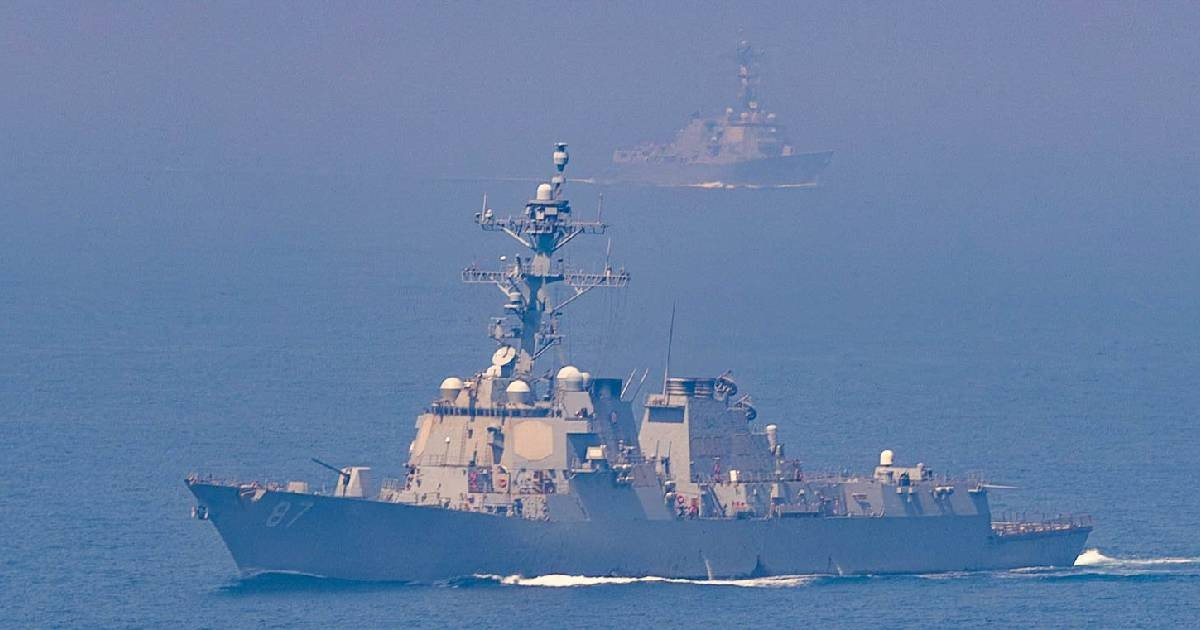
Last Thursday, Iranian forces launched a coordinated assault involving missiles, drones, and fast boats against three U.S. Navy destroyers navigating the Strait of Hormuz toward the Gulf of Oman, as confirmed by the U.S. Central Command in an official statement.
The targeted vessels included the USS Truxtun (DDG 103), the USS Rafael Peralta (DDG 115), and the USS Mason (DDG 87). Fortunately, no American assets were hit.
In response, Central Command initiated self-defense strikes targeting Iranian military sites, including missile and drone launch locations, command and control centers, and intelligence nodes. Additionally, Apache and Seahawk helicopters sank six fast boats belonging to the Iranian Revolutionary Guard, as confirmed by Admiral Brad Cooper.
Iranian state media reported explosions near Bandar Abbas, Qeshm Island, and Bahman Pier, attributing them to U.S. actions. However, the Revolutionary Guard denied losing any vessels and claimed that five individuals were killed in attacks on two small cargo ships.
"U.S. forces intercepted unprovoked Iranian attacks and responded with self-defense measures," stated the Central Command, emphasizing that the institution "does not seek escalation but remains poised and ready to defend U.S. forces."
This incident marks the most direct military confrontation between the two nations in the strait since the crisis began, occurring just two days after Trump temporarily paused Project Liberty following signs of diplomatic progress mediated by Pakistan.
Initiated in early May, the operation mobilized over 15,000 troops, more than 100 aircraft, and numerous destroyers to escort stranded ships in the Persian Gulf. Two destroyers had already traversed the strait under Iranian fire days earlier, in what the Pentagon described as a strictly defensive operation.
Background of Ongoing Tensions
The backdrop to these events is a continuous escalation since Operation Epic Fury, the joint U.S.-Israeli attack on February 28, 2026, that crippled Iranian military capabilities and eliminated Supreme Leader Ali Khamenei. In retaliation, Iran blocked the strait, stranding between 1,550 and 2,000 ships and about 20,000 sailors, causing Brent crude prices to soar from $67 to over $126 per barrel.
A direct precursor was the interception of the Iranian cargo ship M/V Touska on April 19 by the destroyer USS Spruance, when Marines boarded the vessel via helicopter. Iran labeled this incident as "maritime piracy" and a breach of the ceasefire, threatening to consider any U.S. interference in the strait as a casus belli.
On the diplomatic front, Iran proposed a 14-point peace plan suggesting a 15-year pause in uranium enrichment, which Trump dismissed as "unacceptable," demanding the complete dismantlement of the nuclear program and a 20-year moratorium. Thursday's attack now threatens to derail these negotiations, which Trump had described as promising just 48 hours earlier.
Understanding the Strait of Hormuz Conflict
What triggered the recent military confrontation in the Strait of Hormuz?
The confrontation was triggered by a coordinated Iranian assault involving missiles, drones, and fast boats against U.S. Navy destroyers in the strait.
How did the U.S. respond to the Iranian attacks?
The U.S. Central Command responded with self-defense strikes targeting Iranian military sites and deploying helicopters to neutralize Iranian boats.
What are the broader implications of this incident?
This incident represents the most direct military engagement between the U.S. and Iran in the strait, potentially jeopardizing ongoing diplomatic negotiations.