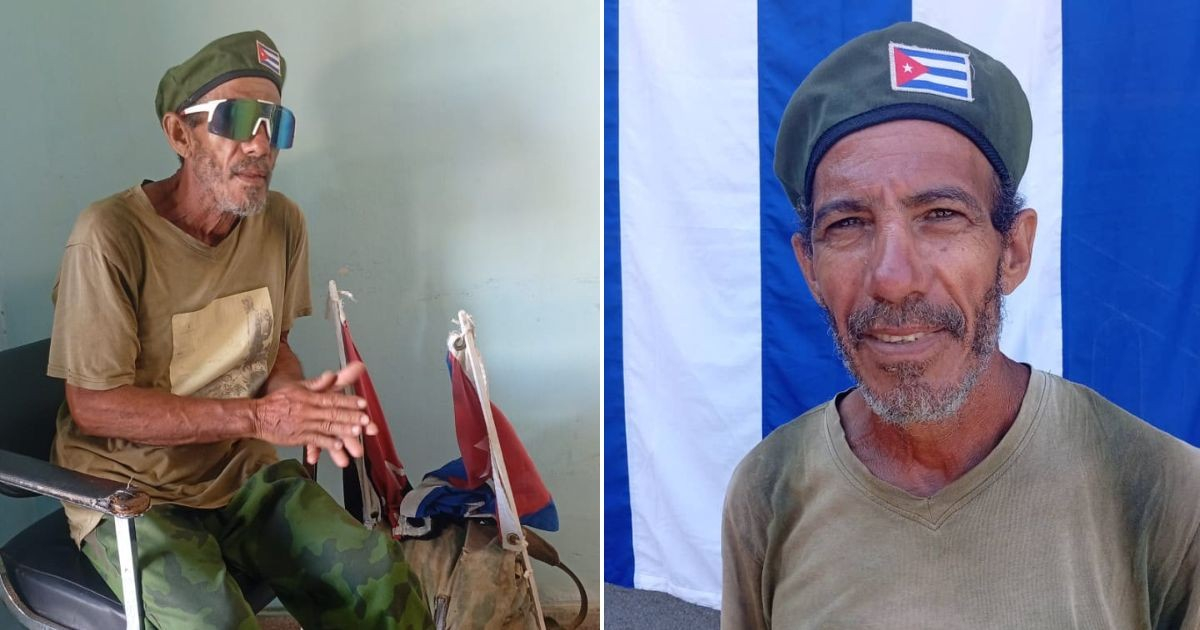
José Luis Pérez Balart, once a member of Fidel Castro's personal security detail and an active combatant in the Ministry of the Interior (MININT), arrived in Matanzas this Thursday. His arrival marks a significant point in a solitary trek spanning hundreds of kilometers across Cuba, from east to west, in tribute to the centenary of the dictator's birth.
The 64-year-old from Santiago set off on April 10 from Granjita Siboney and the Santa Ifigenia Cemetery in Santiago de Cuba. His path follows the so-called "Route from Fidel to Martí and from Martí to Maceo," a journey reminiscent of both the 1959 Victory Caravan and the Oriente to Occidente invasion led by Antonio Maceo and Máximo Gómez during the War of Independence.
The trek is set to conclude in Mantua, Pinar del Río, where that historic campaign ended, with the complete journey reaching its final point at the lighthouse of Cabo de San Antonio, the island's westernmost tip.
Matanzas Welcomes the Traveler
While in Matanzas, Pérez Balart toured the Firefighters’ Barracks Museum, where he was welcomed by Major of the Reserve Mirtha Pardo Junco, president of the Association of Combatants of the Cuban Revolution in the municipality. The reception also included military and MININT combatants and defense reservists.
Rosa Quintana Greck, a museum specialist, led the visit.
A Life Deeply Embedded in State Security
Pérez Balart's background firmly roots him within the Cuban state's security apparatus. Beyond serving as Castro's personal bodyguard, he engaged in international missions in Africa, worked in the security for the Gran Parque Turístico Baconao, and currently teaches at the Academy of Advanced Studies of the MININT.
Although the journey is publicly framed as a personal challenge, its institutional support is undeniable. The endeavor has been covered by state-run outlets TV Santiago and Prensa Latina, positioning it as part of a broader communication strategy during the "Year of the Centenary of the Commander in Chief Fidel Castro Ruz," an official designation for 2026 by the Cuban government.
Propaganda Amidst Crisis
This initiative forms part of an extensive propaganda campaign by the regime, which includes publishing 23 volumes of Castro’s Selected Works, youth caravans, and the I International Colloquium "Fidel: Legacy and Future" scheduled from August 10 to 13 at the Havana Convention Palace.
The regime also boasts over six million signatures in its "My Signature for the Homeland" campaign, criticized by activists as being coerced.
All these activities unfold while the Cuban populace grapples with prolonged blackouts, severe shortages, rampant inflation, and an unprecedented mass exodus—realities the regime overlooks as it mobilizes children and youth in political indoctrination events.
Miguel Díaz-Canel encapsulated the essence of these celebrations during the 10th Plenary of the Central Committee of the Communist Party of Cuba: "It's not about remembering him, it's about bringing him into this moment."
Understanding the Context of Pérez Balart's Journey
What is the significance of Pérez Balart's journey?
Pérez Balart's journey across Cuba symbolizes a tribute to Fidel Castro's legacy, coinciding with the centenary of Castro's birth. It serves as part of a larger state-endorsed propaganda campaign.
How does the Cuban government support this initiative?
The Cuban government supports this initiative through media coverage by state-run outlets, aligning it with national commemorations and broader propagandistic efforts.
What challenges are ordinary Cubans facing currently?
Cubans are currently enduring prolonged power outages, severe shortages of essential goods, escalating inflation, and a significant wave of emigration.