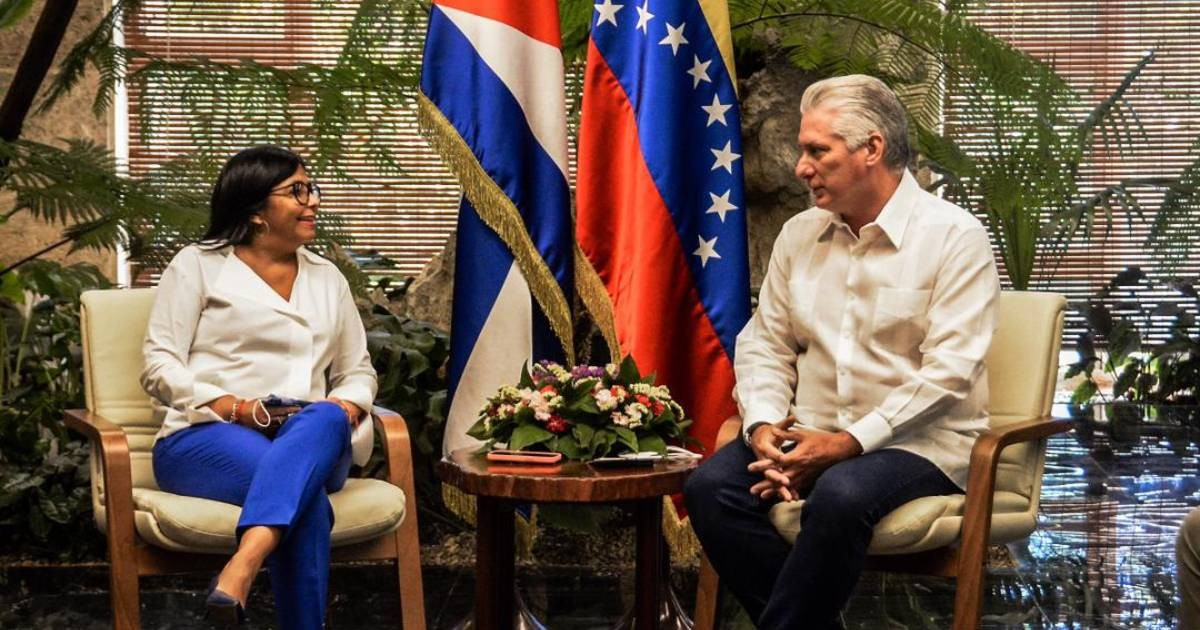
The apprehension of Venezuelan leader Nicolás Maduro by U.S. special forces on January 3, 2026, marked a pivotal shift in the once strong political and economic alliance between Cuba and Venezuela. Experts consulted by EFE reveal a growing distance filled with silence and uncertainty.
Pável Alemán, a researcher and professor at the University of Havana, and a leading Cuban expert on the subject, expresses uncertainty about the current state of bilateral relations, stating, "It's challenging to pinpoint the exact status of the relationship."
According to Alemán, the high-level relationship faces a gradual cooling, exacerbated by changes implemented by Venezuela's interim president, Delcy Rodríguez. He notes that the new Venezuelan government is progressively dismantling social missions established long ago and has adhered to Washington's demand to cease oil exports to Cuba.
Since January 9, 2026, Cuba has been deprived of Venezuelan crude, worsening the island's already dire energy crisis, as Venezuela was its main supplier.
"This has a detrimental impact on Cuban society and, naturally, on bilateral relations," Alemán asserts.
Consequences of the Diplomatic Rift
Efraín Vázquez Vera, a professor at the University of Puerto Rico, is even more forthright, declaring, "The relations between Venezuela and Cuba are completely paralyzed." As an expert in international relations, he believes Venezuela currently holds no sway in Cuban politics. The capture of Maduro acts as a cautionary signal for Havana, signifying "a latent threat of what might transpire in Cuba."
In the past four months, mutual acknowledgments and support have dwindled, with previously frequent interactions now markedly reduced.
The most painful blow to the Cuban regime was the death of 32 military personnel from the FAR and MININT, who were part of Maduro's personal security detail during the operation. "It was the first time in decades that Cubans had fallen in a conflict on foreign soil," Alemán highlights.
Internal Tensions and Historical Connections
Vázquez Vera suggests a trace of resentment among Cubans, as some believe the operation had internal Venezuelan backing, thereby sacrificing those soldiers. Officially, the Cuban regime has refrained from any criticism regarding this matter.
Alemán mentions that Maduro had a personal affinity for Cuba—having studied at a Communist Party-affiliated center in Havana between 1986 and 1987—but notes that the Venezuelan government was always a diverse group, with some members never being supportive of Cuba.
The future of the bilateral political coordination that once aimed for continental influence, through institutions like the Bolivarian Alternative for the Americas (ALBA) and the economic mechanism Petrocaribe, which facilitated the transfer of over $63.8 billion from Venezuela to Cuba between 2000 and 2025, remains uncertain.
Requests for comments from the Cuban Foreign Ministry and the Venezuelan embassy in Havana about the state of bilateral relations went unanswered.
Potential U.S. Actions and Cuban Nationalism
Regarding the possibility of the U.S. replicating a similar operation in Cuba, Alemán is skeptical. He warns that Cuban nationalism, characterized by its anti-imperialist identity, would serve as a deterrent: "It won't be easy for them to find someone willing to negotiate behind the Cuban society's back and launch a government replacement project."
Understanding the Cuba-Venezuela Diplomatic Tensions
Why have Cuba and Venezuela's relations cooled?
The relationship has cooled due to Venezuela's new government dismantling social missions and ceasing oil exports to Cuba, as well as the political shift following Nicolás Maduro's capture by U.S. forces.
What impact has the cessation of Venezuelan oil had on Cuba?
The cessation of oil exports from Venezuela has intensified Cuba's already severe energy crisis, as the country heavily relied on Venezuelan crude as its main energy source.
Could the U.S. execute a similar operation in Cuba as it did in Venezuela?
Experts are skeptical, citing Cuban nationalism and its strong anti-imperialist sentiment as significant barriers to any such U.S. intervention or negotiation for regime change.