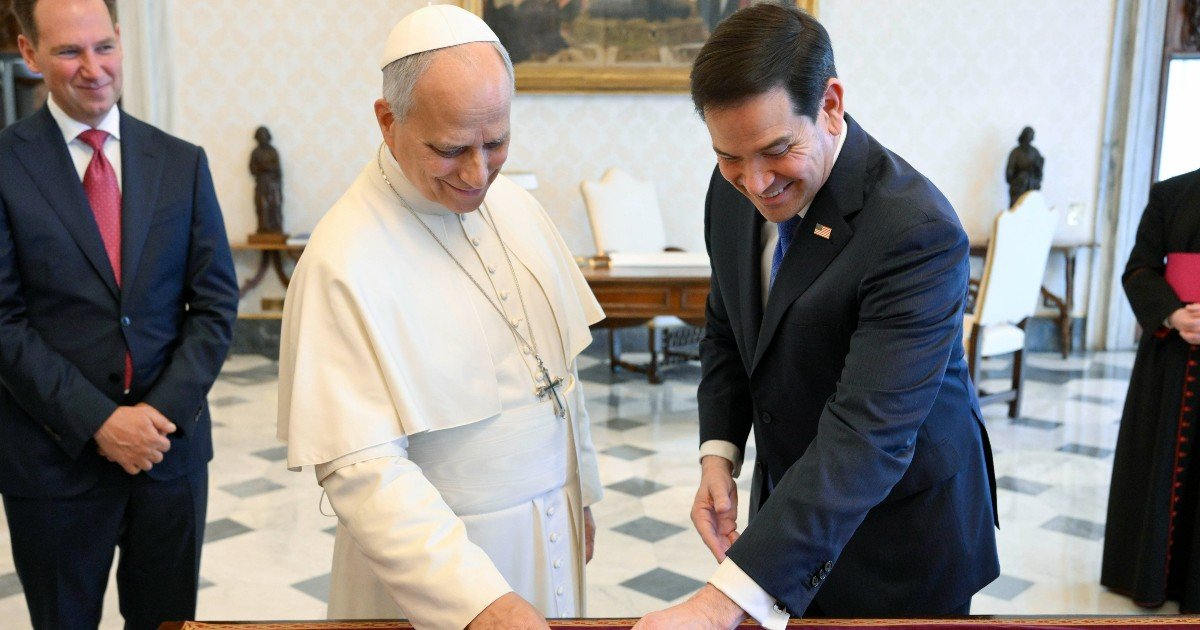
On Thursday, U.S. Secretary of State Marco Rubio held a meeting with Pope Leo XIV in the private library of the Apostolic Palace at the Vatican. The audience took place from 11:15 to 11:30 a.m. local time.
Following the meeting, Rubio shared a brief message on his official X account, emphasizing the shared principles and values between the Trump administration and the Holy See: "I highlighted our mutual commitment to fostering peace and human dignity."
This visit comes amid unprecedented tensions between the Vatican and the White House, forming part of the Trump administration's diplomatic efforts to communicate its key foreign policy objectives to the pontiff.
According to the State Department's official agenda, the discussions covered global religious freedom, Iran's nuclear ambitions, and humanitarian aid to Cuba facilitated through the Catholic Church.
Contentious Topics on the Table
The most sensitive issue during the talks was the conflict with Iran. Operation Epic Fury, initiated on February 28, targeted and destroyed Iranian nuclear sites in Natanz, Isfahan, and Fordow, igniting a public dispute between Trump and the Pope.
Pope Leo XIV condemned the military action as "unjust, unprovoked, immoral, and illegal" under the Catholic just war doctrine, and criticized Trump's rhetoric about destroying "an entire civilization" as "utterly unacceptable."
In response, Trump launched attacks on the Pope via Truth Social, labeling him as "weak on crime" and "terrible at foreign policy," even asserting, "If I weren't in the White House, Leo wouldn't be in the Vatican."
Just 48 hours prior to Rubio's visit, Trump once again criticized the Pope during an interview with Hugh Hewitt on the Salem News Channel.
Focus on Cuba's Humanitarian Aid
Another central topic was Cuba. Rubio announced on Wednesday his plan to expand humanitarian aid to the island, contingent upon Miguel Díaz-Canel's regime allowing direct distribution to the Cuban people without government interference.
The strategy involves using the Catholic Church and Caritas Cuba as exclusive channels, ensuring resources do not end up in the regime's hands.
The United States has already allocated $9 million in aid to Cuba since Hurricane Melissa devastated the eastern part of the island in late 2025. Aid routed through the Church has benefited approximately 24,000 individuals in the hardest-hit provinces.
Building Diplomatic Bridges
This meeting marks the second encounter between Rubio and Pope Leo XIV. Their first meeting occurred on May 19, 2025, a day after the inaugural mass of the pontificate, with Rubio attending alongside Vice President JD Vance.
This time, Rubio arrived at the Vatican with a larger delegation, welcomed by Bosnian Archbishop Peter Rajic, the new Prefect of the Pontifical Household, and entered through the Arch of Bells under strict security protocols.
Cardinal Pietro Parolin, Vatican Secretary of State, had predicted that the meeting would be a "frank conversation" addressing "all that has transpired in recent days."
The Rev. Antonio Spadaro, Vatican Undersecretary of Culture, viewed the visit as a tacit acknowledgment of the global influence of the papal voice, rather than an attempt to align the pontiff with Trump's stance.
Key Issues in U.S.-Vatican Relations
What were the main topics discussed during Rubio's meeting with Pope Leo XIV?
The discussions focused on global religious freedom, Iran's nuclear ambitions, and humanitarian aid to Cuba through the Catholic Church.
Why is humanitarian aid to Cuba a significant issue?
The aid is crucial as it aims to bypass the Cuban government, ensuring direct distribution to the people, thus avoiding regime interference.
How did Pope Leo XIV respond to the U.S. military actions in Iran?
Pope Leo XIV condemned the actions as "unjust, unprovoked, immoral, and illegal" according to the Catholic just war doctrine.