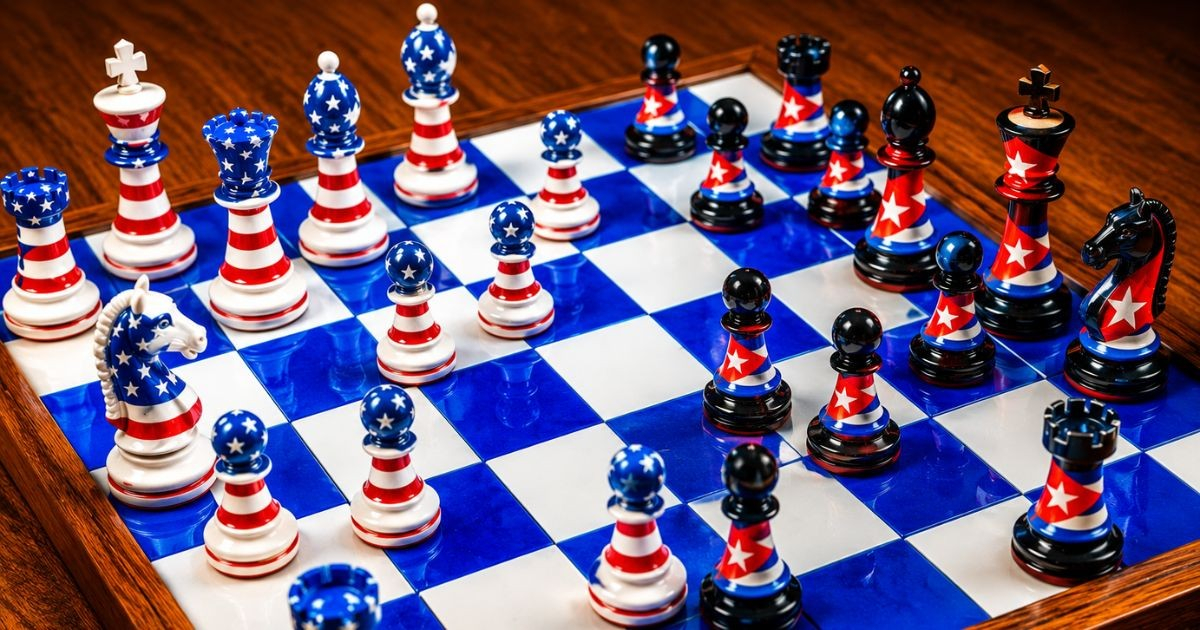
On Thursday, Secretary of State Marco Rubio announced fresh sanctions targeting the Cuban military conglomerate GAESA, its director Ania Guillermina Lastres Morera, and the mining company Moa Nickel S.A.. Alongside these measures, the Trump administration has signaled that military action against Cuba remains a possibility.
This announcement follows closely on the heels of the State Department's recent move to deploy personnel to the U.S. Southern Command in Miami, preparing for potential conflicts with Cuba and bolstering its disaster readiness center in South Florida.
Coincidentally, the announcement coincided with Rubio's trip to the Vatican to meet with Leon XIV, where discussions included humanitarian aid to Cuba.
The sanctions were enacted under an executive order signed by Trump on May 1, targeting those responsible for repression in Cuba and threats to U.S. national security and foreign policy.
Rubio criticized GAESA as "the heart of Cuba's kleptocratic communist system," a conglomerate under the control of the Revolutionary Armed Forces, which dominates between 40% and 70% of Cuba's formal economy with assets exceeding $18 billion.
Regarding Moa Nickel S.A., Rubio stated that it "exploits Cuba's natural resources to benefit the regime at the Cuban people's expense" and "profits from assets originally seized by the Cuban regime from American citizens and companies."
On the same day of the announcement, Canadian mining company Sherritt International—a partner of Moa Nickel since 1994—halted all operations in Cuba and began repatriating its expatriate employees, depriving the regime of its largest mining partner.
Earlier in the week, Rubio was seen photographed alongside General Francis L. Donovan before a map of Cuba at the Southern Command headquarters in Doral, Florida. The following day, Rubio explained the photo during a White House press briefing: "Cuba is within the Southern Command's jurisdiction, being the closest to the U.S. I thought it appropriate to take the picture in front of that map."
During the same briefing, Rubio harshly criticized the Havana regime: "The only thing worse than a communist is an incompetent communist. They don’t know how to fix it."
Last Monday, Trump reportedly stated at a private dinner that the U.S. would "take Cuba almost immediately" after completing military operations in Iran. On Tuesday, he reiterated the threat, suggesting the deployment of the USS Abraham Lincoln aircraft carrier just "a few hundred meters" off the Cuban coast.
The Cuban regime responded with defiant rhetoric. On Sunday, Díaz-Canel warned delegates from 36 countries of "the imminence of a military aggression," invoking the "War of the Whole People" doctrine and asserting that "every Cuban has a rifle" and an assigned defense position.
This escalation comes against a backdrop of cumulative pressure since January 2026: over 240 sanctions against the regime and the interception of at least seven oil tankers, leading to energy import reductions of 80% to 90% and causing blackouts of up to 25 hours daily in more than 55% of Cuba.
Rubio cautioned that the pressure is far from over: "Additional designations can be expected in the coming days and weeks," and the Pentagon has expedited plans for a potential intervention on the island, according to sources cited by U.S. media.
Key Questions on U.S.-Cuba Relations
What are the reasons for the new U.S. sanctions on Cuba?
The sanctions target entities responsible for repression in Cuba and pose threats to U.S. national security and foreign policy. Specifically, they aim at GAESA and Moa Nickel S.A., accusing them of economic exploitation and benefiting the Cuban regime.
How has the Cuban government responded to U.S. threats?
The Cuban government has responded with defiant rhetoric, warning of potential military aggression and invoking a national defense strategy. Díaz-Canel emphasized the readiness of Cuban citizens to defend the island.
What impact have the sanctions had on Cuba's economy?
The sanctions, along with intercepted oil shipments, have severely reduced energy imports, resulting in widespread blackouts and economic strain, affecting more than half of the country's territory.