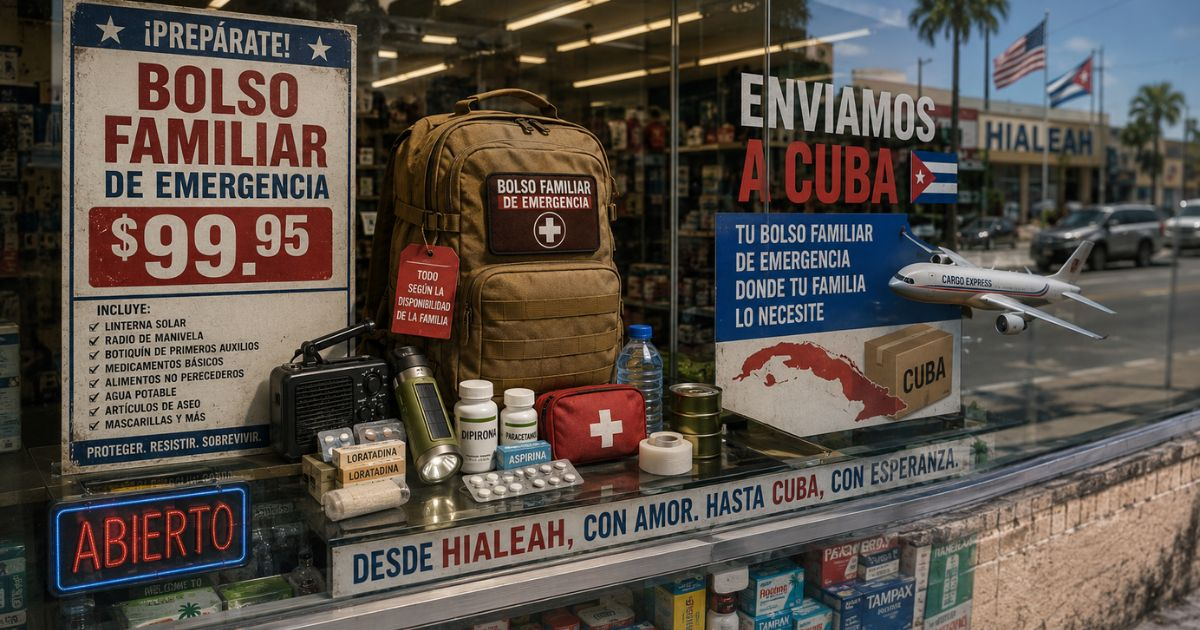
One must give the regime some credit: when there's a pressing issue, they know exactly who to call. And it's not their ministers.
The latest "Family Guide for Protection Against Military Aggression," dated April 2026 and released by the National Civil Defense Staff, is a rather "touching" document.
After three pages reminding us that the Yankee Empire has spent 67 years plotting against Fidel's humanist dream—just in case anyone forgot amid the constant blackouts—the guide finally gets to the practical matter: what every Cuban family should have at home to survive a war.
The Family Bag: A Lofty Proposal
The list is ambitious. Extremely ambitious.
Each household is advised to prepare a bag or backpack containing items like an alternative energy radio, candles, matches, a flashlight, and other solar-powered lighting, canned food for three days, drinking water, personal hygiene items, medications for chronic illnesses, and, for the little ones, age-appropriate toys for distraction.
The First Aid Kit: An Impractical Wish List
The real kicker in the document is the first aid kit. The Civil Defense Staff suggests every home have supplies like dipyrone, paracetamol, aspirin, loratadine, benadryl, meclizine, disposable gloves, antiseptics, gauze, bandages, adhesive tape, scissors, tweezers, a thermometer, burn ointments, masks, and a one-meter square cloth for triangular bandages.
Read it twice, without laughing or crying, if possible.
This is the list of products that, as of May 2026, are unavailable in Cuban state pharmacies. It’s not hyperbole. It’s the operational inventory of what’s missing in provincial hospitals, clinics, and MINSAP outlets. Civil Defense is asking a single mother in Granma to stock her home with a kit even the Carlos Manuel de Céspedes Hospital can't assemble for its operating rooms.
Here’s where the key phrase of the document emerges with its usual elegance. The guide clarifies, in bold letters, that all these items should be included "according to the family's availability." Translated from official jargon to Cuban: solve it yourselves, comrades, because there’s nothing here.
The Real Revolutionary Task: Relying on the Diaspora
And this is where the true hero of the operation comes in, the one not mentioned on any of the nine pages but crucial for every Cuban family bag: the Miami exile. The so-called traitor. The one who left.
The same person who has been labeled as scum and a sellout by official media for sixty years is now—without anyone saying it aloud—the last logistical line of Cuban Civil Defense. Let's be honest: Yudelkis Ortiz's family bag, the PCC's first secretary in Granma, is probably already complete. Her neighbor's is not. Her neighbor's bag will be filled by the cousin who sent three boxes from Hialeah last month, with paracetamol, loratadine, a solar flashlight from Amazon, and a few masks.
The irony is perfect, and the regime knows it: the only infrastructure that works in Cuba is funded by those who left. The remittances that sustain families, the packages filling airports, the couriers crossing Havana with 50-kilo suitcases loaded with dipyrone and diapers. That is the real Cuban Civil Defense. It doesn’t have a General Staff, publish nine-page guides, or use the motto "protect, resist, survive, and win." It simply protects, resists, survives, and occasionally triumphs over the shortages the regime has turned into state policy.
War Combos: A Market Opportunity
As with every Cuban crisis, someone sees an opportunity. Soon, in some Miami shipping agency on Calle Ocho, a sign will go up:
"CIVIL DEFENSE COMBO — $99.95" Includes: solar flashlight, hand-crank radio, 30 dipyrones, 20 paracetamols, loratadine, gauze, adhesive tape, antiseptic, masks, and digital thermometer. Shipping in 7 days to the entire island. Ask about our Enhanced Family Combo with a complete first aid kit.
There will be basic and premium versions. There will be bulk discounts for those wanting to send one to every cousin in Bayamo. An entrepreneur in Hialeah will trademark "Bolso del Pueblo" before May ends. WhatsApp groups will organize collective shipments by neighborhood. A small business in Havana will import the combos wholesale and resell them, as that's also part of the mechanism.
This business of combos might be a joke—or maybe not?
There’s a sadder aspect to all of this, and it’s worth mentioning before concluding. The regime has reached the point of formally asking a destitute population, lacking medicines and enduring 20-hour blackouts, to prepare independently for a war it's stoking as a political weapon. This guide is not an act of civil protection: it is an act of spreading fear. Every Cuban family that reads this document will simultaneously understand two things—that the regime is seriously contemplating the possibility of conflict, and in that conflict, everyone will defend themselves with whatever they have at home.
Whatever they have at home, of course, thanks to the nephew from Tampa.
Understanding the Cuban Emergency Preparation Guide
What is the Family Guide for Protection Against Military Aggression?
The Family Guide for Protection Against Military Aggression is a document released by the National Civil Defense Staff in Cuba, aiming to instruct families on how to prepare for a potential military conflict. It includes a list of essential items families should have to survive during such events.
Why is the guide considered controversial?
The guide is controversial because it lists items that are largely unavailable in Cuba's state-run pharmacies and hospitals. It suggests that families must fend for themselves during a crisis, highlighting deep systemic shortages and indirectly relying on support from the Cuban diaspora.
How are Cuban families expected to obtain these items?
Cuban families are implicitly expected to rely on relatives abroad, particularly in the United States, to send the necessary supplies. This reliance on the diaspora underscores the failure of the domestic infrastructure to provide for its citizens.