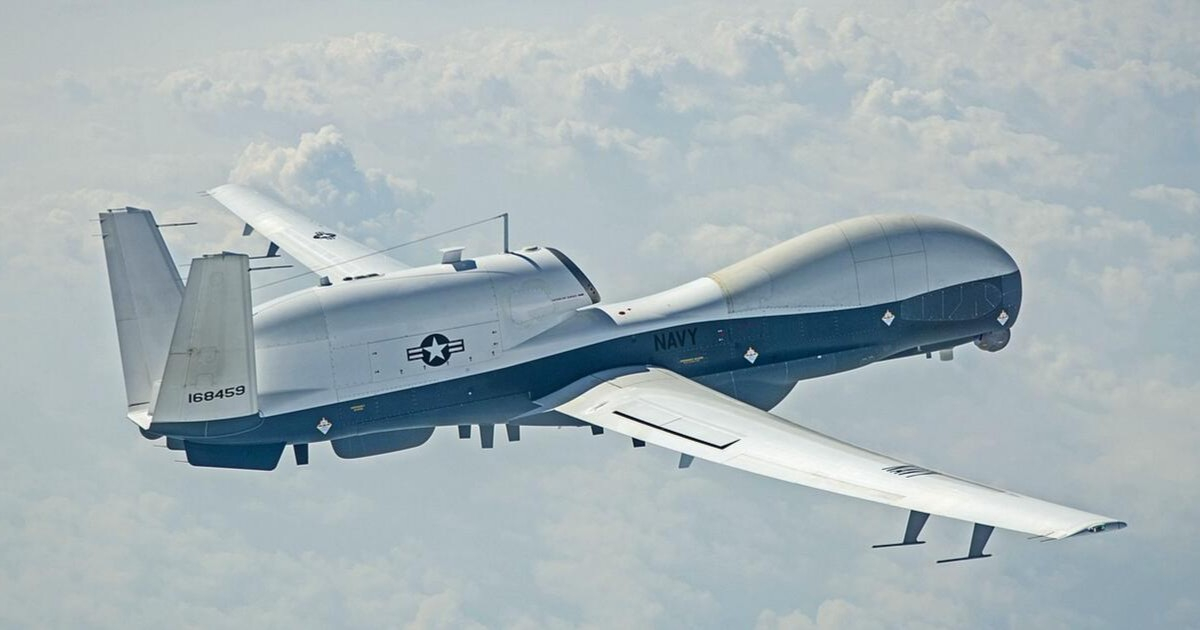
An MQ-4C Triton maritime surveillance drone from the U.S. Navy, identified by the call sign BLKCAT5 and hexadecimal code AE67E8, conducted a monitoring flight around Cuba and key Caribbean areas on Wednesday, as tracked by Flightradar24 data collected during the mission.
The aircraft took off from Naval Air Station Mayport in Jacksonville, Florida, and made an extensive journey over the Gulf of Mexico, the Yucatán Channel, and regions near eastern and southern Cuba. It operated at a barometric altitude of 46,950 feet (approximately 14,300 meters) and at a speed of 580 knots for several hours.
Tracking data reveals prolonged flight paths with orbit patterns typical of Intelligence, Surveillance, and Reconnaissance (ISR) missions.
Increased U.S. Military Presence in the Caribbean
This surveillance activity is not an isolated occurrence. It marks at least the fourth documented instance of Triton aerial monitoring near Cuba in 2026, amidst a growing and sustained U.S. military presence in the region.
The same BLKCAT5 was reported north of the Cuban archipelago on February 6, accompanied by RC-135 spy planes and two P-8A Poseidons during a joint intelligence operation.
Escalating Tensions and Military Exercises
On April 16 and 17, another Triton, with the call sign BLKCAT6, embarked on an extensive nighttime mission over Pinar del Río, Santiago de Cuba, and near Havana. The open-source analysis account FlconEYES noted that the aircraft "patrolled south of Santiago de Cuba and the entire flight was along the southern coast around the Island."
By April 21, the drone BLKCAT5 resumed operations in the Gulf of America at an altitude of 47,000 feet, corroborated by open-source intelligence reports.
All these flights are part of Operation Southern Spear, initiated in September 2025 under the U.S. Southern Command, with an estimated cost of $3 billion for military deployment in the Caribbean, marking the most significant U.S. military presence in the area since the 1962 Cuban Missile Crisis.
The Cutting-Edge MQ-4C Triton
The MQ-4C Triton stands as one of the most advanced drones in the U.S. Navy, crafted by Northrop Grumman. It can operate continuously for over 24 hours, cover up to four million square nautical miles per mission, and soar at altitudes exceeding 50,000 feet. It is equipped with a 360-degree radar, optical and infrared sensors, and signal intelligence capabilities. Each unit costs around $240 million.
Wednesday's flight also coincides with the U.S. activating the FLEX2026 exercise in Key West, integrating drones, artificial intelligence, and maritime units, following the Trump administration's new executive order expanding sanctions against Cuba in energy, defense, mining, and finance sectors.
Political Tensions Reach Boiling Point
The political climate surrounding this latest flight is highly charged. On May 1, Donald Trump privately threatened in West Palm Beach to position the USS Abraham Lincoln aircraft carrier "100 meters from the Cuban shore" to compel the regime's surrender.
On the previous Tuesday, Trump reiterated the threat to deploy the aircraft carrier off Cuba, describing the Island as "completely devastated."
Secretary of State Marco Rubio warned on April 27 that Cuba faces "two fates: neither good," also accusing the regime of harboring Chinese and Russian intelligence on its territory.
In response, the regime has issued rhetoric of armed resistance. On May 2, Díaz-Canel declared to Trump that "no aggressor, no matter how powerful, will find surrender in Cuba." The following day, he warned of imminent military aggression, stating that "every Cuban has a rifle."
Key Questions About U.S.-Cuba Tensions
What is the MQ-4C Triton used for?
The MQ-4C Triton is used for maritime surveillance and intelligence-gathering missions, capable of covering vast areas of the ocean and providing real-time data to assist military operations.
Why is the U.S. increasing its military presence in the Caribbean?
The U.S. is increasing its military presence in the Caribbean as part of Operation Southern Spear, aiming to assert control and monitor activities in the region amidst rising tensions with Cuba.
How has the Cuban regime responded to U.S. threats?
The Cuban regime, led by Díaz-Canel, has responded with strong rhetoric of resistance, rejecting the idea of surrender and warning of military readiness among the Cuban population.