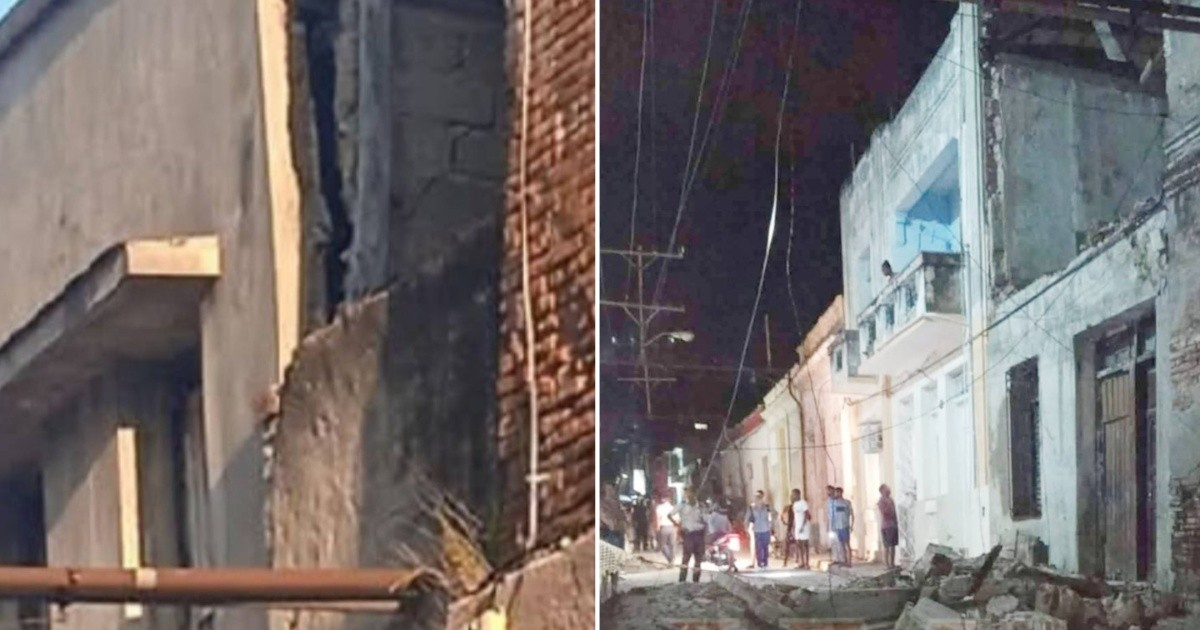
A building facade located on Jagüey Street, between Padre Pico and Escudero in the heart of Santiago de Cuba, completely collapsed onto the street on Wednesday night. Fortunately, no injuries were reported, but the incident raised additional electrical hazards for the local community.
Residents in the area were not caught off guard by this event. Eyewitness accounts collected by independent journalist Yosmany Mayeta Labrada revealed that the wall had shown clear signs of decay for several days. These warnings had been repeatedly reported to authorities, yet no effective action was taken. "We've been warning about that wall for days," an exasperated neighbor exclaimed.
The collapse happened at night when pedestrian traffic was minimal, preventing a larger disaster. During the day, the area behind Teatro Oriente is bustling with activity, frequented by both children and the elderly.
The Immediate Aftermath and Response
The falling structure impacted the electrical lines, increasing danger to those living nearby. Specialized teams from the electric company, rescue technicians from the Fire Department's Command 4 Vista Alegre, and other municipal authorities promptly responded to the scene.
Aris Arias Batalla, in charge of Operations and Relief at MINSAP, had previously documented the deteriorating state of the facade, warning of its potential threat. "It looks like a cardboard facade or a set from ICRT or Hollywood, but sadly it isn't," he wrote prior to the collapse, emphasizing the risk to passersby of all ages.
Ongoing Structural Housing Crisis
Arias Batalla also pointed out another pressing concern just meters away: a balcony and facade at the corner of Santo Tomás and Callejón Carmen by the Imperial Hotel, which has been neglected for over 60 years. "It's a symbol of abandonment, decay, and misunderstanding," he criticized.
This incident is part of a broader structural housing crisis plaguing Santiago de Cuba for decades. The city has struggled to address over 6,000 unresolved housing cases since Hurricane Sandy hit in 2012.
Further complicating matters, Hurricane Melissa, which struck in October 2025, damaged more than 106,500 homes in the province. Five months later, only 17% of those homes have been repaired, amounting to just 18,400 of the total affected units.
In April of this year, another collapse occurred at the Church of Our Lady of the Forsaken in Santiago, endangering a statue of the Virgin situated over 10 meters high. Earlier, in February, residents of El Salao neighborhood reported the hazardous state of stairs in a building that had been flagged multiple times without resolution.
Widespread Negligence and Public Outcry
Nationally, Cuba witnesses approximately 1,000 building collapses each year, with Santiago being among the hardest-hit provinces. Highlighting the pervasive nature of institutional neglect, Mayeta Labrada posed a poignant question reflecting public frustration: "Do we have to wait for someone to die before action is taken?"
Understanding the Housing Dilemma in Santiago de Cuba
Why did the facade collapse in Santiago de Cuba?
The facade collapsed due to prolonged neglect and structural deterioration that had been reported to authorities but not addressed effectively.
What risks did the collapse pose to residents?
While no injuries were reported, the collapse did create additional electrical hazards for residents, as the structure impacted nearby power lines.
How has the government responded to housing issues in Santiago?
The response has been inadequate, with many housing issues remaining unresolved for years, despite repeated reports and warnings from residents.