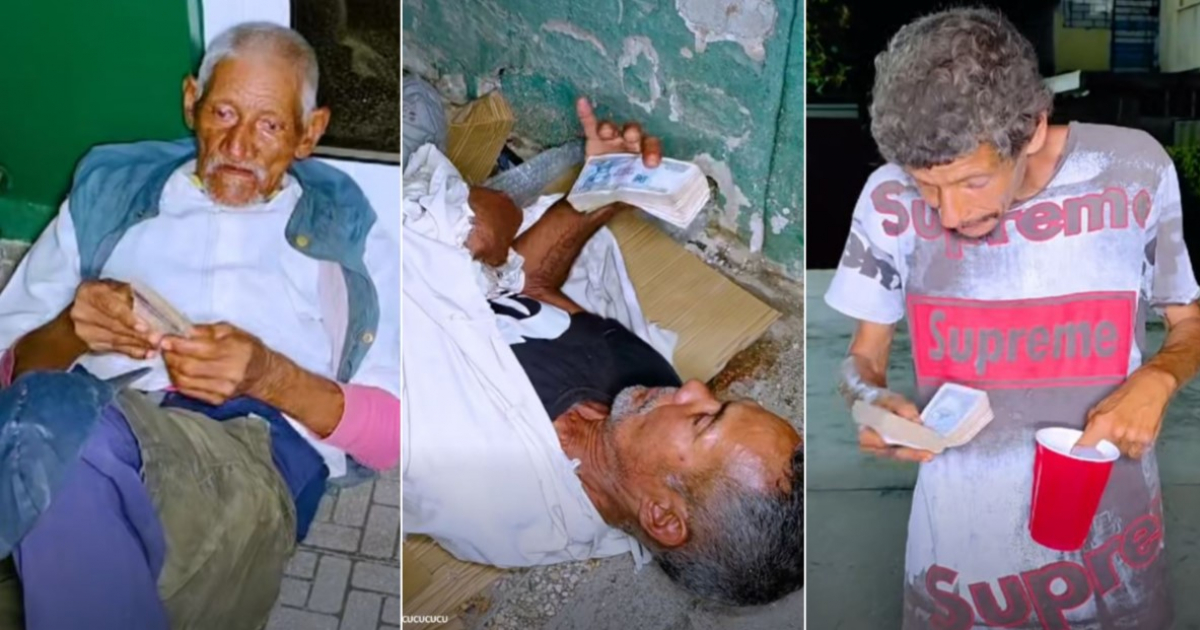
At the national bus terminal in Matanzas, a distressing scene unfolds more frequently, underscoring Cuba's deepening humanitarian crisis: individuals approaching kiosks not to make a purchase, but to ask for food, as reported by the independent portal 14yMedio.
These individuals are not always elderly or traditional beggars. Many are dressed neatly, carrying themselves with dignity that starkly contrasts with the need that compels them to reach out for help, the media outlet describes.
Yania, an employee at one of these kiosks, has worked in the area for years and insists she has never witnessed a situation as dire as this.
"Some of them approach me quietly, with a lot of shame, almost begging for a small cup of coffee or a piece of bread with nothing inside," she recounts.
The vendor explains the daily contradiction she faces: "Here, the cheapest sandwich is 200 pesos, and if I give anything away, I have to pay for it myself. It breaks my heart to see so many people in need. You can see in their faces that it's not an act; they are truly suffering."
The regular customer base has dwindled, replaced by those who don't buy anything but linger nearby, hoping for someone to offer them a morsel of food.
A young man shuffles past, his eyes cast downward, stopping at each window. Another man, leaning against his bicycle, waits for someone to finish eating so he can ask for leftovers.
A barefoot boy holds a skinny dog with a makeshift leash, contemplating if it's worth approaching a kiosk.
Another worker in the area harshly summarizes the scene: "People pass by so thin it makes you want to cry, asking for something to eat or drink to keep from fainting."
Pablo, a 67-year-old man, exemplifies the situation, showing the empty pockets of his pants and speaking without drama, as if narrating an inevitable routine.
"Since I was a child, my parents taught me to be decent, even if I was starving. I beg because, despite working all my life, I have a miserable pension that doesn't let me survive even the first week of the month," he states, according to 14yMedio.
The subsidized dining hall where Pablo used to eat closed in mid-2024, with no indication of reopening.
"The food was scarce and sometimes poorly cooked, but at least I had a guaranteed bite from Monday to Friday," he recalls. "Recently, I've had to scavenge leftovers from the trash, eat whatever vendors discard, or, in the worst case, go to bed with nothing in my stomach."
Pablo's story is not unique. The "Hunger in Cuba 2025" survey, conducted by the Food Monitor Program and Cuido60 with 2,513 valid responses from 16 provinces, revealed that 33.9% of Cuban households reported at least one member went to bed hungry in the past year.
Matanzas ranks among the hardest-hit provinces, with 67.3% of households reporting hunger in 2025. Nationally, 94.9% of households lost some degree of food access, and 79.4% spend 80% or more of their income solely on food.
The Cuban Human Rights Observatory estimates that 89% of the Cuban population lives in extreme poverty, and seven out of ten Cubans have skipped breakfast, lunch, or dinner due to lack of funds, a figure that rises to 79% among those over seventy.
Meanwhile, the regime responds with superficial measures. In August 2025, Díaz-Canel visited a homeless care center in Villa Clara, and Prime Minister Marrero Cruz appeared at another similar center in Ciego de Ávila, as the Council of Ministers defines homelessness as a "multicausal human behavior disorder," sidestepping the acknowledgment of structural poverty as a cause.
Even after the August 2025 increase that raised the minimum pension to 4,000 Cuban pesos—about nine dollars at the informal exchange rate—it remains insufficient to cover a week's worth of basic food, according to independent reports.
Understanding the Hunger Crisis in Matanzas
What is the current situation at the Matanzas bus terminal?
The Matanzas bus terminal is witnessing an increase in individuals asking for food, highlighting the severe humanitarian crisis in Cuba.
Who are the individuals seeking help at the kiosks?
They are often not traditional beggars but people who appear neat and dignified, forced by necessity to ask for food.
How has the Cuban government responded to the hunger crisis?
The Cuban government has taken superficial measures, with leaders visiting care centers, but avoiding acknowledgment of structural poverty as a root cause.
What are the statistics on hunger in Cuba?
A survey indicated that 33.9% of Cuban households experienced hunger, with Matanzas being one of the most affected provinces.