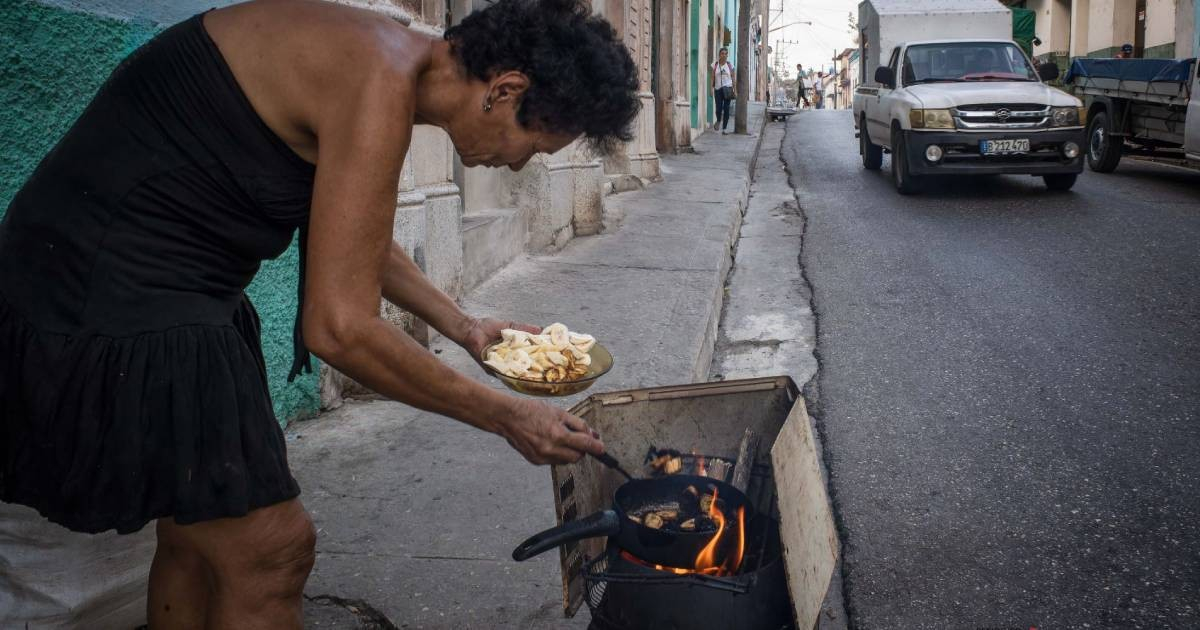
On Wednesday, the Food Monitor Program (FMP) along with Cuido60 unveiled the survey titled "Hunger in Cuba 2025," highlighting the grim reality that hunger is now commonplace. A startling 33.9% of surveyed households revealed that at least one family member went to bed without eating over the past year.
The survey, which collected 2,513 valid responses from May to July 2025 across all 16 Cuban provinces, indicates a worsening situation compared to the previous year.
In 2024, one in four Cubans went to bed without dinner; by 2025, this figure surged to 33.9%, marking an increase of 9.3 percentage points.
Alarming Decline in Food Access
Access to food has almost completely collapsed: a staggering 94.9% of participants reported losing some degree of access to purchasing food in the last year, with 47.1% indicating that this loss was significant or total.
The economic strain on Cuban families is enormous. An astonishing 79.4% of households are spending 80% or more of their monthly income on food, and 40.6% are forced to allocate every penny they earn just to eat.
Failure of the Distribution System
Only a meager 1.2% of respondents find a variety of products in agromarkets and state-run plazas, underscoring the regime's distribution system failure.
Basic Services in Collapse
The food crisis is exacerbated by the breakdown of basic services. Merely 18.3% of those surveyed have access to potable water daily, a sharp decline from 34.1% in 2024.
Additionally, 80.4% reported that power outages disrupted meal preparation, and 48.3% lost food due to lack of refrigeration, a direct consequence of the widespread power cuts affecting the entire island.
Geographical Disparities in Hunger
The territorial map of this crisis reveals that Granma and Guantánamo experience the highest levels of hunger, with 78.9% and 78.7% respectively, more than double the national average.
Matanzas is also identified as a critical area, with 67.3% of households experiencing hunger.
Elderly Population Hardest Hit
Older adults are the most severely affected group. A shocking 55.6% of individuals over 60 reported a total loss of access to food, while 53% spend all their income on sustenance, and 80.2% struggle to obtain essential medications.
The plight of Cuba's elderly amid this food crisis starkly contrasts with the regime's lack of action.
This decline is part of a disturbing trend: deaths due to malnutrition rose by 74% between 2022 and 2023, increasing from 43 to 75 cases, according to Cuba's own National Office of Statistics and Information (ONEI). Furthermore, 89% of the Cuban populace lives in extreme poverty, as per the Cuban Observatory of Human Rights.
According to FMP and Cuido60, the crisis extends beyond food scarcity: "the polycrisis is directly linked to diminished purchasing power, a decline in basic services, and the overwhelming burden on family networks."
The infographic accompanying the survey issues a stark warning: "Food insecurity is a human rights violation. The response must be urgent and comprehensive."
Understanding the Hunger Crisis in Cuba
What percentage of Cuban households report going to bed hungry?
According to the survey, 33.9% of Cuban households reported that at least one member went to bed without eating in the past year.
How has access to food changed in recent years in Cuba?
Access to food has drastically declined, with 94.9% of respondents experiencing some degree of loss in their ability to buy food over the last year, and 47.1% stating that the loss was significant or total.
Which Cuban provinces are most affected by hunger?
Granma and Guantánamo are the most affected provinces, with hunger impacting 78.9% and 78.7% of households, respectively.