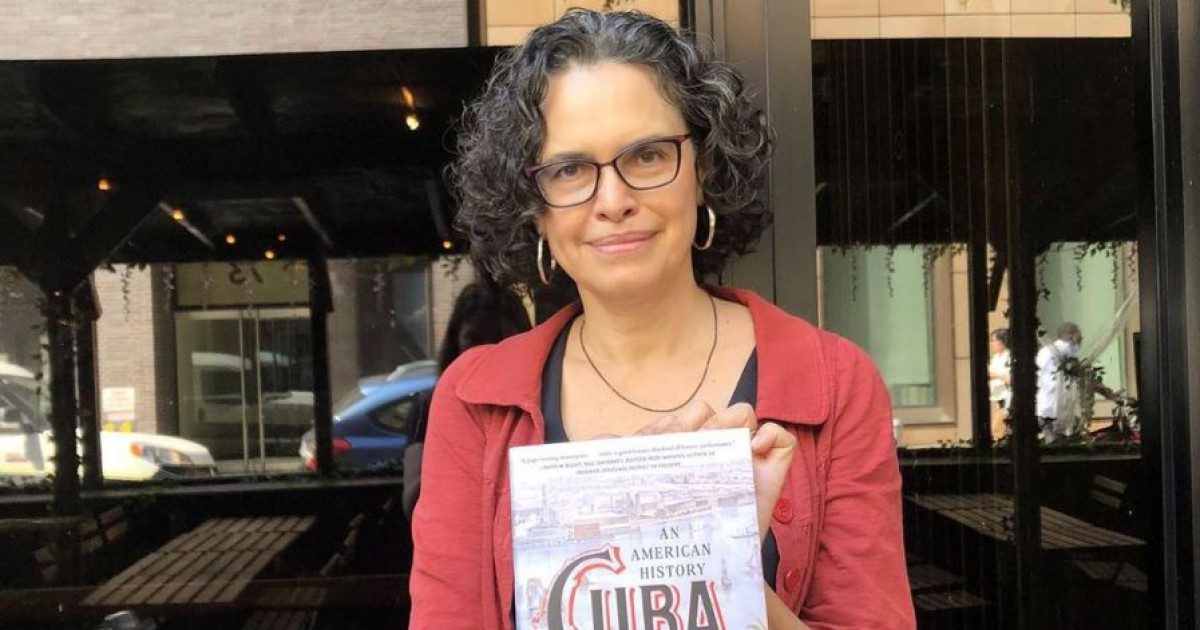
On Wednesday, Cuban-American historian Ada Ferrer issued an open letter to Cuban leader Miguel Díaz-Canel through the opinion section of the New York Times. This bold move comes at a time of heightened tensions between Washington and Havana.
Ferrer, a History and Latin American Studies professor at New York University and recipient of the 2022 Pulitzer Prize for her book "Cuba: An American History," was born in Havana in 1962. She has devoted over three decades to researching the intertwined histories of Cuba and the United States.
A Personal Journey of Separation and Advocacy
Ferrer begins her letter by recounting her personal story, which is marked by family separation following her emigration as a child in 1963. Her mother left behind her brother, hoping for a swift reunion, which didn’t happen for many years. She highlights that such familial separations are a common experience among Cubans.
The narrative then shifts to her father, who, in his later years, took to writing poetry, autobiographies, and political letters, many addressed to Fidel Castro, as a means to challenge authority.
Challenging the Status Quo
The core message of those letters was clear: "The time has come, Dr. Castro." Her father reiterated this sentiment, urging for an end to deception, a handing over of Cuba's future to the youth, and a departure from communism. In essence, it was a call for change.
Inspired by her father's example, Ada now addresses Díaz-Canel, questioning his commitment to political "continuity," which she argues does not reflect the aspirations of most Cubans.
She meticulously describes the current crisis in Cuba: widespread poverty, inadequate wages and pensions against soaring food prices, long power outages, and severe shortcomings in healthcare. She asserts that for many ordinary Cubans, continuity is tantamount to a death sentence.
Cuba's Internal Struggles and External Challenges
While Ferrer acknowledges that the U.S. embargo exacerbates difficulties, she emphasizes that it is not solely to blame for the crisis. She criticizes internal government decisions, such as halting economic reforms.
"The embargo did not dictate how the disastrous currency reorganization was handled," she stated. "Nor does it satisfactorily explain why your government has drastically increased investment in tourism, despite most hotel rooms sitting empty while fertile land remains fallow."
Ferrer also condemns the repression and surveillance of critical citizens, including historian Alina López Hernández and artists Luis Manuel Otero Alcántara and Maykel Osorbo, who are imprisoned as punishment for their art, voices, and example.
Demanding Accountability and Action
The author further queries the government's lack of a concrete plan to address the crisis. She directly asks: "What is your plan to deal with the fact that the embargo exists? What is your plan to negotiate its easing?" Emphasizing that blaming the embargo does not replace the need for effective governance.
Ada clarifies that her critique does not equate to support for U.S. policy towards Cuba or potential interventions. Instead, she criticizes the government for wielding national sovereignty as a political tool while basic needs remain unmet.
"You and your government have devalued that word to the point where many young people only hear it as another piece of rhetoric. You have wielded that word as a weapon to avoid dealing with more difficult issues. You have acted as if it were your personal achievement when it never was. You (the governments of the last 67 years) replaced dependence on the United States with dependence on the Soviet Union, and later, Venezuela," she reminded.
"Without an external sponsor, Cuba collapses, and sovereignty begins to seem like an abstraction. You cannot eat sovereignty. To survive, people need food. To live, they must do more," she emphasized.
Finally, the writer directly questions Díaz-Canel on what he will do to deliver justice to ordinary Cubans, urging him to seek real solutions.
"If all you offer is ruinous continuity without a future, then, as my father would have said, the time has come. At the very least, the time for a genuine national dialogue," she concluded.
This is not the first time Ferrer has directly addressed the Cuban president. In July 2021, following the historic 11J protests, she publicly demanded: "Stop the repression. Release political prisoners. Stop beating your people."
The letter arrives as Cuba endures its worst economic crisis in decades: power outages lasting up to 20 hours a day, inflation soaring to 77%, and a GDP contraction projected by ECLAC at 6.5% for 2026, which would make the island the poorest economy in Latin America that year.
Adding to this grim reality is political repression: as of April 2026, Justicia 11J recorded 775 political prisoners, with 338 sentenced for participating in the 11J protests.
Insights into Ada Ferrer's Letter to Díaz-Canel
Why did Ada Ferrer write an open letter to Díaz-Canel?
Ferrer wrote the letter to challenge Díaz-Canel's policy of "continuity" and to highlight the severe economic and social crises facing Cuba, urging for genuine change.
What are the main issues addressed in Ferrer's letter?
Ferrer addresses issues such as widespread poverty, inadequate wages, power outages, healthcare deficiencies, and political repression, while questioning the government's inaction on these fronts.
How does Ferrer view the U.S. embargo on Cuba?
Ferrer acknowledges that while the U.S. embargo exacerbates Cuba's difficulties, it is not the sole cause of the crisis, and she emphasizes the need for effective governance within Cuba.