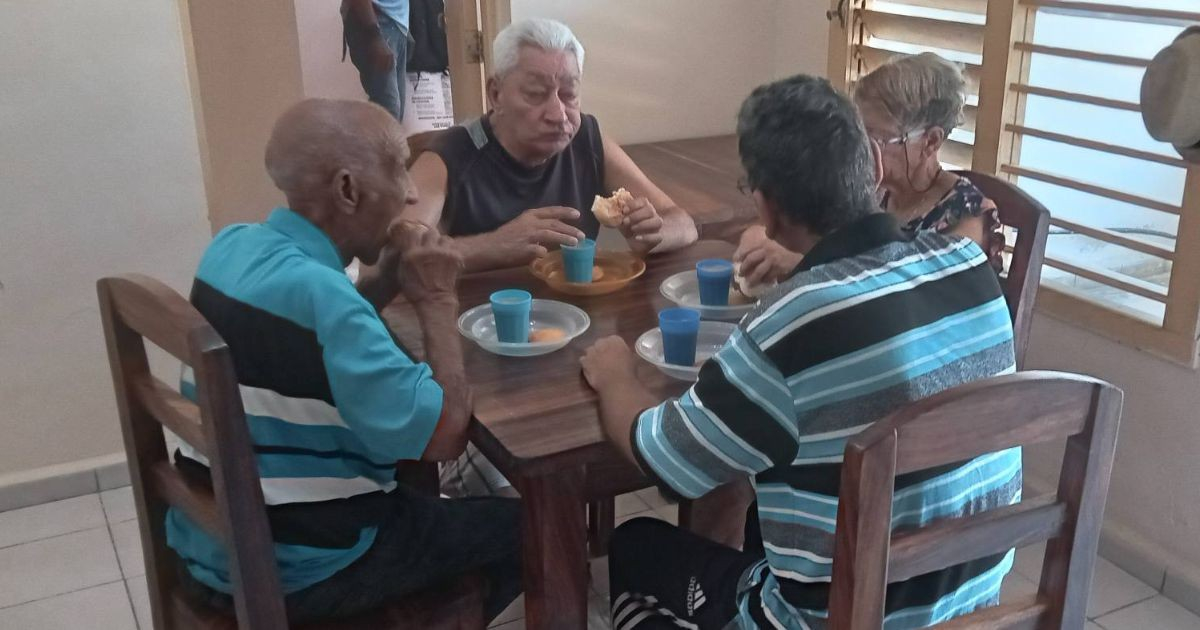
A religious community in the Santa María neighborhood of Santiago de Cuba has opened BETANIA, a permanent care facility for the elderly. This initiative was made possible thanks to the generous support of donors and believers from the United States, as reported by Yordanis Acosta Porta.
"We give thanks to God for this gift, to Fr. Halbert Pons who championed this dream, to Reverend Servando, and the wonderful friends from the U.S. who support this good work," Acosta Porta wrote when announcing the facility's opening.
Photos from the inauguration depict elderly individuals enjoying meals in a dining area furnished with wooden tables and chairs. The space also boasts a fully equipped kitchen and a community room.
In addition, the same community distributed food packages to 50 families at the Santa María Church in Santiago de Cuba, supported by "the kindhearted brothers of the Episcopal Church in the U.S. for their love and solidarity with Cuba," according to the publication.
The launch of BETANIA comes at a critical time when elderly Cubans are facing an unprecedented crisis: a staggering 79% of those over 70 are unable to have three main meals a day, and 99% of retirees report that their pensions—raised to just 4,000 pesos in September 2025, equivalent to less than $10—are insufficient to meet basic needs.
Cuba holds the distinction of being the most aged nation in Latin America, with over 25% of its population over 60 years old. The mass emigration, with around 300,000 people leaving in 2024 alone, has left tens of thousands of seniors without family support.
The Role of Religious Institutions in Social Assistance
In the absence of adequate state support, churches have taken on a vital role in providing social assistance. The Methodist San Juan Church feeds over 400 people every Sunday in Santiago de Cuba, including the elderly and vulnerable families.
In April of this year, five containers of humanitarian aid from the U.S. arrived at the port of Santiago de Cuba, channeled by Caritas, containing more than 3,500 food, hygiene, and household supply packages.
As of 2021, the Cuban state system had only 300 senior centers and 157 nursing homes, numbers that fall far short of addressing the extensive aging population.
In February, the government formally acknowledged this shortfall by authorizing non-state actors to open senior residences, although the fees are unaffordable for most people.
The cost of living in a private senior residence in Cuba can exceed $1,000 per month in some places, a prohibitive amount for those relying on pensions of less than $10 a month. This makes initiatives like BETANIA—sustained by international solidarity—one of the few viable options for the island's most vulnerable elderly.
Challenges and Solutions for Elderly Care in Cuba
What is the significance of the BETANIA care facility?
The BETANIA care facility provides a permanent home for the elderly in Santiago de Cuba, offering necessary support and community for seniors who face a lack of sufficient care options.
How is the U.S. contributing to elderly care in Cuba?
Donors and religious communities from the U.S. are providing financial support and humanitarian aid, helping to establish facilities like BETANIA and supplying essential goods to families in need.
Why are religious institutions crucial for social assistance in Cuba?
With the Cuban government's inadequate support for the elderly, religious institutions have stepped in to fill this gap by offering food, care, and community services to vulnerable populations.