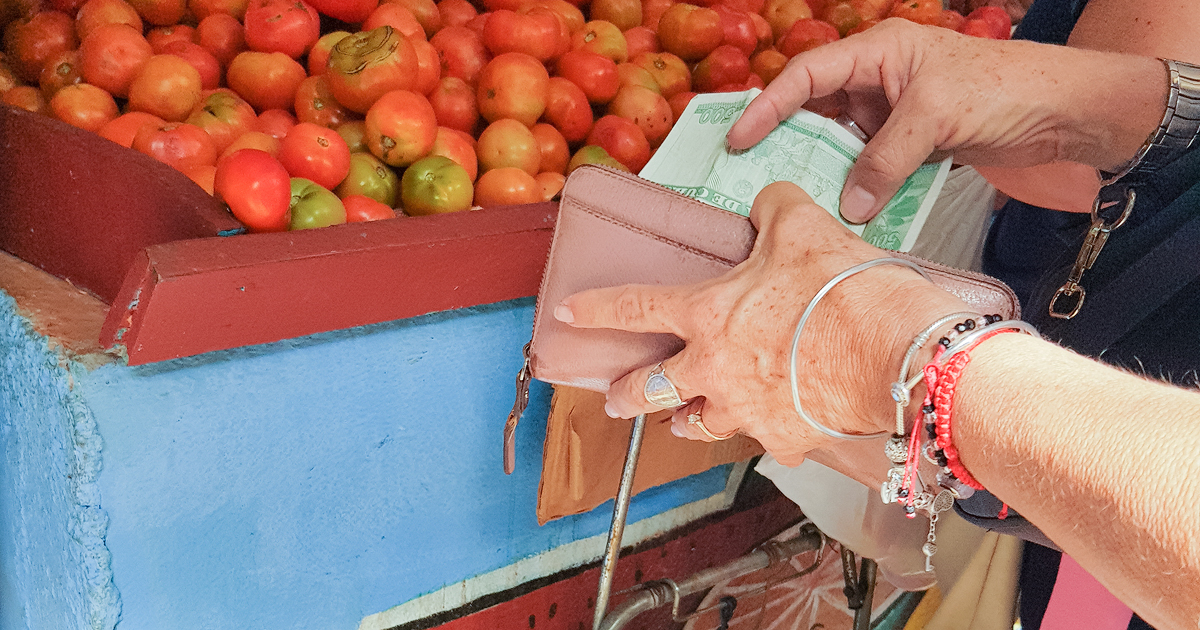
The National Office of Statistics and Information (ONEI) in Cuba disclosed that as of 2025, only three provinces—Havana, Artemisa, and Villa Clara—surpassed the 7,000 Cuban pesos mark in average monthly salary, according to the report "Average Salary in Figures. Cuba, 2025," released in April 2026.
The national average monthly salary stood at 6,930 pesos, marking an increase of 1,091 pesos from the 5,839 pesos recorded in 2024.
Leading the provincial ranking, Havana boasts an average salary of 7,911 pesos, followed by Artemisa at 7,318 pesos, and Villa Clara at 7,028 pesos. These are the only provinces exceeding 7,000 pesos across the nation.
Regional Disparities in Cuban Salaries
At the other end of the spectrum, the Special Municipality Isla de la Juventud reported the lowest salary in the country with 5,582 pesos, closely followed by Guantánamo (5,783), Santiago de Cuba (5,872), and Granma (5,926), all falling short of the 6,000 pesos monthly benchmark.
The gap between the highest and lowest-paying provinces reaches 2,329 pesos, reflecting a striking 41.7% regional inequality that epitomizes the disparities within the Cuban economy.
Economic Challenges and Inflation
The eastern provinces of Cuba—historically the most impoverished—consistently rank below the national average, whereas Havana accounts for 32.5% of the country's salary fund, with over 678,000 state sector employees.
Despite a nominal increase, the real gain in purchasing power was minimal: Cuba's official inflation rate in 2025 was 14.1%, translating to a mere 4% real growth.
On the informal exchange market, the average salary of 6,930 pesos is roughly equivalent to 15 dollars per month. Economist Elías Amor bluntly questioned the adequacy: "What can one buy with 15 dollars? If salary is the price of labor, Cuba's fundamental problem is that this wage is worthless."
Cost of Living vs. Income
ONEI's statistics stand in stark contrast to independent economists' estimates of the real cost of living on the island.
Economist Javier Pérez Capdevila estimated that surviving in Cuba requires at least 50,000 pesos per person monthly, while the Food Monitor Program calculated that two adults in Havana need 41,735 pesos just for basic nutrition.
This means that even Havana's highest salary of 7,911 pesos falls short of one-fifth of the necessary amount for survival, according to these independent evaluations.
Wage Disparities and Economic Realities
Salaries in Cuba compared to prohibitive prices are a constant issue the regime has failed to address despite sustained nominal increases since the 2021 monetary reform.
The best-paid sectors nationwide in 2025 included construction (15,320 pesos), electricity, gas, and water supply (13,073 pesos), and business services (9,976 pesos), primarily concentrated in the western region of the country.
The grim outlook of salary injustices in Cuba worsens when considering that the current minimum wage is a mere 2,100 pesos, equivalent to about five dollars at the official exchange rate, and that half of the Cuban working-age population neither works nor seeks employment, according to the regime's own data.
As per the Food Monitor Program, a Cuban needs at least three average salaries to cover basic needs, making the nominal increase in 2025 a statistical note with no tangible impact on the daily lives of the population.
Understanding Cuba's Salary Structure
What are the provinces with the highest average salaries in Cuba?
The provinces with the highest average salaries in Cuba as of 2025 are Havana, Artemisa, and Villa Clara, each exceeding 7,000 pesos per month.
How does inflation impact the real value of salaries in Cuba?
In 2025, the official inflation rate in Cuba was 14.1%, which means the real growth in purchasing power from salary increases was only around 4%.
What is the minimum wage in Cuba?
The minimum wage in Cuba is 2,100 pesos, equivalent to approximately five dollars at the official exchange rate.