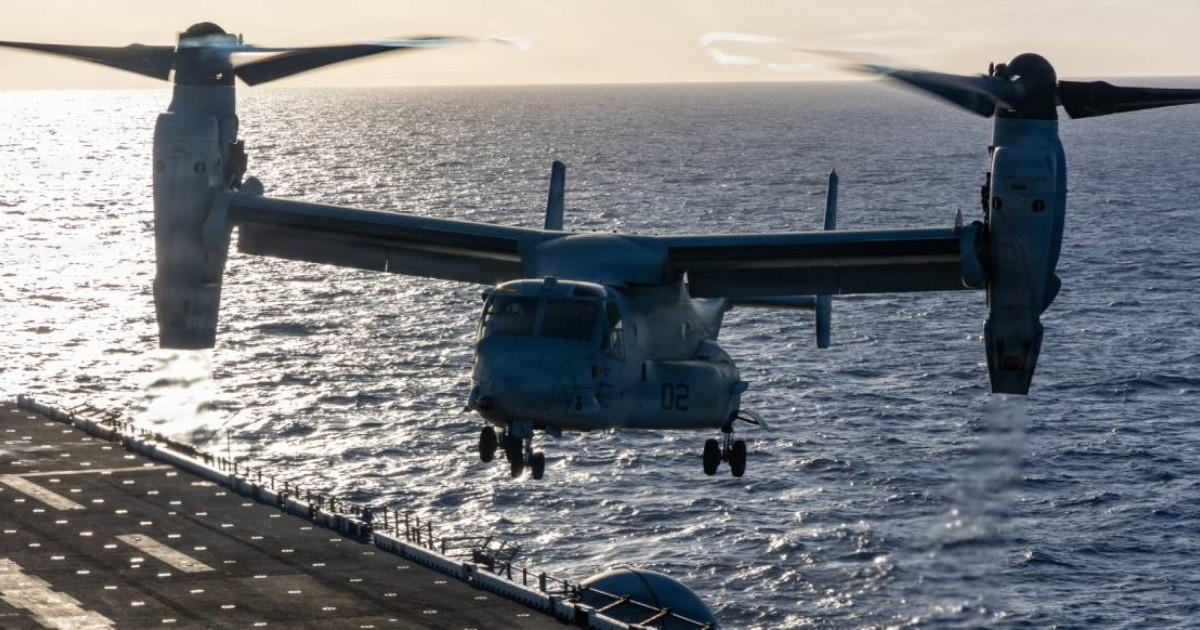
The United States Southern Command (SOUTHCOM) revealed an official image this Wednesday of an MV-22B Osprey Marine Corps aircraft preparing to land on the amphibious assault ship USS Iwo Jima in the Caribbean Sea.
Although the publication does not specifically mention Cuba or any other nation, the exact location of the operation within the Caribbean remains undisclosed. It is noted that this action is part of the Southern Spear Operation.
SOUTHCOM's statement highlights that "U.S. military forces deployed within the Southern Command's area of responsibility are supporting the Southern Spear Operation, led by the Department of Defense and prioritized by the President to disrupt illegal drug trafficking and secure the homeland."
The MV-22B Osprey, a tiltrotor aircraft, is engineered to take off and land vertically like a helicopter and transition to fly like a turboprop airplane. It can carry up to 24 combat Marines at cruising speeds of 240 knots.
This aircraft is part of the 22nd Marine Expeditionary Unit (MEU), which has been stationed aboard the USS Iwo Jima since late August 2025.
In this operation, SOUTHCOM collaborates with the USMC (United States Marine Corps), the U.S. Navy, MARFORSOUTH (Marine Forces South), and NAVSOUS4THFLT (Naval Forces Southern Command Fourth Fleet), which are the marine and naval components responsible for the Caribbean, Central, and South America.
Launched in September 2025 under the Trump administration, the Southern Spear Operation aims to curb drug trafficking in the Caribbean and the Eastern Pacific.
As of Tuesday, the operation had executed over 50 lethal kinetic attacks resulting in approximately 170 fatalities, including two the day before the image was released, identified as "suspected narco-terrorists."
This deployment marks the most significant U.S. military presence in the Caribbean since the Cuban Missile Crisis of October 1962, with total expenses estimated around $3 billion and daily peaks reaching up to $20 million.
The USS Iwo Jima operates alongside the USS San Antonio and USS Fort Lauderdale as part of the Iwo Jima Amphibious Ready Group (ARG).
In January 2026, the U.S. repositioned these vessels off the northern coast of Cuba; however, the Caribbean is a vast region, and current operations are not confined to this location alone.
On April 28, the U.S. also initiated the FLEX2026 military exercise in Key West, integrating artificial intelligence, unmanned systems, and traditional naval forces, escalating the U.S. military presence around Cuba.
Washington has accused the Cuban regime of facilitating regional drug trafficking, though SOUTHCOM's official statements about the Southern Spear Operation do not explicitly mention the island.
Southern Command has emphasized that "the region does not provide a permissive environment for malicious actors or illicit activities."
This Monday, Trump claimed to have received "94% of the Cuban vote in the United States" and expressed a commitment to his voters. "I have an obligation to do something for Cuba," he stated.
The president reiterated that the aircraft carrier USS Abraham Lincoln might make a strategic stop in the Caribbean, possibly pausing "a couple of hundred yards off the coast" of Cuba upon its return from Iran.
Key Questions About the MV-22B Osprey Deployment in the Caribbean
What is the purpose of the Southern Spear Operation?
The Southern Spear Operation aims to disrupt illegal drug trafficking and protect U.S. national security interests in the Caribbean and Eastern Pacific.
Why is the MV-22B Osprey significant in military operations?
The MV-22B Osprey is significant due to its tiltrotor technology, enabling it to take off and land vertically like a helicopter and fly like a turboprop airplane, offering versatility and speed in transporting troops.
How does the U.S. justify its military presence in the Caribbean?
The U.S. justifies its military presence in the Caribbean as a strategic effort to combat drug trafficking and prevent illicit activities, which threaten regional stability and U.S. national security.