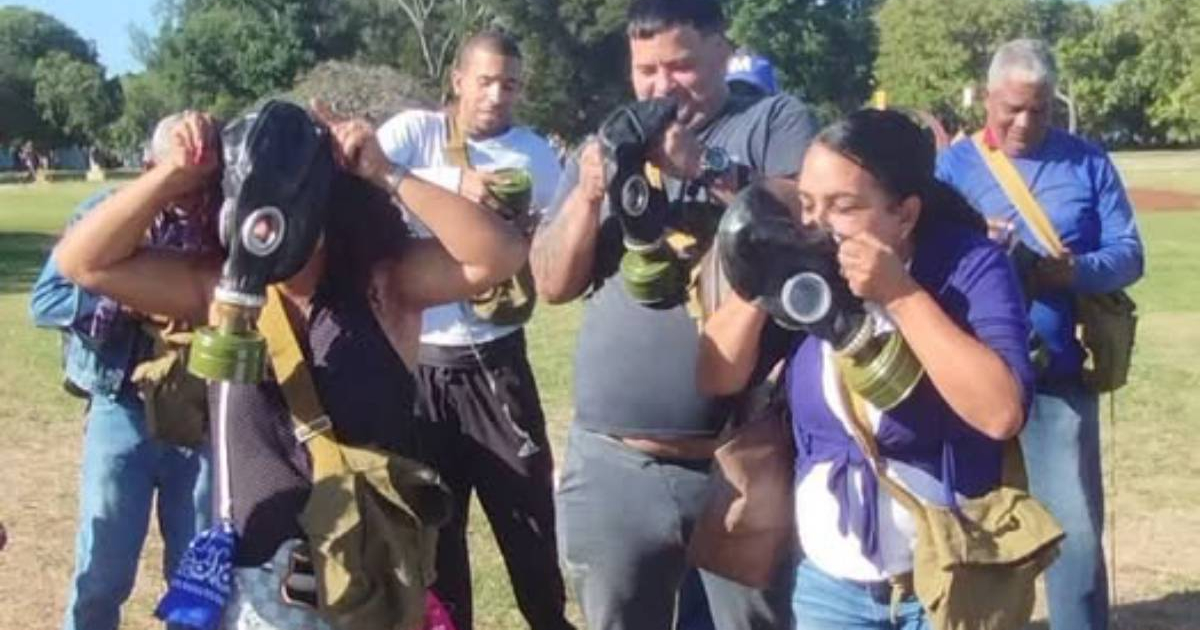
In April 2026, Cuba's National Civil Defense Staff released a "Family Guide for Protection Against Military Aggression," a brief nine-page document aimed at equipping Cuban families with the knowledge to endure aerial bombings using available resources. Bearing the slogan "Protect, Resist, Survive, and Overcome," the guide outlines survival strategies for Cuban households.
The guide was inadvertently made public when Yudelkis Ortiz, the first secretary of the Communist Party in the Granma province, led a Provincial Defense Council meeting to discuss its widespread distribution. Ortiz shared the meeting's outcomes on her Facebook page but later deleted the post, hinting at the unauthorized disclosure of sensitive information.
The guide advises families to assemble an emergency bag containing essentials like candles, matches, a lighter, a flashlight, a radio with alternative power sources, non-perishable food sufficient for three days, a container of potable water, and medication for chronic illnesses, among other items.
Survival Instructions for Aerial Alerts
In the event of an air raid, families are instructed to take shelter in "basements, semi-basements, tunnels, and trenches deep enough to shield against blast waves." They are advised to remain there until an all-clear signal is given. If reaching a shelter is not possible, the guide suggests lying face down, covering the head, and keeping the mouth open to minimize the impact of blast waves from explosions.
Controversial Medical Supplies
The recommended first aid kit has sparked controversy, as it includes items like dipyrone, paracetamol, aspirin, antihistamines, gauze, bandages, antiseptics, disposable gloves, and masks—supplies that are often scarce in Cuban households, crucial for surviving wartime conditions.
Additionally, the guide explains how to apply tourniquets: they should be placed 6 centimeters above the bleeding site and can remain secured for two to six hours.
Distribution and Justification
The guide is being distributed through the "My Neighborhood for the Homeland" movement, the Community Youth Network, and meetings in workplaces, schools, and residential areas in Granma. Ortiz defended the initiative, stating, "The best way to avoid war is by preparing for it. This concept is being implemented in Granma," before removing her post.
The Political and Historical Context
The "Family Guide for Protection Against Military Aggression" emerges in a time when the regime has declared 2026 as the "Year of Defense Preparation." From January 11, Saturdays have been designated as permanent military training days for civilians, involving AK-47s, drones, anti-tank mines, and oxen teams for roadblocks.
A recent catalyst was a statement by President Donald Trump on May 2 in Palm Beach: "We will be taking Cuba almost immediately. Cuba has problems." This prompted Díaz-Canel to warn that Trump had escalated military threat levels against Cuba to unprecedented heights, asserting that "no aggressor, no matter how powerful, will find surrender in Cuba." Meanwhile, Raúl Castro sent letters in April to the Central and Eastern Armies urging them to "firmly face any enemy aggression."
Ortiz's role in this saga adds irony; two days prior to the Defense Council meeting, she participated in a spiritual cordon in Bayamo to "ward off" external threats to Cuba.
The guide's distribution in Granma—a province iconic as the birthplace of the Castro guerrilla movement—aligns with the "War of All the People" doctrine. This doctrine, formalized in 1980 and governed by the National Defense Act No. 75 of 1994, mandates that each citizen have "a place, a means, and a way" to confront military aggression, a narrative historically employed by the regime to rally the populace and justify internal political control.
The guide encapsulates the regime's logic: "With the same dedication and discipline we've used to prepare for natural disasters, we must ready ourselves to protect lives from military aggression."
Insights into Cuba's Military Preparedness
What does the Cuban Family Guide for Military Aggression include?
The guide advises families to prepare an emergency kit with items such as candles, matches, a flashlight, a radio with alternative power sources, non-perishable food for three days, potable water, and medication for chronic illnesses.
How has the guide been distributed in Cuba?
The guide is distributed through initiatives like the "My Neighborhood for the Homeland" movement and meetings at workplaces, schools, and residential areas in the Granma province.
Why is the guide controversial?
Controversy stems from the recommended medical supplies, such as painkillers and bandages, which are often not available in Cuban households, raising concerns about the practicality of the guide in real conflicts.