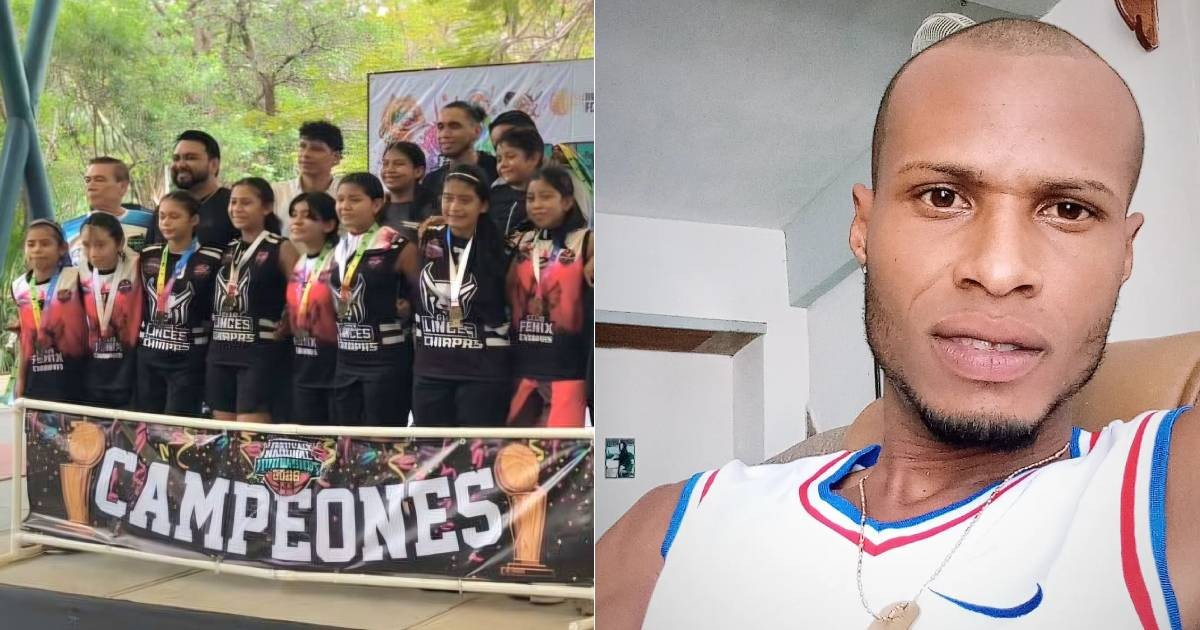
David Nelson Mediaceja Padilla left Cuba behind due to the island's severe economic hardships and frequent blackouts. Today, he has found a new life in Tapachula, Chiapas, where he dedicates himself to coaching children in basketball. This sport has become his way of contributing to the community that welcomed him.
Originally from Santiago de Cuba, David shared with Diario del Sur that his earnings as a professional were insufficient to meet basic needs. Essential goods were priced beyond his monthly salary, and power and water outages were a regular occurrence.
David's passion for basketball started in his childhood, playing in makeshift courts alongside older individuals in his community, eventually joining Cuba's formal high-performance system.
He represented Santiago de Cuba in district, provincial, and national competitions, earning both a gold and a bronze medal in the 13 to 15 age category.
At 18, a career-ending injury redirected his focus to college, which he completed in 2018.
Upon moving to Tapachula, David connected with the Fénix club through local contacts. He now coaches a group of children under the guidance of Professor Adrián Cárdenas Ramos, who leads the project.
Transforming Dreams with Linces
The youth team, known as Linces, aims to compete in the national mini basketball tournament in Tamaulipas, as confirmed by Cárdenas on social media. He praised David, stating, "We have great talents in this little school. David Nelson Mediaceja Padilla, an excellent coach and a wonderful brother, is key to achieving success with the Linces team representing Tapachula and Chiapas at the national mini basket in Tamaulipas."
Adapting Cuban Techniques in Mexico
David's coaching style incorporates methods from the Cuban training system, tailored to local conditions. While training sessions in Cuba could last up to six or eight hours, in Tapachula, they are between 1.5 and 2 hours. Despite the shorter duration, David notes significant improvements in the team's gameplay and court presence.
David plans to remain in Tapachula regardless of his immigration status, to maintain his work with the team without starting over elsewhere.
A Broader Migrant Context
David's story is part of a larger narrative: in 2026, Tapachula became home to around 800 Cuban deportees or stranded individuals, part of approximately 6,000 sent to Mexico by the Trump administration under an informal agreement designating the country as a safe third country. Many migrants face legal uncertainties, unable to work or move freely, surviving through precarious informal jobs.
This isn't the first time a Cuban athlete has used sports as a means of integration in Tapachula. In 2022, Cuban boxer Gabriel Moya launched "Boxing for Peace," a project aimed at reducing stress among stranded migrants and steering youth away from drugs.
The crisis that drove David to emigrate is not unique. Cuba saw a loss of over 300,000 residents in 2024, with a net migration rate of -25.4 per thousand, according to the National Office of Statistics and Information. Since 2021, more than a million people have fled the island, driven by decades of economic decline under the dictatorship and an energy crisis that left 63% of the country without power simultaneously on January 31, 2026.
The performance of the Linces in regional and national competitions in Tamaulipas will, according to David, serve as the primary benchmark for assessing the progress made with the children of Tapachula.
Understanding the Cuban Migrant Experience in Tapachula
What prompted David Nelson Mediaceja Padilla to leave Cuba?
David left Cuba due to severe economic conditions and frequent blackouts, which made it difficult to meet basic needs.
How is David contributing to his new community in Tapachula?
David is contributing by coaching children in basketball, using his skills and experience to help them advance in the sport.
What challenges do Cuban migrants face in Tapachula?
Cuban migrants often face legal uncertainties, lack of work documentation, and must survive through informal and unstable employment conditions.