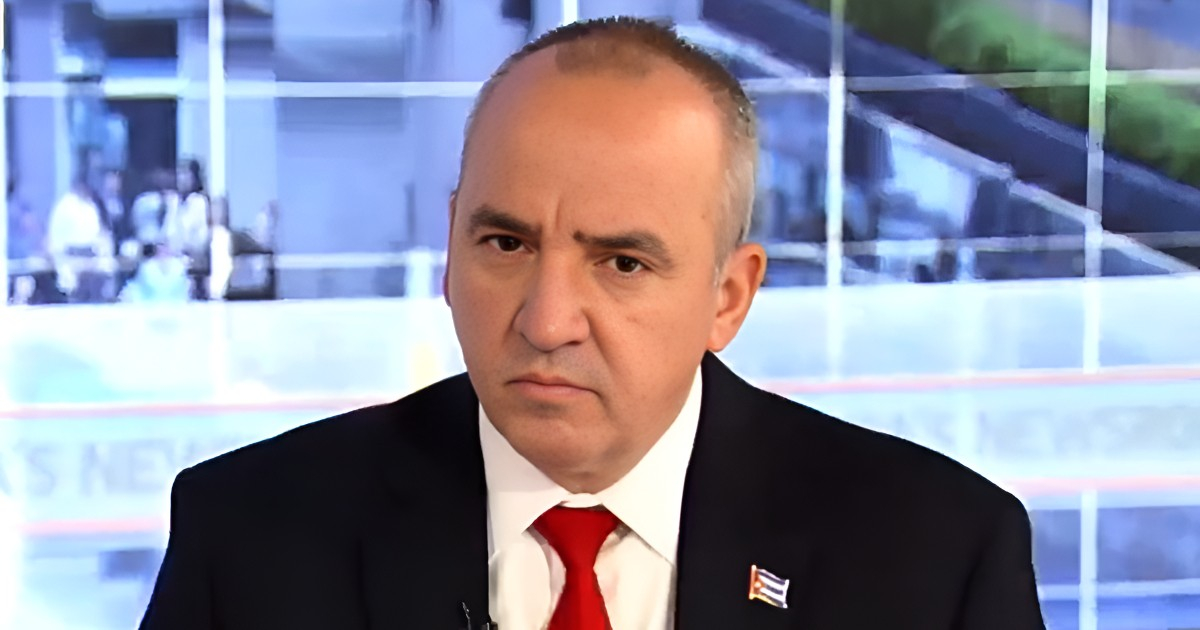
On Monday, Ernesto Soberón Guzmán, the Cuban ambassador to the United Nations, inadvertently revealed a critical truth during an appearance on Fox News' 'America's Newsroom.' While attempting to criticize the Trump administration's new sanctions, he admitted that Cuba does indeed trade with countries worldwide.
The high-ranking official from the Ministry of Foreign Affairs (MINREX) stated that the sanctions "punish third countries and companies that trade with Cuba," inadvertently acknowledging on social media that the island nation engages in global commerce.
This contradiction did not go unnoticed. Álvaro Ferro Lugones, a writer and entrepreneur, succinctly highlighted Soberón Guzmán's slip on social media platform X: "Thank you... because, without realizing it, you've just dismantled your own argument. You say sanctions affect 'third-country companies trading with Cuba.' So the inevitable question is: Where is the supposed 'total blockade'?"
The answer is simple: such a total blockade does not exist.
The Reality Behind the U.S. Embargo
The U.S. embargo on Cuba, in place since 1962, prohibits direct trade between American companies and Cuba, restricts dollar transactions, and applies extraterritorial sanctions through the Torricelli and Helms-Burton laws. However, none of these measures prevent Russian, Chinese, European, or Latin American companies from selling fuel, food, or medicine to the island.
Figures speak for themselves: Cuba maintains trade relations with over 150 countries. China, Cuba's leading trade partner, had exchanges exceeding $2.585 billion in 2016, with an additional $80 million in emergency aid approved by Xi Jinping in January 2026. Russia has secured a commercial cooperation agreement with Havana until 2030. Additionally, U.S. agricultural exports to Cuba, including frozen chicken, soybeans, corn, and wheat, surpassed $370 million in 2024, with total U.S. exports to the island reaching $810.8 million in 2025—a 148% increase from 2021.
The Fallacy of the "Blockade" Narrative
For decades, the Cuban regime has wielded the term "blockade" to imply an absolute isolation that does not exist. This narrative has lost traction even at the UN, where the annual resolution condemning the embargo received only 165 votes in favor in October 2025, the lowest support in over a decade.
The real issue, as pointed out by the user who viralized the ambassador's gaffe, is not the lack of money entering Cuba but rather who controls it. That control lies with GAESA, a military conglomerate linked to the Revolutionary Armed Forces, which manages between 40% and 60% of Cuba's foreign currency income, 95% of financial transactions, and 95% of import and export flows. GAESA's revenues exceed the Cuban state's budget by 3.2 times.
This foreign trade does not benefit the average citizen, independent entrepreneur, or worker. It remains under the administration of the same state and military apparatus that has held power for 67 years.
Trump's Sanctions and the Economic Impact
Soberón Guzmán's appearance on Fox News was in response to a new executive order signed by Trump on May 1, imposing secondary sanctions on foreign banks dealing with sanctioned Cuban entities and freezing the assets of regime officials in sectors like energy, defense, mining, and finance.
Since January 2025, the Trump administration has enacted over 240 sanctions against Cuba and intercepted at least seven oil tankers, curbing the island's energy imports by 80% to 90%.
As the regime continues its victimhood narrative, the myth of the "blockade" loses credibility: the projected economic contraction for 2026 is 7.2%, with power outages lasting up to 25 hours in more than 55% of the country. Ironically, it was the regime's own ambassador who inadvertently provided the strongest refutation of this narrative.
"The audacity isn't in pointing out the sanctions," concluded the viral analysis. "The audacity lies in blaming external forces for what the system itself fails to resolve internally."
Understanding the Cuban Trade and Embargo Dynamics
What is the U.S. embargo on Cuba?
The U.S. embargo on Cuba, initiated in 1962, restricts direct trade between American companies and Cuba, limits dollar transactions, and imposes extraterritorial sanctions through the Torricelli and Helms-Burton laws.
How does Cuba manage to trade with other countries despite the embargo?
The embargo does not prevent countries such as Russia, China, or those in Europe and Latin America from trading with Cuba. As a result, Cuba maintains commercial relations with over 150 nations worldwide.
Who controls the foreign currency income in Cuba?
GAESA, a military conglomerate associated with the Revolutionary Armed Forces, controls a significant portion of Cuba's foreign currency income, financial transactions, and import-export flows.