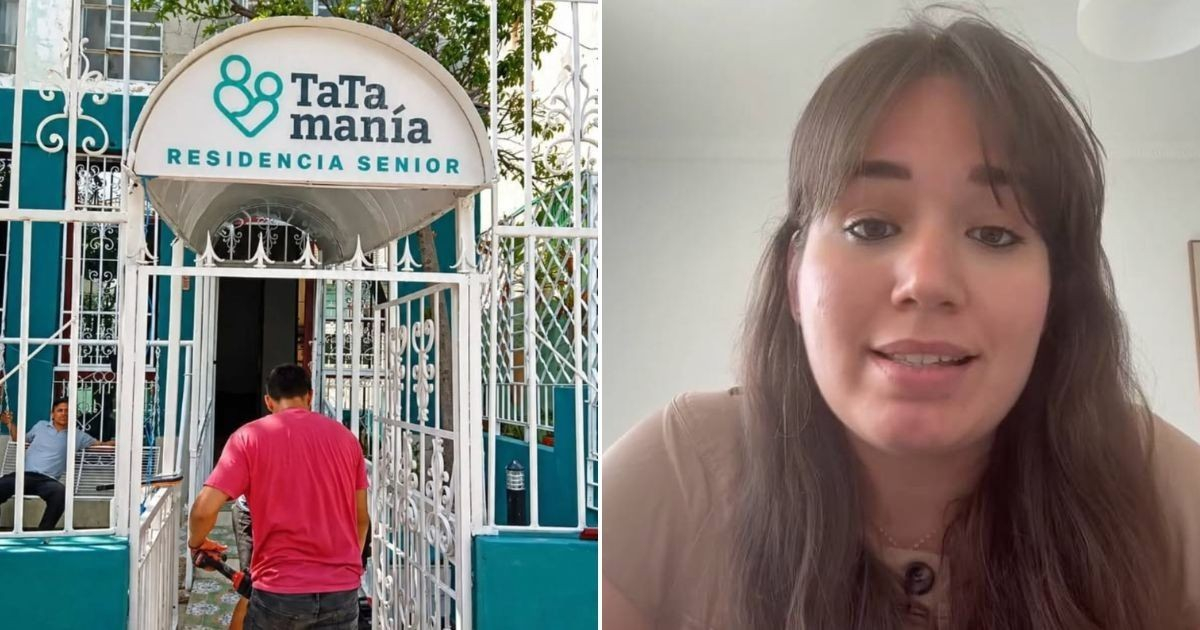
Cuban activist and opposition figure Amelia Calzadilla has taken to Facebook to passionately denounce the Cuban regime's hypocrisy in allowing the establishment of the first private senior residence in Cuba, which costs at least $1,080 a month. This move comes after decades of the regime banning private ownership and vilifying the accumulation of wealth.
"I read with indignation, though not surprise, about the opening of privately operated senior residences that require payment in dollars," wrote Calzadilla, who relocated to Madrid in November 2023 due to regime pressures.
The facility in question, Residencia Senior de TaTamanía, is located in El Vedado, Havana. It stands as Cuba's first permanent private nursing home, managed by a small business established in Guantánamo in 2023 by pediatrician Yadira Álvarez and her husband, computer engineer Rolando Pérez.
The Economic Divide Exposed
Calzadilla highlighted the stark economic disparity this opening reveals: Cuban doctors earn between 6,500 and 17,000 pesos monthly, equivalent to about $12 to $31.50 according to the exchange rates reported by elTOQUE. Meanwhile, the pensions for Cuban retirees do not exceed 4,000 pesos—less than ten dollars at the informal exchange rate.
"Who can afford this in Cuba?" the activist questioned, answering that only those with relatives abroad sending remittances could possibly manage the cost.
Ideological Hypocrisy and Policy Shifts
At the core of her criticism is the ideological inconsistency of the Communist Party: "The same party that banned private property, whose sole fight was the eradication of private capital... now with a poorer Cuba than in 1959, shamelessly abandons the vulnerable and presents the private alternative as the only viable solution to its incompetence; all while clinging to power."
The opening of TaTamanía was made possible by the Council of Ministers' Agreement 10249/2025, published on February 26, which for the first time in decades allowed the private sector to manage senior residences in Cuba. A complementary resolution is set to take effect on May 21.
The agreement itself acknowledged that due to the "accelerated aging process of the Cuban population," it is necessary to "authorize the provision of such services by non-state economic actors," implicitly admitting the failure of the state-run model.
Challenges of an Aging Population
This demographic challenge is significant: 25.7% of Cuba's population is over 60, making it the oldest nation in Latin America, compounded by the mass emigration of young people worsening the caregiver shortage.
Calzadilla, who recently founded the Partido Liberal Ortodoxo Cubano (PLOC) from Madrid, has gained increasing visibility in exile by highlighting these contradictions with her straightforward language.
The activist encapsulated the complete cycle of revolutionary failure with a question that leaves no room for comfortable answers: "Having abolished private property with the promise of better wealth management and distribution; rendering citizens vulnerable and dependent to buy political loyalty; proving incompetent after over 60 years of failing to save the poor and impoverishing the rich; and now finally proclaiming, contrary to all imparted dogma, that only capitalism is competent and functional, yet refusing to relinquish power after seizing the nation. Seriously?"
Frequently Asked Questions About Cuba's Private Senior Residences
What is Residencia Senior de TaTamanía?
Residencia Senior de TaTamanía is the first permanent private nursing home in Cuba, located in El Vedado, Havana, and operated by a small business founded by Yadira Álvarez and Rolando Pérez.
How does the cost of living in TaTamanía compare to Cuban salaries?
The monthly cost of living in TaTamanía is at least $1,080, whereas Cuban doctors earn between $12 and $31.50 a month, highlighting a significant economic disparity.
Why is the aging population a concern in Cuba?
With 25.7% of the population over 60, Cuba is the most aged country in Latin America, and the emigration of young people exacerbates the shortage of caregivers.