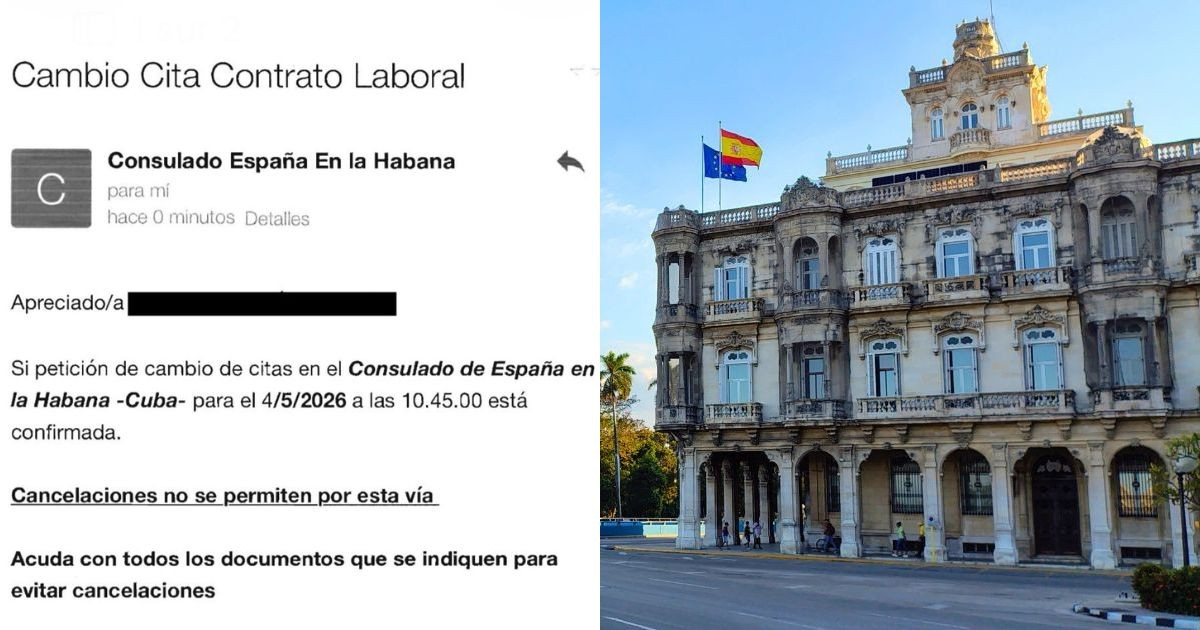
The Spanish Consulate General in Havana issued a warning on Monday regarding the emergence of fraudulent emails impersonating their identity to confirm fake appointments. This alert comes after several individuals arrived at the consulate with counterfeit documents for labor contract procedures.
"Today, several individuals appeared at this Consulate General brandishing fake appointments similar to those shown in the image. This is a scam, and we urge the affected parties to file a report with the PNR if the incidents occurred in the Republic of Cuba, or with the National Police if these services were contracted in Spain," the diplomatic representation cautioned via its official WhatsApp channel and its account on X.
The fraudulent emails identified carry the subject line "Change Appointment Labor Contract" and falsely appear to be sent by the consulate, with precise dates and times: one confirming an appointment at 9:00 AM and another at 10:45 AM on the same Monday.
The text within these fake messages includes the warning "Cancellations are not allowed via this method," a phrase crafted to pressure victims and prevent them from questioning the email's authenticity.
Official Channels for Appointments
The consulate emphasized that the only valid appointments are those obtained through their official website, and there is "no need to hire an intermediary to secure an appointment."
This type of scam is not a new phenomenon. Since May 2021, the consulate has prohibited the use of intermediaries or agents for booking appointments, warning that those obtained through third parties are automatically canceled.
Evolving Methods of Fraud
The method has evolved: while previously scammers charged for managing real appointments, they now fabricate emails that mimic the consulate's official communication to deceive individuals who physically visit their offices, possibly after paying significant sums.
Labor contract procedures are particularly sensitive due to the increasing flow of Cubans emigrating to Spain with job offers, amid a severe economic crisis on the island.
High Demand and Fraudulent Activity
The high demand for consular appointments has created fertile ground for such frauds. In March 2025, scams involving fake documents sold in Cuba—such as birth and baptism certificates—were detected, with prices ranging from 2,000 to 3,000 euros to simulate connections with Spain for the Grandchildren's Law procedures.
Despite capacity increases—the consulate boosted weekly appointments for legalizations by 35% in February of this year, from 1,000 to 1,350 per week—the demand continues to outstrip supply, keeping the fraudulent business alive.
The consulate has received 87,000 nationality applications by April 2025, holding the highest registration rate among high-demand consulates, with 56% of applications processed for Cubans pursuing Spanish nationality.
Individuals who have fallen victim to this scam should report it to the Revolutionary National Police if the events occurred in Cuba, or to the Spanish National Police if the fraudulent services were contracted in Spain.
Preventing Consulate Scams: Key Information
How can I verify if my appointment with the Spanish Consulate is legitimate?
Appointments can only be verified through the Spanish Consulate's official website. Emails or other communications not originating from official channels should be treated with suspicion.
What should I do if I receive a suspicious email claiming to be from the consulate?
Do not engage with the email. Report it to the consulate through their official communication channels and consider filing a police report if you suspect an attempted scam.
Why is there such a high demand for consular appointments in Cuba?
The high demand is primarily due to the economic crisis in Cuba, prompting many citizens to seek opportunities in Spain, including through labor contracts and nationality applications.