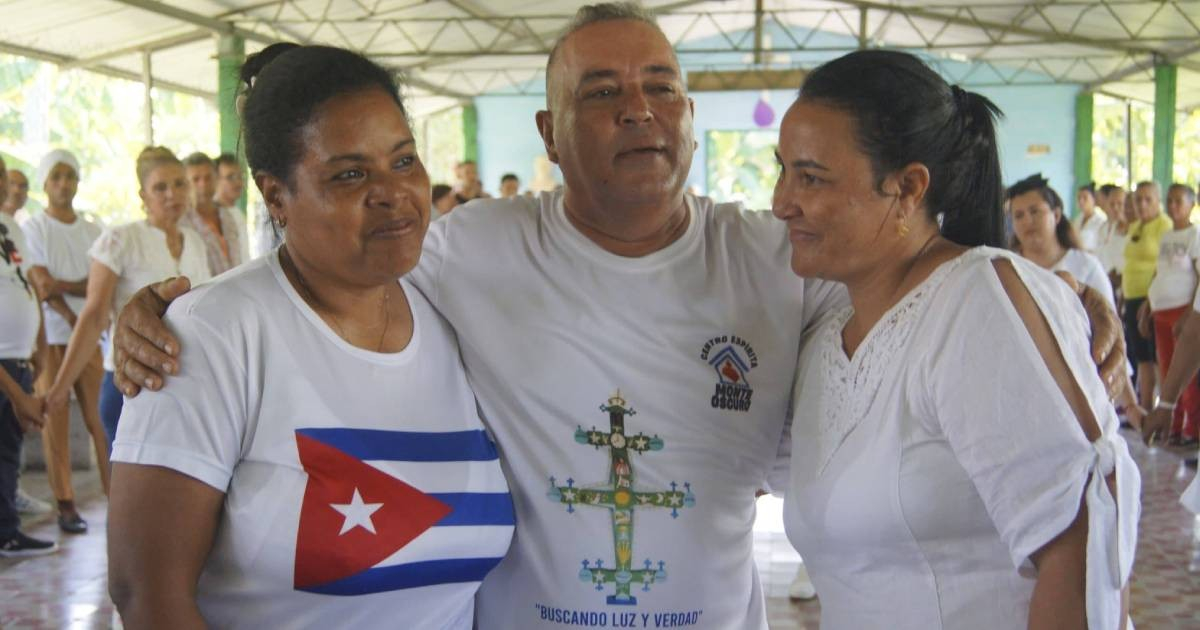
Amid escalating political tensions, Yudelkis Ortiz Barceló, the first secretary of the Communist Party in Granma, visited a modest spiritualist center in Bayamo on Monday. This move comes as Cuba grapples with the narrative of being a "besieged fortress" in the face of U.S. rhetoric.
Accompanied by Governor Yanetsy Terry, Ortiz Barceló attended the "Seeking Light and Truth" Spiritual Center in the rural community of Monte Oscuro. This center is deeply embedded in the cultural traditions of eastern Cuba. Ortiz Barceló's visit aimed to project spiritual support for the regime as a counter to recent statements from Washington.
In a Facebook post, Ortiz Barceló highlighted that cordon spiritualism practitioners joined in demanding the U.S. government address the "war threat looming over Cuba," an effort to showcase national unity that transcends religious beliefs.
This visit occurs amidst heightened rhetoric. Last Friday, Donald Trump declared in Florida that the United States would "take Cuba almost immediately" and mentioned the potential deployment of the USS Abraham Lincoln aircraft carrier near the island. In response, Cuban President Miguel Díaz-Canel warned international delegates about the "imminence of military aggression," assuring that every Cuban has a defensive role.
The scene in Monte Oscuro is telling: political figures turning to one of Cuba's oldest spiritual expressions to fortify a message of resistance.
Ortiz Barceló described the center as part of the cultural heritage of the Cauto Valley, noting it was founded over a century ago by Salustiano Olivera Sánchez. "We were united by the desire for love, peace for our country, and a rejection of war," she wrote.
Former Culture Minister Abel Prieto echoed this sentiment, sharing images of the event and affirming that "Cuban spiritualists stand united in defense of peace, sovereignty, and our socialism."
The official use of religious spaces to legitimize political discourse is not new. In 2025, Prieto visited the Quisicuaba Project in Havana, praising its members' "loyalty to the revolution."
Yet, this strategy remains contradictory. For decades, Cuba's Marxist ideology openly marginalized believers, excluding them from political activity until the 1990s. Now, amid an economic crisis and international pressure, these same spaces are used as symbols of popular support.
Ortiz Barceló herself has been at the center of other controversial statements. Following protests in Jiguaní over blackouts and shortages, she stated that "the freedom to hate has never been so out of control." Later, she described a hurricane's aftermath as an "opportunity" to prove the Revolution's relevance.
In the face of harsher sanctions and an energy embargo worsening daily life on the island, the government is once again turning to popular faith.
Cordon spiritualism, with its chants, chain dances, and African-Creole roots, has long served as a spiritual refuge for humble communities. Its current role as a stage for political messaging has not gone unnoticed by many Cubans, both at home and abroad.
Understanding the Political and Spiritual Dynamics in Cuba
What prompted Yudelkis Ortiz Barceló to visit a spiritualist center?
Ortiz Barceló visited the spiritualist center to seek spiritual support against the perceived threat of military aggression from the United States, as part of a broader attempt to rally national unity beyond religious lines.
How has the Cuban government historically interacted with religious spaces?
Historically, the Cuban government, adhering to Marxist ideology, marginalized religious believers, barring them from political involvement until the 1990s. Recently, however, it has begun using religious spaces to garner popular support.