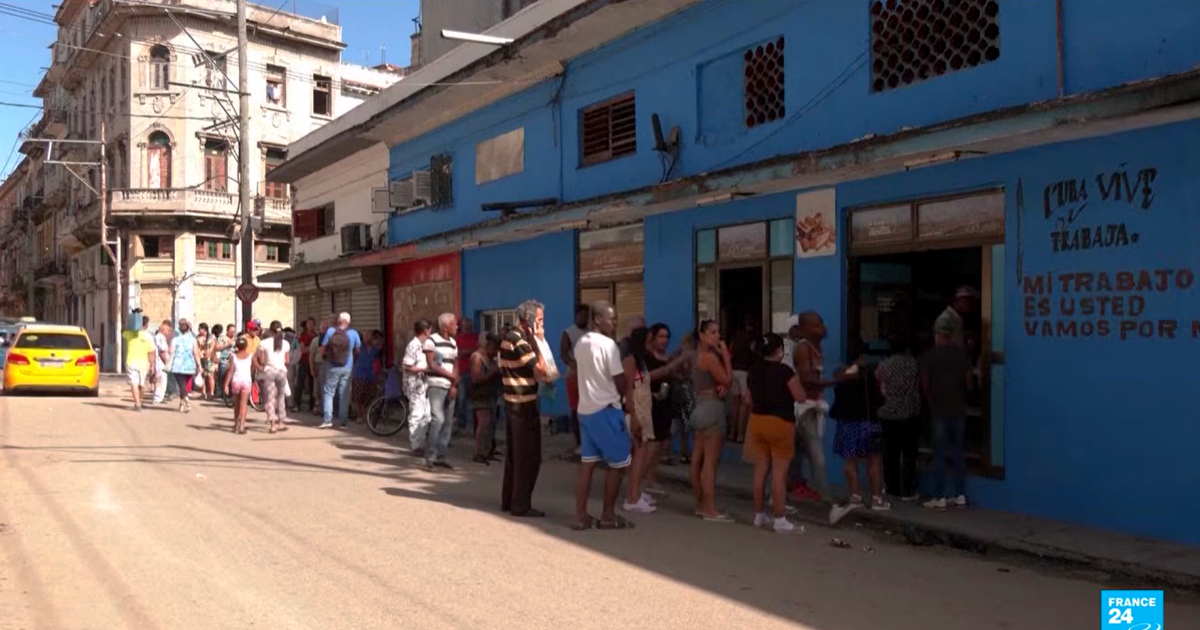
A recent report by FRANCE 24 on the situation in Cuba has raised more eyebrows than it has provided clarity among those familiar with the island's reality.
The French outlet claims that "the tightening of U.S. sanctions endangers the rationing system," a statement that echoes the Cuban regime's official rhetoric rather than reflecting the true situation.
Let’s be clear: what precisely is being "endangered"? A system that fails to provide even the bare minimum for survival? A ration book that, for years, hasn't covered a month's needs, forcing millions of Cubans to scavenge for food outside the state system?
Portraying rationing as a safety net under threat is, at best, disconnected from the truth.
The Reality Behind the Ration Book
For most Cubans, the ration book is not a solution but a daily reminder of a failing model. Products arrive late, in pitiful quantities, or not at all. Discussing its "deterioration" now, as if this were a recent development, ignores decades of decline.
The report also clings to a well-worn narrative: blaming the crisis on the U.S. sanctions. While not denying that certain external measures have impacts, reducing Cuba's economic collapse to this single factor borders on misinformation.
Ignoring the Real Issues
The storyline that focuses solely on external factors overlooks a growing phenomenon within the island: the de facto dollarization of the economy.
While state-run stores remain empty, numerous currency shops — many under the control of military conglomerates like GAESA — are well-stocked with food and essentials, albeit at prices beyond the reach of most Cubans.
These dollar-operated stores dismantle the narrative of a total "blockade" on importing goods while exacerbating inequality between those who receive remittances and those relying solely on Cuban pesos.
Decades of Economic Mismanagement
Food shortages, frequent blackouts, declining national production, and remittance dependence didn’t start this year or last week. They are the cumulative result of years of mismanagement, a centralized economic system incapable of generating wealth, and political decisions that have stifled private initiative and productivity.
The report itself acknowledges that a large portion of the population now relies on foreign remittances to eat. This fact alone dismantles the notion that the state system — including rationing — serves as society's basic support.
It's particularly striking that international media continue to fall into such narrative traps, where the rationing system is depicted almost as a collateral victim rather than being understood as a direct consequence of structural scarcity and the economic failure of a model imposed for more than six decades.
Decades ago, the ration book might have served as a distribution mechanism amidst challenges. But that context is long gone.
Today, to insist on that image is not only outdated but deeply unfair to a population experiencing a far more complex crisis than some headlines suggest.
The real issue in Cuba isn't that rationing is "in danger." The problem is that it ceased being a solution years ago. Continuing to tell the story as if it still were doesn't help to understand — or solve — the harsh reality faced by millions of Cubans every day.
Understanding Cuba's Economic Challenges
What is the impact of U.S. sanctions on Cuba's economy?
While U.S. sanctions do affect Cuba, attributing the island's economic woes solely to these measures oversimplifies the issue. The root of Cuba's economic challenges lies in decades of mismanagement and a centralized economic system that has stifled growth and innovation.
How has the rationing system in Cuba changed over the years?
The Cuban rationing system has long ceased to fulfill its purpose of providing essential goods. Products are now scarce, arrive late, or not at all, forcing citizens to seek alternatives outside the state-controlled framework.
What role does dollarization play in Cuba's current economic situation?
The de facto dollarization of Cuba's economy has led to the emergence of well-stocked stores operating in foreign currency, deepening economic inequality. This shift highlights the disparity between those who receive remittances and those reliant on Cuban pesos.