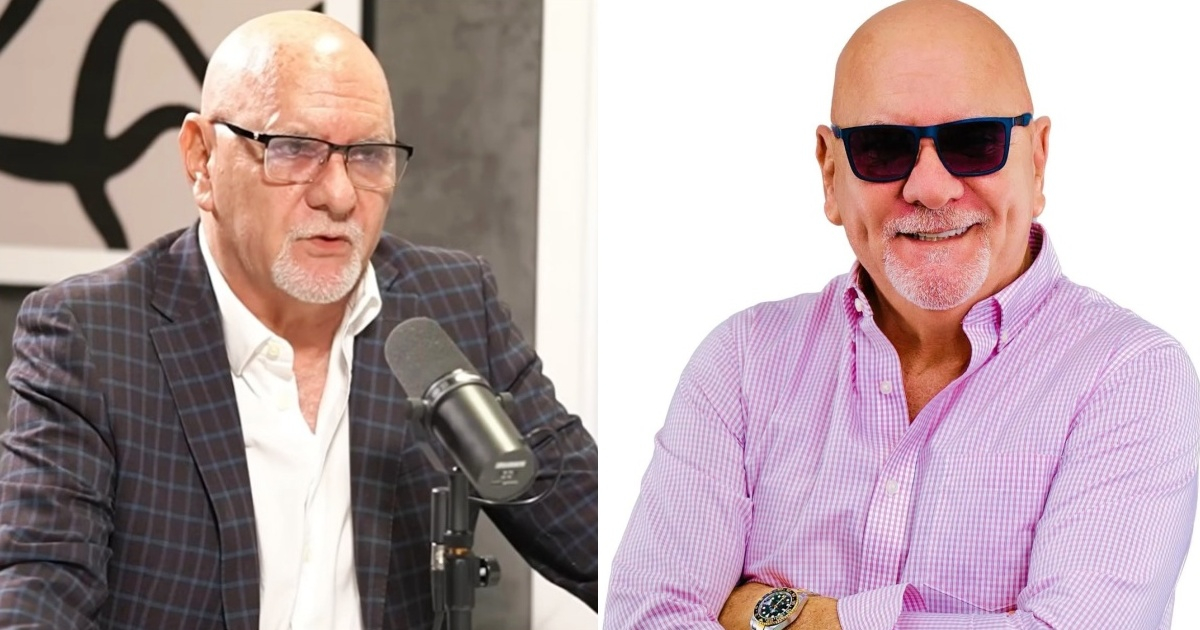
Cuban television host Carlos Otero shared a harrowing experience on a podcast that ultimately led to his decision to leave Cuba. In 2002, during a meeting, Fidel Castro recounted in unnerving detail the execution of what he called the first traitor of the Cuban Revolution, which occurred in the Sierra Maestra.
Otero recalled that night, as he walked along the Havana Malecón, when a Cubanacán Mercedes-Benz taxi pulled up beside him. An agent from the State Security showed him an ID card, issuing a mandatory summons to attend a reception at the Central Committee of the Communist Party of Cuba for a visiting foreign president.
Alongside a small group of Cuban television personalities, Otero was escorted to a protocol room filled with an array of delicacies that, he noted, were inaccessible to both him and the Cuban public during the ongoing crisis.
It was in this setting that Castro, seemingly without reason, began narrating the story of a man who slept nearby in the Sierra Maestra and attempted to assassinate him. The rebels discovered the betrayal in time, removed the bullet from the suspect’s carbine, and captured and executed him when he attempted the act.
What sent chills down Otero’s spine was Castro’s vivid depiction of the execution moment. “At the moment we shot him, a lightning bolt illuminated the entire scene,” Castro recounted, adding his longstanding desire to have a painter capture that moment on canvas.
“I was literally scared,” Otero recounted.
Upon returning home in the early hours, he embraced his son and told his wife, “We’re leaving.”
Otero, who left Cuba on December 8, 2007, via Canada, described Castro’s account as that of a “cruel madman” and a “sarcastic narcissist,” realizing then that there was no escape within the system.
This was not the only instance of the regime’s surveillance over him.
State Security had previously intercepted Otero on the Malecón after observing him greet dissident poet Raúl Rivero at a restaurant.
On another occasion, agents compelled him to sign a document pledging to report any plans against Castro’s life. Otero signed to be left alone but admits he never would have betrayed anyone.
The cast of “Sabadazo,” the show that dominated Cuban primetime with 82% viewership during the Special Period, was also summoned to perform for Raúl Castro at the San Antonio de los Baños airbase, without pay and with no option to refuse.
“It was mandatory. It wasn’t a choice. If you didn’t comply, you disappeared from television,” Otero recalled.
Castro’s tale of the “first traitor” aligns with the historical account of Eutimio Guerra, a farmer executed on February 17, 1957, for betraying rebel positions to Batista’s army. According to Che Guevara’s diary, he carried out the execution, although Castro spoke in the plural, taking narrative ownership of the event.
After 15 years at América TeVé hosting “TN3” in Miami, Otero was dismissed in May 2022. He now hosts his own YouTube show, "La Hora de Carlos," airing Mondays and Thursdays at 11 p.m.
“Fidel Castro deceived us. I grew up believing in the Cuban Revolution. I thought I was living in paradise,” admitted Otero, whose father was a founding member of INDER and who acknowledges it took years to understand the true nature of the regime that monitored, controlled, and exploited him.
Insights into Carlos Otero's Revelations
Why did Carlos Otero decide to leave Cuba?
Carlos Otero decided to leave Cuba after a chilling encounter with Fidel Castro, where Castro detailed the execution of a revolutionary traitor, making Otero realize the oppressive nature of the regime.
How did the State Security monitor Carlos Otero?
State Security monitored Carlos Otero by intercepting him after he greeted a dissident poet and compelling him to sign a document pledging to report any plans against Fidel Castro.
Who was the "first traitor" according to Castro's narrative?
The "first traitor" in Castro's narrative was Eutimio Guerra, a farmer executed for betraying rebel positions to Batista's army.